

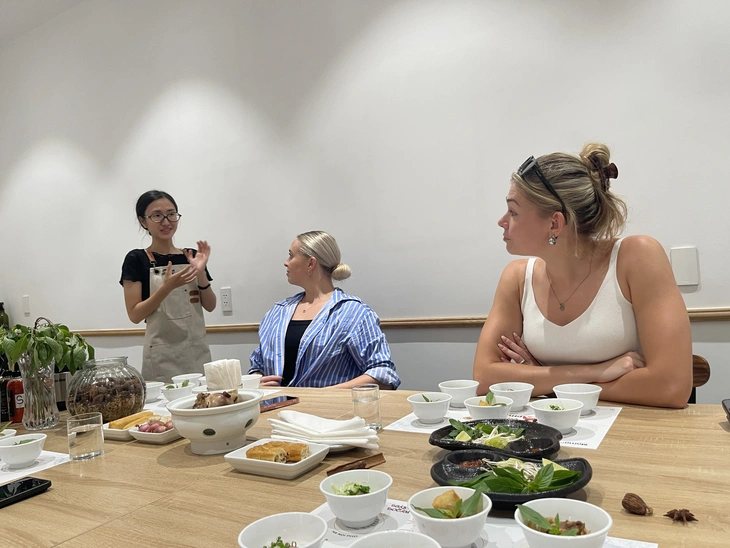
Hannah Prescott (right) and Emily Riby listen as Minh Anh explains the dish - Photo: NGOC DONG
In a small room on the first floor of a house on Ngo Duc Ke Street, Minh Anh, an employee of Saigon Social, introduced each ingredient for making pho displayed on the table. Before her were foreign guests listening attentively, occasionally reaching out to touch the cinnamon, star anise, cardamom, coriander seeds, and other spices with curious eyes.
When it came to the most important part, Minh Anh enthusiastically recounted the process of simmering the bones, skimming off the foam, and spending hours to create the clear and fragrant broth—the soul of Vietnamese pho.
"You know, 'pho' is actually the name of this type of noodle," Minh Anh said as she moved on to introducing how to make pho noodles, from making the batter and cutting the noodles to tips on how to tell if they're fresh by chewing or gently pulling them with your hand.
As British people living in Singapore who have visited Vietnam many times, Emily and Hannah are no strangers to pho. Emily is also passionate about food reviews and has eaten at many pho restaurants in both Singapore and Vietnam. It was she who brought her friend Hannah to this pho experience.
However, this was the first time the two of them had the opportunity to learn in depth about the ingredients and how to cook pho. "Only now do I know that 'pho' refers to the noodles; before, I always thought pho was the name of the broth," Hannah shared with a laugh.
This experience is the brainchild of Jovel Chan, a Singaporean food blogger living in Ho Chi Minh City. Jovel founded Saigon Social, a culinary exchange space where she and her partners design workshops/tastings for foreign visitors to Vietnam to experience Vietnamese cuisine on themes such as coffee, pho, and fish sauce.
“I’ve had the idea for a pho experience like this for a long time, but it took time to convince our partners to provide the meals and agree to our storytelling approach…,” Jovel shared.
"Although our establishment is relatively new, this type of business is quite attractive to foreign tourists. Most customers who come here don't know that there are so many things related to pho," she added.
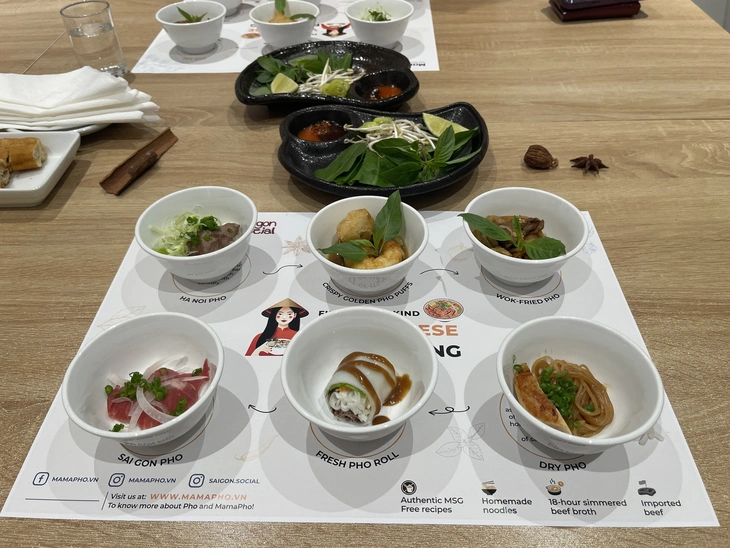
Six types of MamaPhho pho were introduced along with their cooking methods, ingredients, and serving styles at a "pho tasting" event at Saigon Social - Photo: NGOC DONG
Even though it's just pho, there are so many different variations.
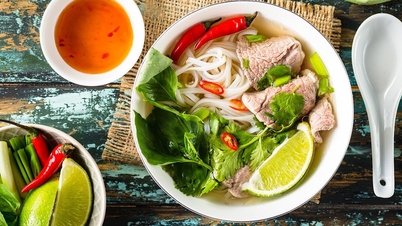
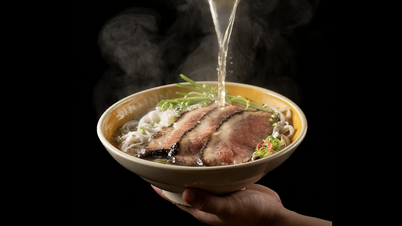
The highlight of the experience is the tasting of six different types of pho: Hanoi pho, Saigon pho, puffed pho, stir-fried pho, rolled pho, and Gia Lai dry pho. The dishes are served in small portions, not to fill you up, but so that guests can fully explore the richness of Vietnamese pho.
Minh Anh introduced the preparation methods, origins, history, ingredients, and even the distinctive ways of eating each type of pho. In particular, the two most familiar versions, Northern pho and Southern pho, also had differences that surprised and delighted the diners.
While Northern pho is light and typically served with only scallions and a little chili sauce, Southern pho is richer with thinly sliced onions, basil, sawtooth coriander, bean sprouts, and even dark soy sauce and chili paste.
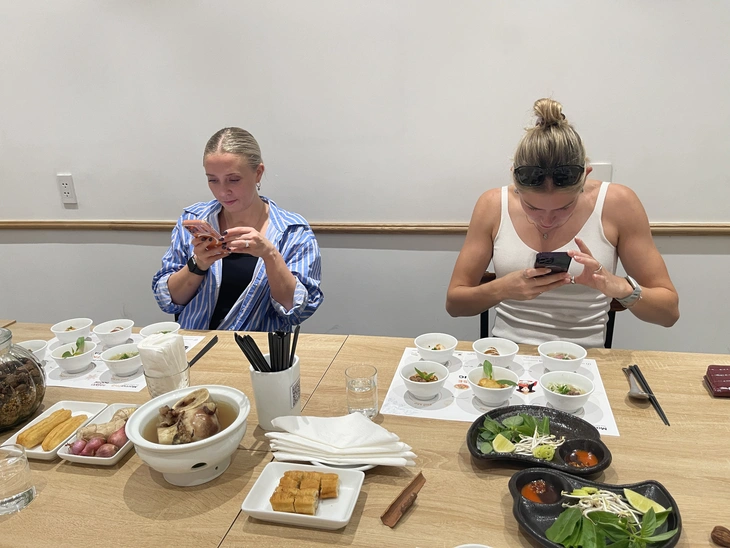
Hannah Prescott (right) and Emily Riby happily take photos of different versions of pho at the experience event - Photo: NGOC DONG
Emily and Hannah were delighted to learn that pho phong is made from square-cut pho noodles, stacked and then deep-fried to create a crispy crunch; and they also nodded in approval at the refreshing pho cuon (rolled pho) served with a rich and creamy peanut sauce.
Next up is stir-fried pho: the pho noodles are stir-fried until tender with meat, vegetables, and spices, maintaining a pleasant chewiness and releasing an impressive aroma.
Finally, dry pho, or Gia Lai's "two-bowl" pho, offers a completely different experience with its unique noodles and accompanying broth, concluding Emily and Hannah's surprisingly diverse pho journey.
"I didn't think pho could be so diverse," Hannah said. "I even know that each pho restaurant has its own recipe, which makes the dish taste different from place to place," Emily added.
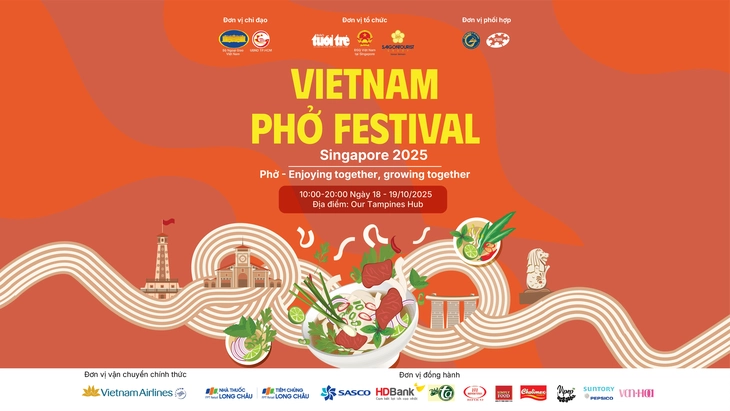
Vietnam Pho Festival 2025: When the flavor of Vietnamese pho becomes a 'cultural ambassador' in Singapore.
Working in the field of nutrition, Hannah also enjoys pho because of its healthy qualities. “The broth is clear and fat-free, the beef provides protein, the noodles add carbohydrates, and with the addition of fresh vegetables, it’s a very balanced dish,” she says.
At the end of the session, participants were "tested" with fun questions to ensure they had grasped the knowledge about pho. Before leaving, Emily also inquired about good pho restaurants so she could "take the opportunity" to enjoy them before flying back to Singapore, and to save the list for future visits to Vietnam.
An hour is certainly not enough time for tourists to understand every aspect of pho, but they leave with a wealth of new knowledge, knowing that the next time they visit a pho restaurant, they can distinguish between Southern and Northern pho, and appreciate more the effort put into making a delicious bowl of pho as well as the cultural value this dish brings to the spiritual life of the Vietnamese people.
Source: https://tuoitre.vn/khach-tay-hoc-an-pho-20251014170308507.htm
















![[Photo] Prime Minister Pham Minh Chinh presides over meetings of the Government Standing Committee to discuss several important issues.](https://vphoto.vietnam.vn/thumb/1200x675/vietnam/resource/IMAGE/2026/03/16/1773674631996_ndo_br_img-5789-jpg.webp)


































Comment (0)