

According to experts, Vietnam's tourism industry has not yet prioritized the domestic market, and services have not met demand, leading Vietnamese tourists to increasingly travel abroad.
At the "Vietnam Tourism 2023: Goals & Recovery" seminar, jointly organized in September by tourism market research company Outbox and Saigontourist Group, Ms. Nguyen Anh Thu, research director of Outbox, noted that the recovery rate of the international tourist market is "much slower" than that of the domestic market.
In 2022, while the inbound tourism market (receiving international tourists into Vietnam) remained quiet, the domestic market had already recovered to levels exceeding those of 2019. In 2019, Vietnam welcomed 85 million domestic tourists, and this number increased to over 101 million in 2022. In the first seven months of 2023, the total number of domestic tourists reached 76.5 million, approximately 11 times the number of international tourists. Meanwhile, in 2019, Vietnam welcomed 18 million international tourists. The target for international tourists in 2023 is 8 million, less than 50% of the 2019 figure.
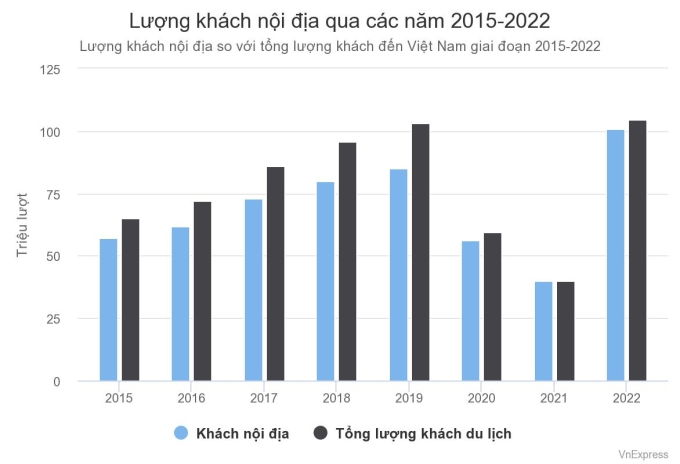
Correlation chart showing the number of domestic tourists with the total number of tourists in Vietnam during the period 2015-2022. Source: Vietnam National Tourism Administration.
Ms. Nguyen Anh Thu stated that 18 months ago, domestic tourism was mentioned as a "lever" for the recovery of the entire tourism industry. To date, the domestic market shows no signs of slowing down and continues to grow steadily. Ms. Thu emphasized that Vietnamese tourism businesses need to pay more attention to and leverage the domestic market, considering it a major market and reducing dependence on international tourists.
Outbox CEO Dang Manh Phuoc believes that the domestic market should be considered a "crucial market." Vietnam possesses a huge advantage in domestic tourism due to its large population, high middle class, and strong purchasing power. "If we only view it as a seasonal market to leverage when needed without a longer-term strategy and proper investment, it would be a great waste," Mr. Phuoc said.
Ms. Anh Thu noted that the domestic market has always played a crucial role in Vietnamese tourism, both in terms of visitor numbers and revenue. Between 2015 and 2019, the domestic market accounted for 85% of total visitor numbers. Revenue from this market increased steadily over the years, from VND 158,000 billion in 2015 to VND 334,000 billion in 2019, accounting for 43% of total tourism revenue.

The Tú Lệ terraced rice fields during the rainy season are one of the experiences that attract domestic tourists. Photo: Đào Việt Hùng.
Besides the growth in total revenue, the average revenue per domestic tourist is also showing a strong upward trend, meaning that domestic tourists are spending more on tourism products and services.
The domestic market is also a key factor in the sustainable development of the national tourism industry, especially during periods of external environmental fluctuations. The boom in the domestic market in 2022 is a prime example, contributing significantly to the recovery of the tourism industry after Covid-19.
According to Nguyen Dong Hoa, Deputy General Director of Saigontourist Group, the number of domestic tourists in 2023 "has decreased somewhat and is uneven" compared to 2022. In some localities that were once popular tourist spots like Phu Quoc or Nha Trang, the number of visitors did not meet expectations, and was even lower than the same period last year. However, some localities recorded positive growth thanks to new expressways, for example Phan Thiet.
According to Mr. Hoa, 2022 was considered a "boom" year for domestic tourism. Based on those positive figures, Vietnam's tourism sector continued to have high expectations for this year. However, the economic downturn and inadequate tourism infrastructure meant that revenue did not meet expectations.
"The quality of service not meeting demand is also one of the reasons why Vietnamese tourists tend to travel abroad this year," Mr. Hoa said.
According to a survey on overseas travel demand (measured by user interest and search volume on Google Search for flights and accommodation) among Southeast Asian tourists in the second quarter, Vietnam had the highest growth rate, at 175% compared to the same period before the pandemic. 65% of Vietnamese searches targeted destinations within Southeast Asia.

Tourists visit the Ho Chi Minh City People's Committee headquarters during the recent April 30th holiday. Photo: Quynh Tran
Thao Ly, 27, a communications employee in Ho Chi Minh City, said that last year she traveled to domestic destinations like Ha Giang, Da Lat, Phu Quoc, and Quy Nhon on average once every two months because "all costs, from airfare to accommodation, were cheap." This year, Ly "only traveled abroad and hasn't had any domestic trips yet."
"The cost of a 5-7 day trip from Ho Chi Minh City to Hanoi or Phu Quoc is around 7-10 million VND, including airfare and 4-5 star hotel accommodation. After consideration, I chose a 5-day trip to Thailand with a total cost of about 10 million VND. Travel to some destinations in Asia like South Korea or Taiwan currently has quite attractive prices; with 10-15 million VND, you can comfortably travel abroad," Ms. Ly said.
According to the Deputy General Director of Saigontourist Group, to attract domestic tourists, Vietnamese tourism businesses need to improve service quality, create more attractive promotional programs, and offer more new experiences.
Mr. Hoa said that Vietnamese people developing tourism in Vietnam have the advantage of "understanding customer needs." For example, Vietnamese tourists are more interested in and tend to spend more on food compared to international tourists. Meanwhile, foreign tourists often seek out traditional Vietnamese dishes with high cultural value but at a lower cost.
Mr. Nam Nguyen, General Director of Trip.com Vietnam, said that international tourists play a crucial role in the recovery of the tourism market. However, the core foundation for sustainable growth is to "diversify the customer base," especially by "leveraging local tourists." In 2024, Trip.com will implement a strategy of "localizing" the content and products sold on its platform, making them more relevant to the tastes and approaches of Vietnamese tourists.
According to Ms. Anh Thu, to effectively tap into the domestic tourism market, businesses should change their perspective, shifting from a "tool" market to a "customer segment," clarifying the behavioral characteristics, tourism consumption trends, and willingness to pay of the domestic market. More fundamentally, they should identify sub-segments suitable for each product and service group within this large customer base.
Ms. Thu suggested that to encourage domestic tourism, the government and local authorities could intervene in the provision of local tourism services through pricing, marketing, and promotion, and improve the link between transportation and tourism. For example, in 2019, Thailand stimulated domestic demand by subsidizing people to travel within the country. Each citizen received 1,500 baht (approximately 1 million VND) to travel to 55 provinces and cities nationwide.
Focusing on the domestic market does not mean sacrificing another market, but rather "opening up more opportunities to increase total tourism revenue, diversify markets, and create more demand for destinations and businesses," Ms. Thu said.
Bich Phuong - Van Khanh
Source link

































































































Comment (0)