


On the morning of January 2nd, the opening ceremony of the "Soul of Southern Vietnam" exhibition took place at the Ho Chi Minh City University of Culture . The exhibition showcases nearly 200 representative ceramic artifacts and will run until January 10th, 2026.
The event, organized by the Faculty of Ethnic Heritage and Culture in collaboration with the Faculty of Culture and Communication, is part of a series of activities celebrating the 50th anniversary of the University's founding (January 3, 1976 - January 3, 2026).
The exhibition was attended by representatives from agencies, organizations, universities, research institutes, museums, businesses, and more.
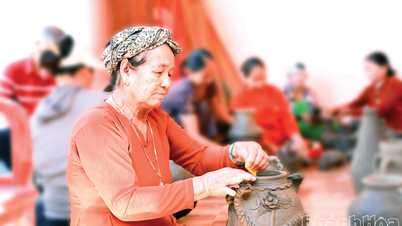
The exhibition, organized with the participation of 11 private collectors, showcases typical products of traditional Southern Vietnamese pottery. Through household, religious, and decorative pottery artifacts belonging to the Cay Mai, Saigon, Lai Thieu, Bien Hoa, and Thanh Le pottery lines, the exhibition outlines the face of Southern Vietnamese pottery in the process of its formation and development.


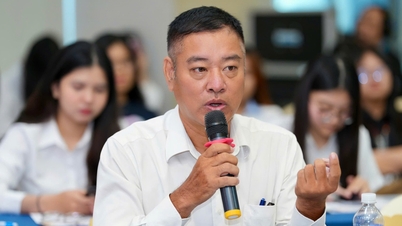
Speaking at the opening ceremony, on behalf of the collectors, Mr. Truong Vinh Thang said that "ancient Southern Vietnamese pottery" is a general term for pottery lines such as Cay Mai, Saigon, Lai Thieu, Bien Hoa, Thanh Le, etc., which were formed and developed from the late 19th century to around the 1970s.
Among them, Cay Mai pottery and Lai Thieu pottery, Quang Nam style, are mainly produced using clay, shaped by hand or molded, covered with colored glaze, and fired at high temperatures, resulting in durable stoneware products that can withstand the test of time.


The products of Cay Mai pottery are mainly intended for temple construction and civil needs such as: miniature statues for temple architecture, religious statues, incense burners, pedestals and flower pots…
Early Saigon and Lai Thieu ceramics, featuring blue and white glaze, used kaolin clay combined with local clay, shaped using a potter's wheel, glazed, and painted with blue or colored glazes, resulting in semi-porcelain and household ceramic products such as vases, teapots, bowls, cups, and plates. The decorative patterns bear the strong imprint of Eastern culture, reflecting the Sino-Vietnamese cultural exchange.
Meanwhile, Bien Hoa and Thanh Le pottery stand out with their sculpting techniques, inscribing patterns on the clay body and then applying glaze, focusing on decorative art products that depict images of the homeland, country, and people of Vietnam.


According to collector Truong Vinh Thang, the exhibition showcased typical ceramic artifacts, ranging from works of art to simple items associated with the daily life of people in Southern Vietnam in the past.
Ancient ceramic artifacts are displayed alongside wooden objects of the same period, aiming to recreate the ancestral worship space and guest reception area of Southern Vietnamese families in the past.
"Through the 'Soul of Southern Vietnam' exhibition, we hope to contribute to preserving, introducing, and spreading the traditional values of ancient Southern Vietnamese pottery to schools and the community, as a part of our national cultural heritage," Mr. Truong Vinh Thang shared.

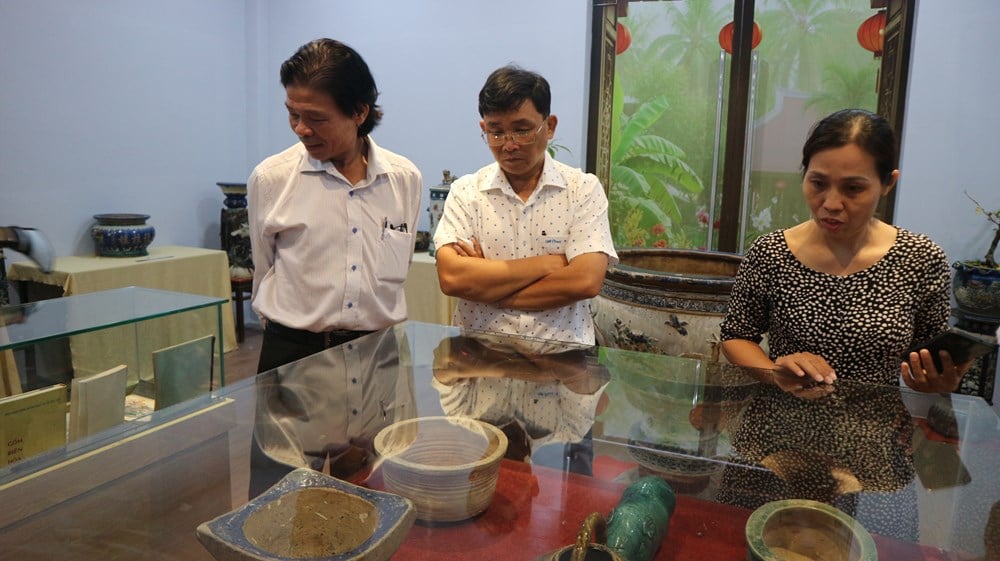
On this occasion, the collectors awarded 20 scholarships, totaling 20 million VND, to students of the Faculty of Heritage and Ethnic Culture and the Faculty of Culture and Communication. Folk culture researcher Huynh Ngoc Trang also donated books to the school.
Mr. Le Thanh Nghia, Chairman of the Ho Chi Minh City Antiquities Association, said that since its establishment, the Association has actively participated in the socialization of museum and conservation work, coordinating with museums and universities to organize many thematic exhibitions, and awarding scholarships to students in conservation, museum studies, and cultural management, contributing to the training of human resources for the heritage sector.
Associate Professor Lam Nhan, Rector of Ho Chi Minh City University of Culture, said the university is delighted to connect with collectors, creating opportunities for Heritage students to intern and learn in a practical setting at museums and private collections.
According to him, the long-standing support of the Ho Chi Minh City Antiquities Association is of great importance. At the same time, through this activity, the school also hopes to contribute in return by inventorying, classifying, and documenting artifacts, thereby training human resources to meet practical requirements and reducing the need for retraining after graduation.


The exhibition features 11 collectors: Le Thanh Nghia, Vo Ha Tuan, Nguyen Hieu Tin, Truong Vinh Thang, Luu Kim Chung, Le Van Quy, Le Nguyen Ngoc Ly, Le Anh Dung, Bui Quang Tung, Nguyen Hoang Nguyen, and Nguyen Nhut Hao.
Alongside the exhibition, the school organized a thematic scientific seminar on "Southern Vietnamese Ceramics: Past and Present," creating a forum for scientists, lecturers, collectors, and museum staff to exchange ideas on the origins, manufacturing techniques, distinctive shapes, and heritage value of Southern Vietnamese ceramics, contributing to connecting scientific research with conservation practices.
Source: https://baovanhoa.vn/van-hoa/khai-mac-trien-lam-hon-dat-phuong-nam-194585.html











![[Video] Weather forecast for tonight and tomorrow, May 24, 2026: Widespread heatwave continues in Northern and Central Vietnam.](https://vphoto.vietnam.vn/thumb/402x226/vietnam/resource/IMAGE/2026/05/23/1779541331471_dem-23-png.webp)















































Comment (0)