

Nguyen Ly (1374-1445), from Dao Xa village, Lam Son commune, Luong Giang district (now Giao Xa neighborhood, Lam Son town, Tho Xuan district), was not only a founding hero of the Le dynasty, but also one of the 18 people who participated in the Lung Nhai Oath Ceremony with Le Loi.
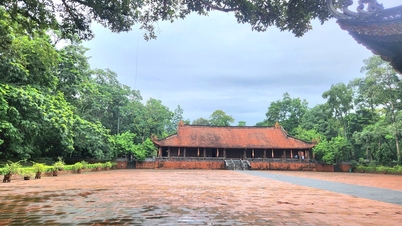
 Le Ly, a founding hero of the Later Le Dynasty, is listed in the Lam Kinh Special National Historical Site.
While the resistance against the Ming army led by Ho Quy Ly was waged during a time of national unrest and unpopular government, the Lam Son Uprising and the national liberation war led by Le Loi not only overcame the limitations of the previous resistance but also showcased many innovations in military strategy. The vast majority of the insurgents were "hardshipmen"—poor and oppressed people who, at the call of their leader Le Loi, rallied and became courageous soldiers.
Nguyen Ly was present from the very beginning of Le Loi's difficult times and in every battle, yet there is still very little documentation about him. The book "35 Founding Heroes of Lam Son" ( Thanh Hoa Publishing House, 2017) contains only a little over 3 pages; "Lam Son Chronicle" also only has a few lines about him.
In 1418, as soon as Le Loi issued the order to revolt, the Ming army immediately launched a fierce crackdown. In this unequal battle, the Lam Son rebels suffered considerable losses. Le Loi was forced to withdraw all his forces to Muong Mot (now Bat Mot area, Thuong Xuan district) and then to Linh Son (also known as Chi Linh mountain). As soon as the enemy ended the siege of Linh Son, Le Loi ordered his soldiers to return to Lam Son to consolidate their ranks, increase food supplies, and acquire more weapons for a prolonged fight. However, after returning to Lam Son for a few days, Le Loi had to face even more fierce attacks and repression, so he had to order his troops to withdraw to Lac Thuy.
At Lac Thuy, Le Loi predicted that the Ming army would certainly pursue him relentlessly. To prevent this fierce pursuit, Le Loi decided to set up a highly effective ambush at Lac Thuy. Nguyen Ly, formerly a cavalry commander, was honored with the position of deputy commander of this ambush. Besides Nguyen Ly, several other outstanding generals were also present, including Le Thach, Le Ngan, Dinh Bo, and Truong Loi.
After a series of minor victories, the enemy became overconfident and advanced into Lac Thuy, hoping to completely crush the Lam Son forces. Taking advantage of this complacency, Le Loi's ambush troops launched a surprise attack. The "Dai Viet Thong Su" (Comprehensive History of Dai Viet) records this victory: "We killed several thousand enemy soldiers, and captured thousands of weapons and equipment." The Ming commander in this battle, Ma Ky, was truly terrified. This was the first major victory of the Lam Son rebels, paving the way for many great victories later on. Among them, Nguyen Ly's name became increasingly prominent.
In 1420, Le Loi stationed his troops in Muong Thoi. This time, two high-ranking enemy generals, Ly Bin and Phuong Chinh, led over 100,000 troops and launched a direct attack on Le Loi's new base. The Ming army's guide was the traitor Cam Lan, who held the position of Deputy District Chief in Quy Chau ( Nghe An ). To gain the initiative and launch a surprise attack, Le Loi dispatched generals Ly Trien, Pham Van, and Nguyen Ly to ambush the enemy at a strategically important location on the road leading to Muong Thoi.
As Lê Lợi had predicted, Lý Bân and Phương Chính had no suspicions. As soon as their vanguard fell into the ambush, Nguyễn Lý, Phạm Vấn, and Lý Triện immediately ordered their troops to charge from all sides. In this battle, the Lam Sơn rebels annihilated a significant portion of the enemy's forces, leaving "Lý Bân and Phương Chính to only escape with their lives."
From 1424 to 1426, the Lam Son rebels continuously launched attacks on the Ming army's encampment in Nghe An. Nguyen Ly was one of the generals who had the honor of participating in most of the major battles such as Bo Dang, Tra Lan, Kha Luu, Bo Ai... Thanks to his many meritorious deeds, he was gradually promoted by Le Loi to the rank of Lieutenant. In September of the year Dinh Mui (1427), Nguyen Ly, along with Tran Nguyen Han, captured Xuong Giang citadel, taking Thoi Tu, Hoang Phuc, and 30,000 enemy soldiers alive. From then on, the Ming army gradually weakened, and the Lam Son rebels won every battle.
When Lê Lợi ascended the throne in 1428, founding the Lê dynasty with the title Thuận Thiên, he rewarded those who had fought alongside him. Nguyễn Lý was promoted to Tư Mã (Commander of the Army), given the right to participate in court affairs, ranked among the meritorious officials of Suy Trung Tán Trị Hiệp Mưu Công Thần (Successor, Commander, Advisor, and Righteous Strategist), granted the royal surname, and praised in a royal decree: "Lê Lý (Nguyễn Lý) governed the four directions, fighting the Ming invaders in the North and repelling the Ai Lao in the South. Wherever he went, he achieved merit, skillfully using weakness to defeat strength, and few to win against many." From then on, history recorded him as Lê Lý. In 1429, the Lê dynasty erected a plaque inscribed with the names of 93 founding meritorious officials, and Lê Lý's name was ranked sixth.
When King Lê Thái Tổ died, King Lê Thái Tông ascended the throne. At this time, Grand Minister Lê Sát held military power and, disliking Lê Lý, reassigned him to the position of Governor-General of Thanh Hóa province, and later to Co-Governor-General of Bắc Giang province. In 1437, Grand Minister Lê Sát was dismissed and subsequently killed. Lê Lý was then recalled to the court as Imperial Junior Lieutenant, advising on military affairs of the western provinces (comprising the districts of Thanh Hóa, Nghệ An, Tân Bình, and Thuận Hóa).
In 1445, Le Ly passed away. King Le Nhan Tong bestowed upon him the posthumous name Cuong Nghi, praising his steadfast character and determination, and ordered the construction of a temple in Lam La. Nguyen Ly's tomb is located in Coc Xa, Dung Tu village, Luong Giang (now Kien Tho commune, Ngoc Lac district, Thanh Hoa province). This is why, in Ba Si, Kien Tho commune, people and descendants of the Nguyen family still offer incense at the small tomb on holidays every year. In the year of Giap Thin (1484), King Le Thanh Tong posthumously conferred upon him the title of "Grand Tutor, Duke of Du," later further promoting him to "Duke of Du." Subsequent Le kings all bestowed upon Le Ly the title of "Great King of the Middle Rank Blessed Deity."
“Perhaps due to the upheavals of the times, in Giao Xa village (now part of Lam Son town, Tho Xuan district), which is recorded as the birthplace of Nguyen Ly, there are currently no records, documents, or official historical accounts about him,” said Nguyen Van Thuy, a cultural official in Lam Son town. The name Le Ly in Thanh Hoa province is now only mentioned at the Lam Kinh National Special Historical Site. Introducing us, Ms. Trinh Thi Luan, Head of the Professional Department of the Lam Kinh Historical Site Management Board, pointed to the plaques recording the lives and careers of 18 people who participated in the Lung Nhai Oath Ceremony with Le Loi. “These simple biographical details are enough to give us some understanding of the famous general Le Ly. It is regrettable that there are so few documents about him. Hopefully, in the next phase, with the development of document collection and archiving, we will have more sources of information about the generals of the Later Le Dynasty, including Le Ly.”
Text and photos: Kieu Huyen
Source

























































































Comment (0)