

Thành Hồ is located on the left bank of the Đà Rằng River, in Phú Hòa town, Phú Hòa district. It is 12km from the center of Tuy Hòa city and 14km west of the Đà Diễn river mouth along National Highway 25 towards Gia Lai .
Strategic location
If we consider the Tuy Hoa plain as a triangle, then Ho Citadel lies right at the apex, with the coastline as its base. Ho Citadel is situated on the banks of the Da Rang River, a major river in South Central Vietnam, originating in the high mountains and flowing through four provinces: Kon Tum, Gia Lai, Dak Lak, and Phu Yen. This location holds significant importance for both economic exchange and military defense.
To the west of Ho Citadel lies a vast, relatively flat mountainous region with numerous relics, sites, and archaeological remains related to the Champa culture. Ho Citadel served as the gateway to the Upper Central Highlands (Tay Nguyen) of the Champa kingdom.
The relics of Cho Dinh Stele dating back to the 4th century, Nhan Tower dating back to the 11th century, and Ba Mountain dating back to the 14th century... demonstrate the continuous and long-term development of Champa culture in Phu Yen . Among them, Ho Citadel plays a central role in the Tuy Hoa plain. Therefore, this relic is an important key to understanding the history of Phu Yen province.
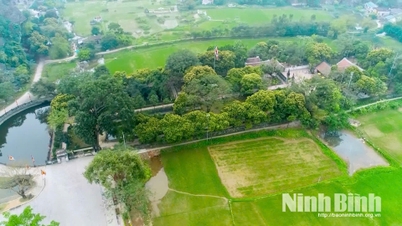
The citadel, roughly rectangular in shape, was bordered on the south by the Da Rang River, on the west by hills, and on the north and east by rice fields. Additionally, a fifth rampart running north-south divided the citadel into two parts: the eastern part, the outer citadel, and the western part, the inner citadel. The citadel had eight gates: four auspicious gates (east, west, south, and north) and four inauspicious gates.
Ho Citadel was originally the political, cultural, and social center of the ancient Champa people, dating from the 5th to 7th centuries, about 1,400 years ago; covering an area of about 1 square kilometer, with some of its ramparts still relatively intact. Ho Citadel was classified as a national historical monument by the Ministry of Culture and Information (now the Ministry of Culture, Sports and Tourism) in 2005.
Architectural community
In the early 20th century, the French architect and archaeologist H. Pacmentier came to study and survey Ho Citadel. He was also the first to create some relatively detailed drawings of this citadel. This is a valuable source of information for us to refer to and study Ho Citadel today.
During the two years of 2003-2004, the Vietnam Institute of Archaeology and the Phu Yen Museum collaborated on excavations at Ho Citadel, covering an area of approximately 200 square meters. They discovered traces of ancient architectural structures buried underground in relatively dense concentrations. The excavation yielded a large quantity of various types of domestic and architectural pottery, dating from the 5th to the 7th centuries.
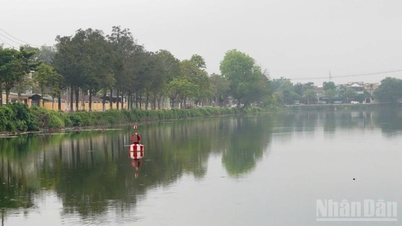
During excavations of the eastern rampart, the team found many layers of earth piled on top of each other, indicating that the Ho Citadel had been repaired numerous times. The citadel was mainly built of earth, mixed with small stones, and some sections were reinforced with bricks, a type of solid brick larger than modern bricks (8cm thick, 13cm wide, and 33cm long). These bricks were lightweight but had a fairly high compressive strength. Inside the citadel were lakes 4-5m deep, dug to obtain earth for building the ramparts, hence the name Ho Citadel.
From a distance, we can see that the eastern rampart is still relatively intact. It is 719 meters long, 5 meters high, and 10-15 meters wide at the top, with many raised earthen mounds resembling guard towers. Trees now grow abundantly on top of these mounds. The western rampart, which encircles Hon Moc Mountain, has two sections. The southeastern section is approximately 600 meters long. The fifth rampart (the middle section) is 920 meters long; a section of the northern part of this rampart has been demolished to create a water channel. The eastern rampart has almost completely collapsed into the Da Rang River; at most, only ruins remain.
Along the outer ramparts, there are still traces of deep moats, serving as a defensive system to support the ramparts. To the west of Ho Citadel, within the inner city area, there is a small mountain called Hon Moc, approximately 600 meters high above the surrounding area. On its summit, remnants of building materials from ancient architectural structures such as watchtowers and guard posts for the Ho Citadel area remain. In early 2006, four ancient statues dating from the 7th to 10th centuries were discovered at Hon Moc, possessing significant historical and artistic value in ancient Cham sculpture.
Ho Chi Minh City doesn't boast extravagant or novel spaces for photo opportunities, but rather ancient features that hold significant cultural and historical value. Here, you can explore the ancient fortifications of the Champa people, admire artifacts such as ancient pottery like roof tiles and vases, and statues... typical of the flourishing period of sculpture and architecture in the ancient Champa capital.
The Department of Culture, Sports and Tourism, together with Phu Hoa district, should develop a plan to utilize Ho Citadel for tourism development; strengthen the promotion of Ho Citadel, train tour guides, build an exhibition hall for artifacts… in combination with other local cultural activities to support tourism development.
Architect Hoang Xuan Thuong
Source: https://baophuyen.vn/94/319686/kham-pha-thanh-ho-chung-tich-van-hoa-cham-pa.html





























































































Comment (0)