

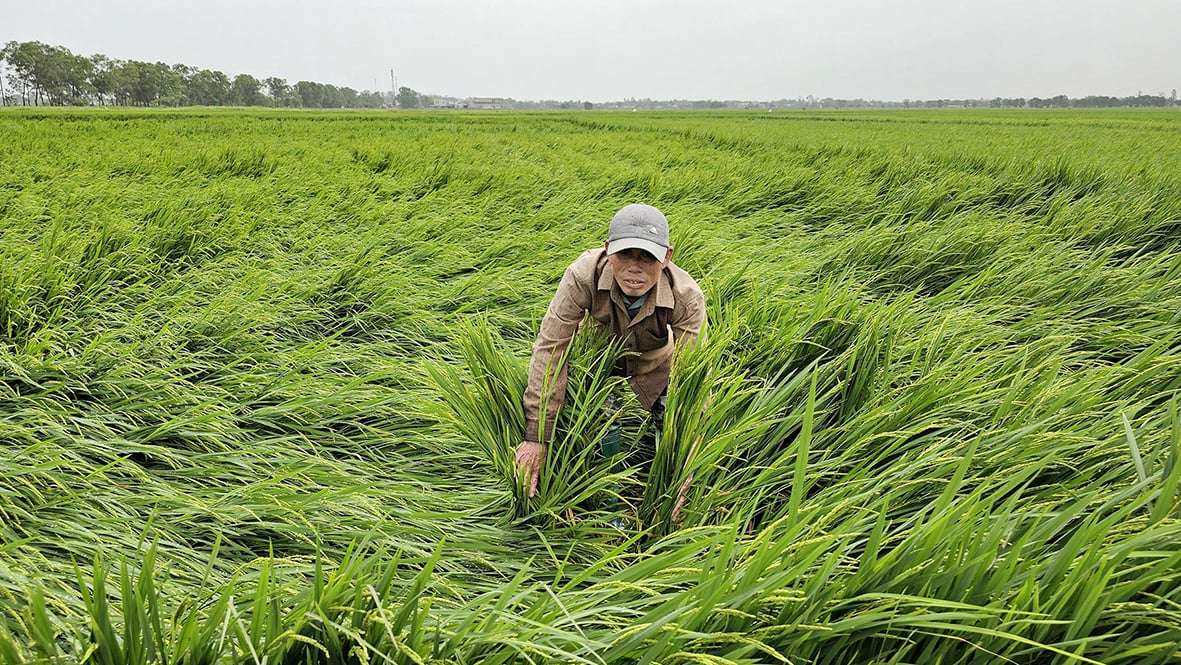
Residents of Hoi Yen village, Hai Binh commune, Hai Lang district, are rebuilding rice fields that were flattened - Photo: LA
Mr. Hoang Ngoc Tien, residing in Hoi Yen village, Hai Binh commune, Hai Lang district, said that this year his family planted 1.5 acres of rice during the winter-spring season, mainly HN6 and Khang Dan varieties. Approximately 3.5 acres of rice were flattened by heavy rain and strong winds on the evening of April 12th. To help the rice plants recover and minimize yield losses, since the morning of April 13th, taking advantage of favorable weather, he has been pumping water out of the fields to allow the rice plants to recover naturally in areas with minor lodging and to straighten the flattened plants.
According to Mr. Tien, fortunately, the rice plants have only been flowering for 3-4 days and haven't fully matured yet, so if the weather continues to be sunny and warm like now, the plants can still stand upright on their own. However, because the upper layer is pressing down on the lower layer, the expected harvest yield may be lower than the previous season. "Luckily, this winter-spring season has had quite a lot of rainy and cloudy days, so the rice plants are flowering later than usual; otherwise, the losses would be even higher. From now until harvest, it is estimated to be about another month. If it doesn't rain, we farmers will have a more favorable harvest," Mr. Tien said.
According to Vo Viet Dinh, Vice Chairman of the People's Committee of Hai Binh commune, out of a total of 786 hectares of rice fields in the commune, about 170 hectares were flattened due to heavy rain and strong winds. The most severely affected area was Co Luu village. Mr. Dinh said that after the rain, thanks to good sunshine and gentle winds, most of the lightly flattened rice fields have basically recovered. For areas where the rice was completely flattened, the local authorities have instructed farmers to drain the water from the fields and straighten the fallen rice plants to minimize damage.
Similarly, in Hai Duong commune, out of a total of over 900 hectares of rice fields, approximately 157 hectares were flattened due to heavy rain and strong winds. According to Hoang Canh, Chairman of the Hai Duong Commune People's Committee, to minimize damage, the commune's People's Committee directed cooperatives to increase the use of pumps to quickly drain water from the fields. Combined with warm, sunny weather, most of the flattened rice fields are now recovering.
According to Mr. Canh, the forecast for the coming period, being a transitional season, indicates a high risk of extreme weather phenomena, especially thunderstorms and tornadoes, which can cause rice plants to fall over during the flowering to ripening stages, particularly in fields with high planting density, excessive nitrogen fertilization, and persistent waterlogging. The commune's People's Committee has directed cooperatives to mobilize forces to clear waterways in canals and ditches, inspect and raise embankments, and ensure quick and efficient drainage in areas at risk of flooding. Simultaneously, they are increasing field inspections to detect pests and diseases early and implement timely control measures.
Speaking to a reporter from Quang Tri Newspaper while inspecting the situation of the winter-spring rice crop that had been flattened, the Vice Chairman of the Hai Lang District People's Committee, Duong Viet Hai, said that heavy rain and strong winds on the evening of April 12th had caused more than 710 hectares out of a total of nearly 6,900 hectares of rice in the entire district to be flattened.
However, because these areas of flattened rice are only in the flowering stage, not yet fully mature, and the rice panicles are still light, most of them can recover on their own after the water is drained from the fields, coupled with warm, sunny weather. Hai Lang district has also directed specialized agencies and localities to closely monitor the production situation and natural disasters and pests affecting crops. They are strengthening field inspections, promptly detecting and guiding farmers on measures to care for the crops, respond to natural disasters, and control pests and diseases affecting rice plants.
"If the warm, sunny weather continues, it is expected that the flattened rice plants will be able to stand up on their own in about 3-5 days. Only a small area remains completely flattened, and the district is directing local authorities to guide farmers to quickly tie the rice plants back up to minimize damage and facilitate harvesting later," Mr. Hai added.
According to Bui Phuoc Trang, Head of the Department of Crop Production and Plant Protection, preliminary statistics estimate that approximately 1,100 hectares of rice have been flattened, mainly concentrated in Hai Lang and Trieu Phong districts; on rice varieties with weak stems such as Khang Dan and HN6; and in fields with dense planting and excessive nitrogen fertilization. To minimize losses for farmers, the unit has increased the number of technical staff to closely monitor the situation on the ground, guiding farmers on appropriate measures to respond to and overcome natural disasters and control pests and diseases according to the actual situation in the locality. According to Mr. Trang, this year's spring crop saw over 26,200 hectares of rice planted throughout the province.
Currently, the rice plants are in the heading and flowering stage. However, given the forecast of extreme weather phenomena such as thunderstorms, tornadoes, and strong winds in the coming period, there is a risk of the rice plants being flattened from the flowering to ripening stage.
At the same time, this is also a favorable period for many rice pests and diseases to continue to develop and cause widespread damage, especially rice blast, brown planthopper, white-backed planthopper, small leaf roller, bacterial blight, bacterial leaf streak, bacterial leaf spot, grain discoloration, etc., posing a risk to yield and harvest production. Therefore, localities need to strengthen propaganda and warnings about extreme weather conditions and pests and diseases affecting rice crops from now until the end of the season so that farmers are aware and can proactively implement response and control measures.
In addition, it is necessary to inspect and repair dikes and embankments to prevent flooding caused by heavy rains; if tornadoes cause rice crops to be flattened, it is necessary to mobilize pumping equipment to quickly drain the water and promptly harvest rice that is over 85% ripe.
For rice fields that are in the heading and ripening stages, after draining the water from the field, it is necessary to prop up the rice plants by tying 3-5 rice stalks together with nylon string, in order to create favorable conditions for the rice to head, ripen, and mature.
For rice plants in the heading stage, ensuring quick drainage and straightening any lodged plants. After the weather clears, apply supplemental foliar fertilizer containing super potassium to help the rice plants recover quickly and promote heading.
Le An
Source: https://baoquangtri.vn/khan-truong-phuc-hoi-cay-lua-bi-do-nga-192947.htm


![[Photo] Commemorating the unwavering friendship between Vietnam and Laos](/_next/image?url=https%3A%2F%2Fvphoto.vietnam.vn%2Fthumb%2F1200x675%2Fvietnam%2Fresource%2FIMAGE%2F2026%2F01%2F27%2F1769518372051_ndo_br_1-jpg.webp&w=3840&q=75)


![[Photo] The General Secretary attends the groundbreaking ceremony for the construction of the Truong Ha Primary and Secondary Boarding School.](/_next/image?url=https%3A%2F%2Fvphoto.vietnam.vn%2Fthumb%2F1200x675%2Fvietnam%2Fresource%2FIMAGE%2F2026%2F01%2F28%2F1769604498277_vna-potal-tong-bi-thu-du-le-khoi-cong-xay-dung-cong-trinh-truong-pho-thong-noi-tru-tieu-hoc-va-trung-hoc-co-so-truong-ha-8556822-jpg.webp&w=3840&q=75)


![[Photo] National Assembly Chairman Tran Thanh Man meets with former leaders of the National Assembly from various periods.](/_next/image?url=https%3A%2F%2Fvphoto.vietnam.vn%2Fthumb%2F402x226%2Fvietnam%2Fresource%2FIMAGE%2F2026%2F01%2F28%2F1769601014034_anh-man-hinh-2026-01-28-luc-18-50-04.png&w=3840&q=75)


![OCOP during Tet season: [Part 3] Ultra-thin rice paper takes off.](/_next/image?url=https%3A%2F%2Fvphoto.vietnam.vn%2Fthumb%2F402x226%2Fvietnam%2Fresource%2FIMAGE%2F2026%2F01%2F28%2F1769562783429_004-194121_651-081010.jpeg&w=3840&q=75)


![OCOP during Tet season: [Part 2] Hoa Thanh incense village glows red.](/_next/image?url=https%3A%2F%2Fvphoto.vietnam.vn%2Fthumb%2F402x226%2Fvietnam%2Fresource%2FIMAGE%2F2026%2F01%2F27%2F1769480573807_505139049_683408031333867_2820052735775418136_n-180643_808-092229.jpeg&w=3840&q=75)
![OCOP during Tet season: [Part 1] Ba Den custard apples in their 'golden season'](/_next/image?url=https%3A%2F%2Fvphoto.vietnam.vn%2Fthumb%2F402x226%2Fvietnam%2Fresource%2FIMAGE%2F2026%2F01%2F26%2F1769417540049_03-174213_554-154843.jpeg&w=3840&q=75)




Comment (0)