

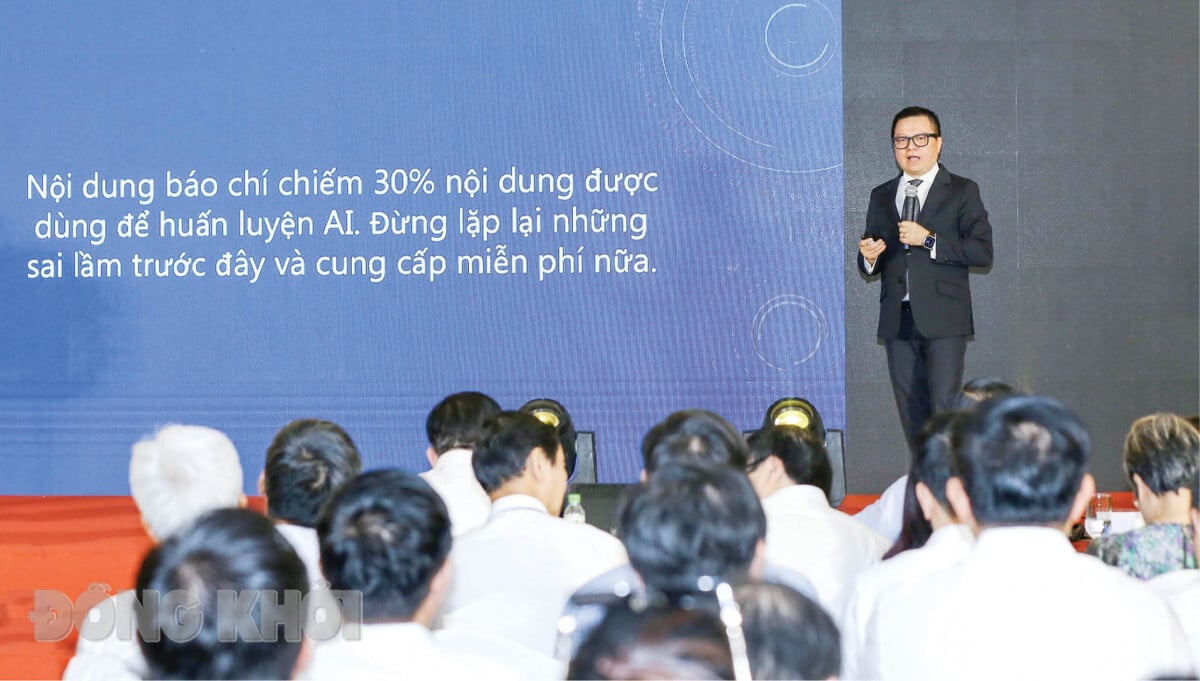
Chairman of the Vietnam Journalists Association, Le Quoc Minh, presented the survey results at the National Press Forum 2024 (held in Ho Chi Minh City in March 2024). Photo: T. Thao
Current challenges
In the current era, journalism has continuously innovated, been creative, flexible, and effective, promoting the application and mastery of modern communication technologies with the emergence of many new programs and products, spreading widely across digital platforms, and having a positive impact on society.
However, the increasingly fierce competition from new forms of information such as social media presents an extremely difficult time for journalism worldwide , as well as for Vietnamese journalism. Journalism provides useful information to society, but its crucial role and power, built over centuries, are being threatened by constant changes, especially in the last decade.
In March 2024, Le Quoc Minh, Editor-in-Chief of Nhan Dan Newspaper, Deputy Head of the Central Propaganda and Mass Mobilization Department, and President of the Vietnam Journalists Association, announced the results of a survey titled "Vietnamese Journalism: Challenges and Opportunities." The survey involved 111 media outlets, 66 magazines, and 46 radio and television stations. The results showed that the majority of media organizations are small, with fewer than 50 employees. The average age of journalists is typically between 36 and 45, indicating an aging workforce in the media industry. Most organizations have monthly print circulations below 500,000 copies, and most online news sites also have traffic below 500,000 visits per month, although a few exceed 50 million visits.
Despite positive signs such as traffic growth of 10-30% in some units, overall reach to young readers under 18 remains limited. This poses a significant challenge in rejuvenating the readership and innovating content to align with modern information consumption trends.
Application of technology and artificial intelligence
According to Le Quoc Minh, Chairman of the Vietnam Journalists Association, surveys show that the application of AI in media organizations is still in its infancy. Only 46 out of 117 media organizations reported using AI, and 29% indicated plans to implement it. AI is primarily used to support content production. However, a lack of specialized personnel and a clear strategy has resulted in ineffective AI utilization. While AI opens opportunities to improve workflows, reduce the workload for reporters and editors, and increase production efficiency, it also brings many risks such as misinformation, plagiarism, and a decline in public trust in journalism if not properly controlled.
In addition, the survey also collected information on revenue sources and business models in the media industry. Currently, the revenue of media organizations still mainly relies on advertising and state budget. In the three years (2021-2023), about one-third of media organizations recorded a revenue increase of 10-30%. However, nearly half of the organizations reported that their revenue remained unchanged or decreased.
Revenue from print advertising has decreased significantly, from 85-90% previously to only about 20%. While digital advertising has increased, it remains unstable and dependent on technology platforms. Charging for online newspapers – a common trend in many developed countries – has not received much attention in Vietnam, with only 9.4% of media outlets planning to implement it.
The fact that platforms are using journalistic content to train AI models without paying fees also raises copyright issues. Currently, many international news organizations have blocked AI tools from accessing content and demanded compensation. This is something Vietnam needs to consider implementing soon.
Warnings and recommendations
Chairman of the Vietnam Journalists Association, Le Quoc Minh, expressed his hope that media organizations would pay attention to the information from this survey. He emphasized that the "health" of media organizations is crucial, and this data would be useful for guiding future operations.
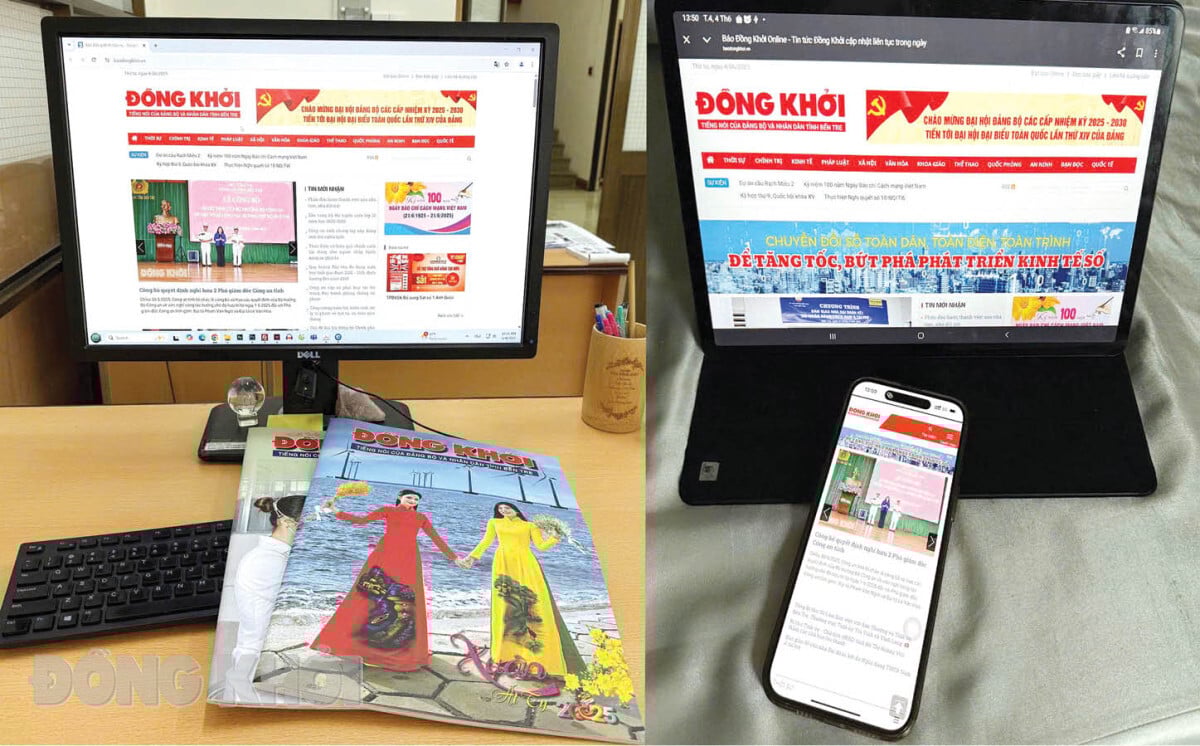
Dong Khoi Newspaper applies multimedia communication solutions. Photo: Le Uyen
Globally, revenue from print newspapers and traditional advertising is declining sharply. However, international news organizations are actively shifting towards new models such as event organization, content licensing, podcast development, and the strong growth of video and audio content... to increase engagement with readers and find sustainable revenue streams.
A worrying trend is the phenomenon of readers "avoiding news" due to an overload of negative information, causing a disconnect from the public. This further underscores the crucial role of creating valuable, in-depth, and humane content.
Chairman of the Vietnam Journalists Association, Le Quoc Minh, emphasized: "We must affirm that using AI is a necessary and inevitable direction. But how to use it to take advantage of its benefits, instead of letting it destroy us, is something that media organizations must consider."
Vietnamese journalism is at a crossroads between opportunity and challenge. Technology can be an ally or a threat depending on how we choose to act. It's time for media outlets to act decisively, innovate their thinking, revise their strategies, and find a path to sustainable development in the digital age. Le Quoc Minh, Editor-in-Chief of Nhan Dan Newspaper, Deputy Head of the Central Propaganda and Mass Mobilization Department, and President of the Vietnam Journalists Association, concluded his remarks by quoting the author of "The Great Salesman": "Don't hesitate any longer, act now, because this moment is the only thing we truly possess."
Thach Thao (recorded)
Source: https://baodongkhoi.vn/khi-ai-len-ngoi-20062025-a148466.html


![[Photo] General Secretary To Lam receives the Special Envoy of General Secretary and President of China Xi Jinping](/_next/image?url=https%3A%2F%2Fvphoto.vietnam.vn%2Fthumb%2F1200x675%2Fvietnam%2Fresource%2FIMAGE%2F2026%2F01%2F30%2F1769759383835_a1-bnd-5347-7855-jpg.webp&w=3840&q=75)


![OCOP during Tet season: [Part 3] Ultra-thin rice paper takes off.](/_next/image?url=https%3A%2F%2Fvphoto.vietnam.vn%2Fthumb%2F402x226%2Fvietnam%2Fresource%2FIMAGE%2F2026%2F01%2F28%2F1769562783429_004-194121_651-081010.jpeg&w=3840&q=75)

![OCOP during Tet season: [Part 2] Hoa Thanh incense village glows red.](/_next/image?url=https%3A%2F%2Fvphoto.vietnam.vn%2Fthumb%2F402x226%2Fvietnam%2Fresource%2FIMAGE%2F2026%2F01%2F27%2F1769480573807_505139049_683408031333867_2820052735775418136_n-180643_808-092229.jpeg&w=3840&q=75)





Comment (0)