

Revival after the plum blossom seasons
Muong Long is a commune nestled deep in the mountains of Ky Son district, at an altitude of nearly 1,500 meters above sea level, and is covered in fog almost year-round. To travel from the center of Ky Son district to Muong Long, one must traverse over 50 kilometers of winding mountain roads with sharp hairpin bends that seem to shoot straight up to the sky. Many people jokingly say, "To reach Muong Long, you need courage, a vehicle, and… good health."
Muong Long is located deep in the mountains, at an altitude of nearly 1,500m above sea level, and is covered in fog almost all year round. Photo: Thien Y |
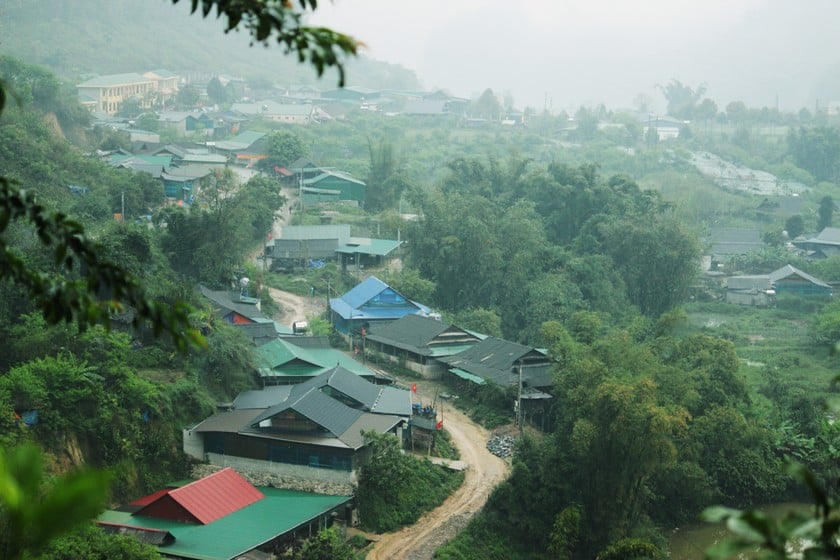
In the 1990s, few people set foot here except for local officials, highland teachers, or border guards. It was precisely because of this rugged terrain that, for a long time, Muong Long became a hiding place for opium poppies. At its peak, the entire commune had over 500 hectares planted with this deadly crop. Poverty, hunger, and even guilt seemed to weigh heavily on the dilapidated wooden houses.
It wasn't until 1997, thanks to the government's decisive policies and the intervention of local authorities, that Muong Long officially eradicated opium cultivation. Instead, the villagers switched to growing trees such as peach and plum blossoms. Within just a few years, the entire valley was ablaze with color every spring, plum blossoms covering the hills and mountains in white, and peach blossoms blushing pink in the warm sunshine. This beauty began to attract the first cameras of tourists from the lowlands.
According to Mr. Va Cha Xa, Chairman of the People's Committee of Muong Long commune, the commune has about one thousand households and more than five thousand inhabitants, all of whom are ethnic Mong people.
"Due to unique natural conditions, the people have long relied on slash-and-burn agriculture, with few cows and chickens. Difficulties piled up, but now, thanks to the Party and State's attention and support in investing in infrastructure and opening roads to the village, the people have more opportunities for development," Mr. Va Cha Xa shared.
According to the Chairman of Muong Long commune, since the road to the village was built, tourists from the lowlands have started to visit in large numbers. In 2023-2024 alone, Muong Long welcomed about 2,000-3,000 visitors, especially in the spring, when the plum blossoms cover the area in white, and the plum picking festival is held.
Muong Long is being revived. Photo: Thien Y |
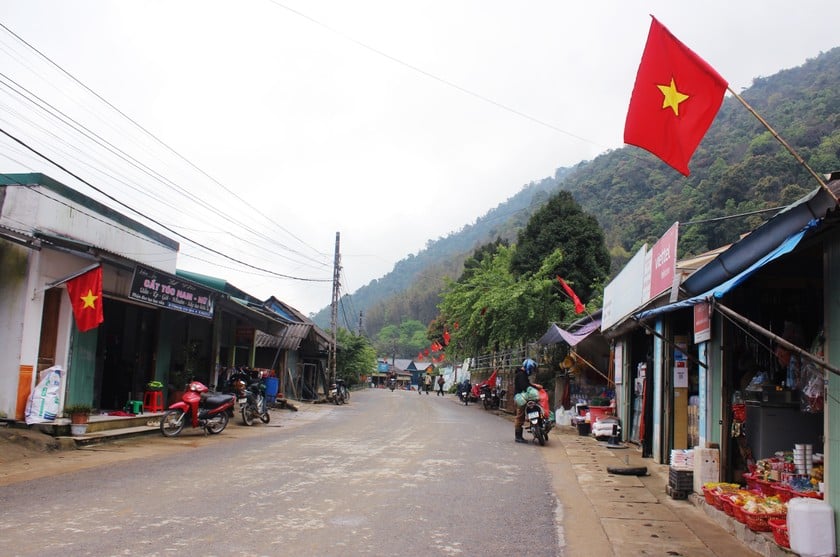
According to Ms. Le Thi Van, an official from Muong Long commune, recognizing the great potential for tourism development in the area, the local authorities proactively established the Muong Long Agricultural and Tourism Cooperative in 2022.
With 67 members, including 10 members of the homestay group, the cooperative is initially helping people become familiar with tourism service skills, learn how to preserve cultural identity while still generating income.
"Nowadays, people not only know how to work in the fields, but they have also learned how to welcome guests, cook, keep their houses clean, and introduce their ethnic culture. Tourism helps the Hmong people become more confident, less dependent on farming, and also gives them more motivation to preserve their identity," Ms. Van said.
When the Hmong people open their doors to welcome the "dawn".
In Muong Long 1 village, there is a Hmong man considered the "pioneer" of the local homestay model, Mr. Vu Tong Po (55 years old).
Previously, Mr. Pó only knew how to grow corn and raise cattle. Then one day, some visitors from the lowlands came up and asked, "Is there anywhere to stay here?" That question sparked an unprecedented idea in him: "Why not let them stay, have a meal with me, and listen to me tell stories about my village?"
From that simple idea, in 2021, Mr. Vu Tong Po decided to renovate and rebuild his traditional Hmong wooden house to serve as a guesthouse. Simultaneously, he participated in training courses organized by the local government and learned more online, beginning his journey of learning about tourism, from greetings and handshakes to cleaning and decorating guest rooms.
Currently, his homestay has 3 rooms with a capacity of about 20 people. During peak season, it welcomes 120-150 guests each month, a number he never imagined in the past.
To develop community tourism, many Hmong people have borrowed money to build guesthouses. Photo: Thien Y |
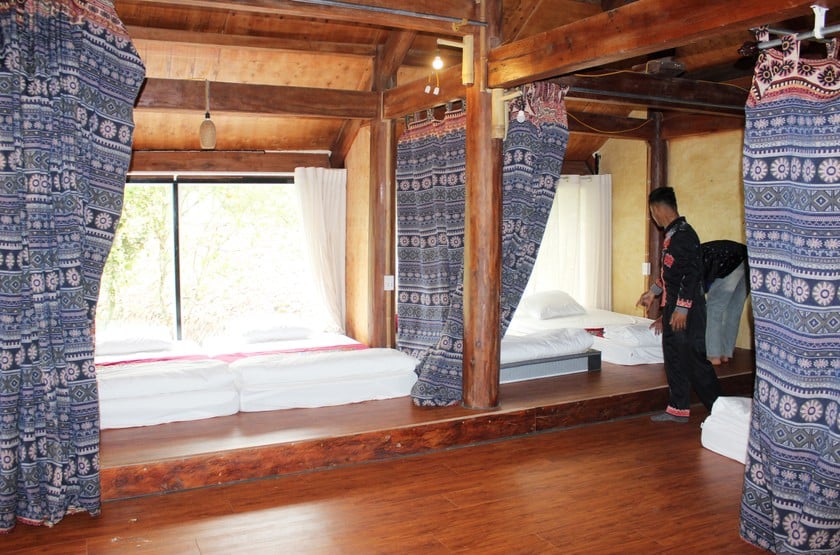
Mr. Pó's example quickly spread to everyone, and many other households in the village began to follow suit. Ms. Lầu Y Dếnh was one of those who boldly borrowed money to renovate her house for tourism.
"Before, no one believed that tourism could be a viable way to make a living. But Mr. Pó said something that made me think for a long time: 'It's your house, you live there, but now you have other people living with you and you even get to earn money,'" Ms. Dếnh said with a smile.
According to Ms. Dếnh, due to a lack of experience, she initially faced many difficulties and uncertainties in starting a tourism business. However, with the support of the local government, she was able to visit successful models in other provinces, learn from their practices, and gradually apply them back home.
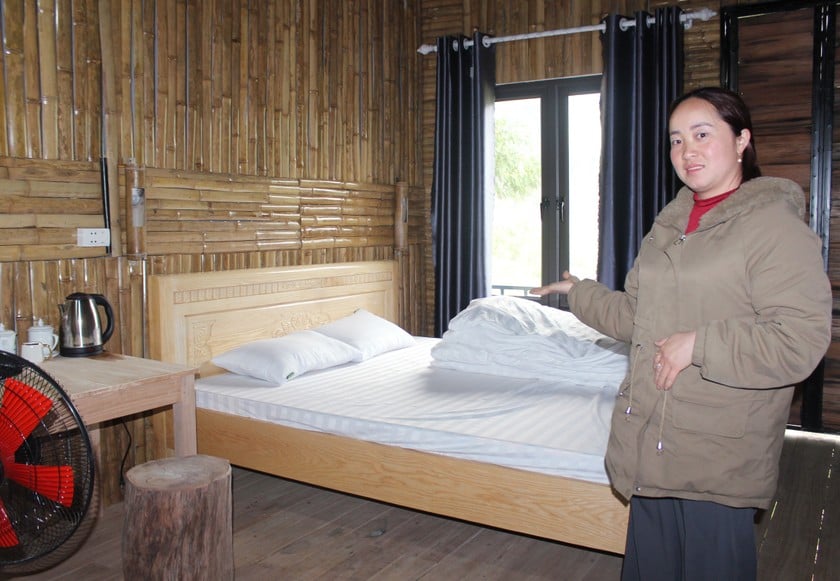
Currently, Ms. Dếnh's homestay can accommodate 40-50 guests. After deducting all expenses, her family's average monthly income is about 5-7 million VND. Besides providing food and accommodation, Ms. Dếnh also guides tourists through experiences such as: hand-embroidering and weaving traditional brocade patterns, playing Hmong games, and enjoying typical local dishes.
Similarly, Ly Y Senh's family also switched to investing in community tourism after seeing more and more tourists coming to Muong Long.
“My husband and I invested nearly 300 million VND to complete three guest rooms with a capacity of about 12-13 people, providing both food and accommodation. We split the work, one cooking, the other entertaining guests, and we earn around 4-5 million VND per month,” Ms. Sềnh shared.
Ly Y Senh's family invested nearly 300 million VND in community tourism. Photo: Thien Y. |
Join hands to "awaken" the "dormant" villages.
Despite its initial success, community-based tourism in Muong Long is still in its infancy.
Mr. Xã Văn Lương, Vice Chairman of the People's Committee of Kỳ Sơn District, observed: "Due to the limited mindset of the local people, the number of households involved in tourism is currently not large. The district is supporting the development of tourism models and organizing study tours for local people to learn from experiences in other localities. At the same time, we are proposing that Nghệ An province recognize Mường Lống as a tourist destination to receive more systematic support."
According to Ms. Le Thi Van, an official in Muong Long commune, the biggest difficulty is that Muong Long lacks a comprehensive service system: no parking lots, no shuttle service between tourist destinations, and no regional connectivity.
"The real long-term challenge is how to make customers want to come back after their first visit, and even recommend us to their friends," Ms. Van pondered.
However, what is truly admirable is that in each wooden house, every Hmong person here is quietly learning and changing little by little. No longer simply "farming and raising cattle," the people now know how to promote and preserve their living space, and how to tell stories in their own language.
Many Hmong people are rewriting their own stories through their words, their homes, their food, and even their proud gazes. Photo: Thien Y |
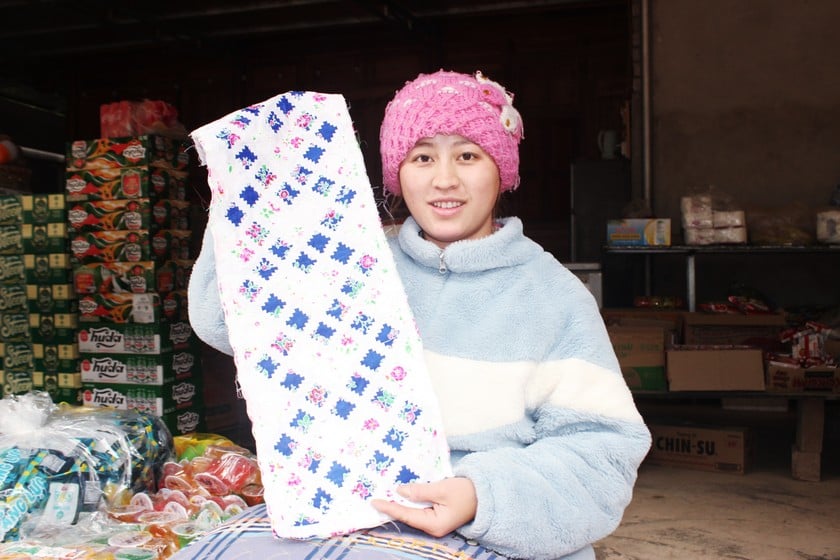
Today, Muong Long is not only the "gateway to heaven" of Western Nghe An, but also a place where the Hmong people are rewriting their own story through their words, their houses, their food, and their proud gazes.
From their slow, initial steps, they are transforming their "villages" into "destinations," turning "those who stay behind" into "guides." In their journey of preserving their identity amidst the mountains and forests, tourism is not only a way out of poverty, but also a way for the ethnic minorities to stand on their own two feet, through their inner strength and love for the land that nurtured them.
Heaven's Will
Source: https://baophapluat.vn/khi-nguoi-mong-lam-du-lich-post545714.html

![[Photo] General Secretary To Lam receives President of the European Council Antonio Costa](/_next/image?url=https%3A%2F%2Fvphoto.vietnam.vn%2Fthumb%2F1200x675%2Fvietnam%2Fresource%2FIMAGE%2F2026%2F01%2F29%2F1769697816651_a1-bnd-5216-9741-jpg.webp&w=3840&q=75)


![OCOP during Tet season: [Part 3] Ultra-thin rice paper takes off.](/_next/image?url=https%3A%2F%2Fvphoto.vietnam.vn%2Fthumb%2F402x226%2Fvietnam%2Fresource%2FIMAGE%2F2026%2F01%2F28%2F1769562783429_004-194121_651-081010.jpeg&w=3840&q=75)


![OCOP during Tet season: [Part 2] Hoa Thanh incense village glows red.](/_next/image?url=https%3A%2F%2Fvphoto.vietnam.vn%2Fthumb%2F402x226%2Fvietnam%2Fresource%2FIMAGE%2F2026%2F01%2F27%2F1769480573807_505139049_683408031333867_2820052735775418136_n-180643_808-092229.jpeg&w=3840&q=75)
![OCOP during Tet season: [Part 1] Ba Den custard apples in their 'golden season'](/_next/image?url=https%3A%2F%2Fvphoto.vietnam.vn%2Fthumb%2F402x226%2Fvietnam%2Fresource%2FIMAGE%2F2026%2F01%2F26%2F1769417540049_03-174213_554-154843.jpeg&w=3840&q=75)



Comment (0)