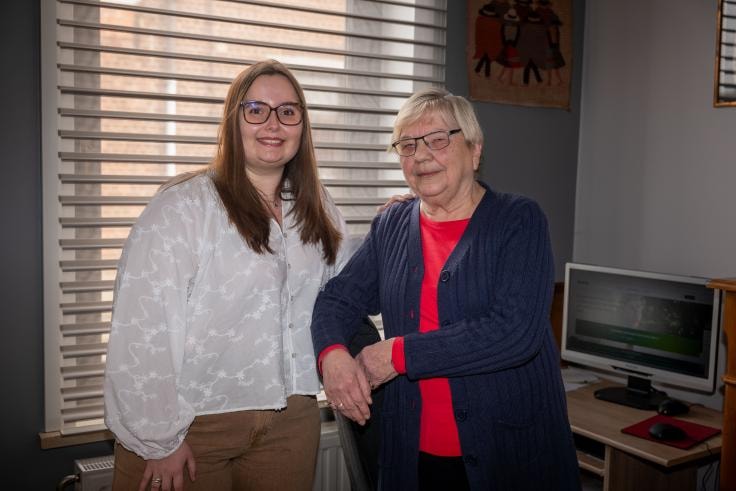
For Laura, a student in her early twenties who grew up with the internet, computer operations are almost instinctive. But for her aunt, each click is still a journey of discovery. And that familiar encounter has become a special "ritual" between the two generations: the younger generation patiently guides, while the older generation gradually becomes acquainted with the increasingly indispensable digital world .
Today, scheduling medical appointments, shopping, paying bills, or completing administrative procedures are all linked to online applications. Living without technology seems like an "impossible task." For Generation Z, born when the internet was ubiquitous, digital skills are simply a given. But for many older adults, each step in adopting technology is a new challenge.
Every time Laura visited her grandmother, they would start by cleaning up her email inbox. Then came the part her grandmother enjoyed most: learning how to use social media, especially Facebook.
"She was often afraid of accidentally clicking on a link or not knowing how to resend a photo to a friend," Laura recounted. Laura's method was very slow: showing her step by step, then letting her try it herself. To avoid forgetting, she carefully noted everything down on a small piece of paper, even drawing the shapes of the buttons she needed to press.
In the days that followed, she practiced again under the patient, watchful eyes of her granddaughter.
As a thoughtful student, Laura always avoided using complex technological jargon. She realized that seemingly simple concepts were not at all obvious to her grandmother's generation.
“For example, the folder icon on a computer,” Laura explained. “To her, it didn’t look like a file cover at all, so she didn’t understand why it was called a ‘folder.’ We had to find a way to explain it using other images.”
Sometimes, the instructions have to be repeated several times. But Laura doesn't mind at all. On the contrary, she sees it as an enjoyable experience.
"It's fascinating to see someone discover social media for the first time," she laughed. "There are things that are so obvious to me, but are completely new to her."
However, learning wasn't always easy. Laura's grandmother sometimes got discouraged when she didn't understand things immediately. But at 75, she persevered.
"She enjoys the feeling of learning something new," Laura said. "For her age, that's a great thing to be able to absorb so much."
In fact, Laura's grandmother belongs to a minority of elderly people in Belgium who are using technology to access social media. According to statistics from Statbel, approximately 20% of elderly people in the country use the internet to access social media platforms.
A study published in the fall of 2024, the first to survey the 75-89 age group, showed that the digital divide between generations remains quite large. However, the trend is gradually changing. By 2025, the percentage of older adults in Belgium who had never used the internet had decreased to 31%, compared to 35% the previous year.
Recognizing the growing need, many initiatives have emerged to help older adults overcome technological barriers.
Azzi Khaoula, 25, is one of those involved in that effort. A graduate in multimedia communications, she currently works for a Brussels-based non-profit organization that organizes digital skills training courses. She also provides in-home technology support services to those in need.
"Typically, people call me when they have a specific problem," Khaoula said. "Some want to check their online bank account, others don't know how to log into administrative service websites."
According to her, the biggest worry for the elderly is the fear of accidentally pressing the wrong button. "They're afraid of making mistakes, afraid of damaging the equipment," Khaoula said.
Many people are also confused when they receive strange text messages or suspicious emails. In such cases, they just need a simple explanation to put their minds at ease.
What Khaoula finds most fascinating is the moment when students suddenly grasp the concept. She recalls explaining tabs—the page cards on an internet browser. When a customer saw a new page open with just one click, he was almost astonished.



"For someone else, simply understanding the function of one button is enough to understand half of how to use the phone," she said.
To make learning easier, Khaoula often uses familiar analogies. For example, passwords are likened to the key to a safe, while the "cloud" storing data is explained as an invisible warehouse.
Not everyone chooses private lessons with an instructor. Micheline, 72, prefers classroom learning.
In the town of Mont-Saint-Libert, she has been attending locally organized computer classes for many years. Every week, she goes to class to explore new features.
"Because I'm learning, I'll just keep learning," she said enthusiastically.
Previously, she often asked her children and grandchildren for help when she had trouble with her phone or computer. But there was one thing that displeased her. "They would often grab the phone and type away so fast that I couldn't understand anything."
According to her, older people need time to understand and practice repeatedly. That's why she decided to take classes to receive instruction at her own pace.
The initial impetus came from a small but significant change: her bank stopped allowing direct transfers at the counter.
"I was forced to learn how to use a banking app," she said. "There was no other way."
According to Professor Yves Deville, a computer science expert at UCLouvain University, the feeling of being "forced" by technology is quite common among older adults.
"Many people feel marginalized," he observed. "Without digital skills, they can't even exercise basic civic rights like administrative procedures."
In many families, support from children and grandchildren is becoming a bridge helping the elderly overcome those barriers.
Chloé, 24, a young lawyer, often helps her grandparents with online paperwork. She even creates her own instruction manuals by taking screenshots and noting down each step in detail.
Her grandmother, who used to be a secretary, was quite proficient with computers. But her grandfather was the complete opposite.
"He always said he didn't need to study," Chloé laughed. "But now he has to, at least to submit the paperwork to the insurance company."
Things didn't always go smoothly. Once, she called Chloé home urgently to fix a "broken" printer. In the end, the cause turned out to be simply... out of ink.
"She changed the ink cartridges a dozen times," Chloé recounted. "But that time she absolutely refused to believe me."
However, such situations usually end in laughter.
In another corner of Brussels, Valentine – a young woman – also spends time each week visiting her grandparents. Instead of preparing guidebooks, she simply sits beside them while they use their phones.
That approach helped my grandparents feel more confident, because they were always afraid that one wrong press could "ruin everything."



According to Professor Deville, dependence on the younger generation in the field of technology is unavoidable. But he also sees a positive side to it.
"In the past, the elderly taught the young about life. Today, that role is somewhat reversed," he said.
However, this reversal does not diminish the significance of intergenerational relationships. On the contrary, it opens up new ways of connecting.
Technology, which once felt alien to many older people, is now becoming a bridge.
For Laura's grandmother, the joy of each day was simple: searching for a beautiful photo on Google, posting it on Facebook, and sending good morning greetings to friends.
Ever since Laura taught her how to repost photos, her Facebook page has become much busier. "She posts a picture every morning," Laura laughed.
And each of those simple little greetings, sent from a computer she once feared, became a thread that extended friendship and the joy of old age in the digital world.
Source: https://baolamdong.vn/khi-nguoi-tre-day-ong-ba-buoc-vao-the-gioi-so-428396.html

![[Image] Paris's oldest bridge goes viral after transforming into a giant cave.](https://vphoto.vietnam.vn/thumb/1200x675/vietnam/resource/IMAGE/2026/06/24/1782283441197_ndo_br_dsc05314-jpg.webp)

![[Photo] Prime Minister Le Minh Hung presides over the thematic session on promoting science and technology development and innovation.](https://vphoto.vietnam.vn/thumb/1200x675/vietnam/resource/IMAGE/2026/06/23/1782207872934_ndo_br_dsc-1724-jpg.webp)