

Exactly 95 years ago, on March 12, 1930, Mahatma Gandhi (1869-1948) and 78 supporters began a nearly 400km walk called the Salt March to protest the salt tax and the British colonial salt monopoly.
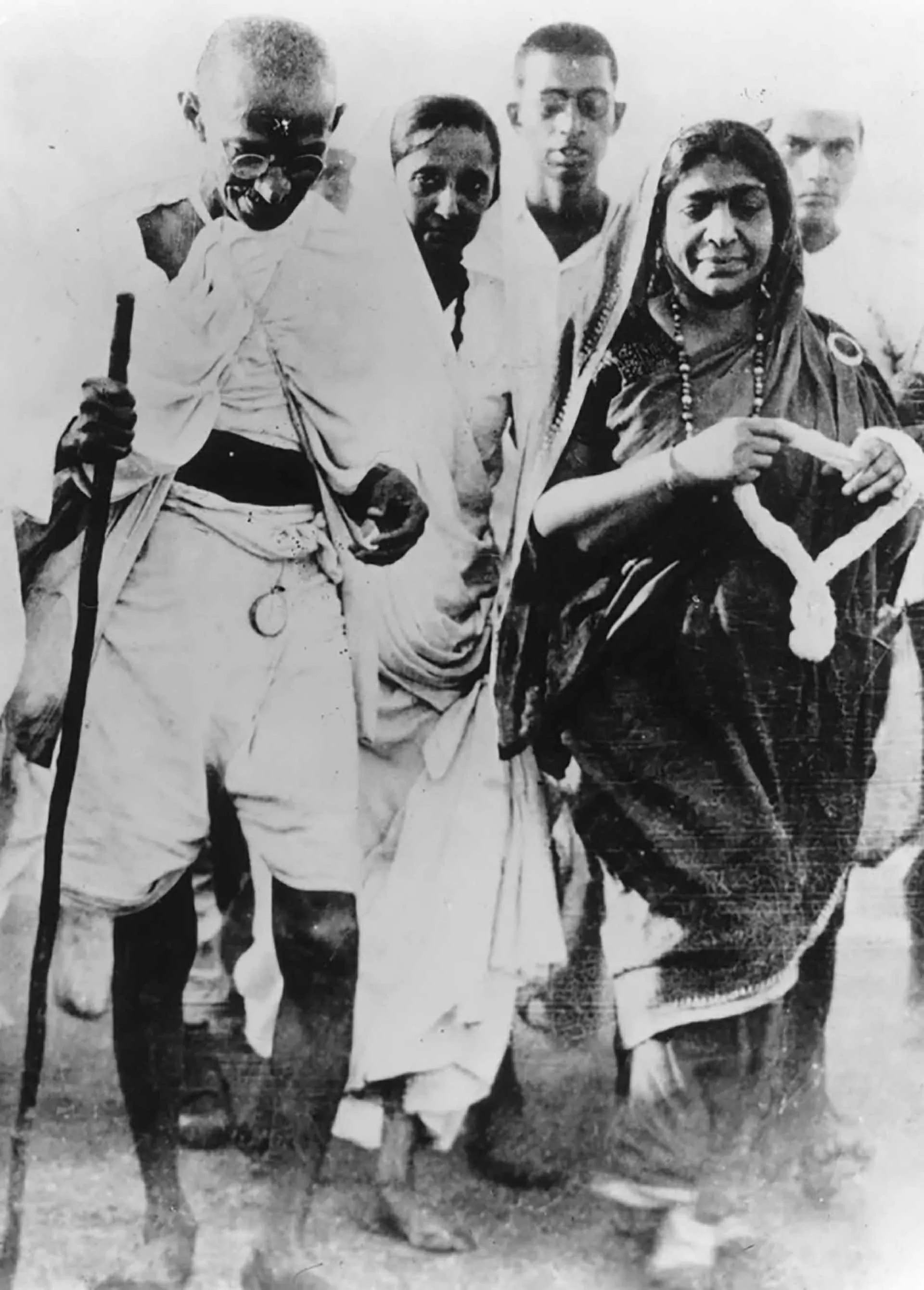 |
| Mahatma Gandhi (left) and Indian poet and political activist Sarojini Naidu during the Salt Voyage in Western India, March 1930. (Source: Getty Images) |
The Salt Voyage is a prime example of the philosophy of non-violence (Satyagraha) advocated by Mahatma Gandhi, one of the great leaders of the Indian independence movement. He believed that peaceful civil disobedience could bring about social and political change, becoming a powerful tool in the struggle against British colonial rule (1858-1947).
"Great Soul"
Mahatma Gandhi, whose real name was Mohandas Karamchand Gandhi, was born on October 2, 1869, in Porbandar, Gujarat, in western India. He came from a middle-class family with a tradition of respecting morality and the law. From a young age, Gandhi displayed perseverance, honesty, and compassion.
In 1888, he went to England to study law at the University of London. After returning, he practiced law. In 1893, Gandhi went to Natal (South Africa) to work, directly experiencing racial discrimination and injustice against the Indian community, which helped shape his later ideology of nonviolent struggle.
In 1915, Gandhi returned to India and quickly became one of the most influential leaders of the independence movement, transforming the Indian National Congress from a middle-class organization into a mass movement. He initiated and led numerous large-scale nonviolent campaigns that directly challenged British colonial rule, including the Salt March (March 12, 1930 - April 6, 1930) to protest the salt tax, attracting tens of thousands of participants.
He also played a central role in the Quit India Movement of 1942, calling for Britain to withdraw from India immediately. Gandhi's unwavering leadership, coupled with pressure from other resistance movements, forced Britain to grant independence to India on August 15, 1947. Mahatma Gandhi was assassinated on January 30, 1948, but his ideas and legacy live on, becoming an inspiration for freedom movements around the world .
In 1994, German theoretical physicist Albert Einstein (1879-1955) praised Gandhi, saying, "Future generations will rarely believe that such a man ever existed on Earth in flesh and blood," while the great Indian poet Rabindranath Tagore (1861-1941) called the leader of the Ganges River country "Mahatma" (Great Soul), showing his respect for his role in the independence and liberation movement.
The shocking march
In 1882, the British colonial government enacted the Salt Act to monopolize the production and distribution of salt in India, while also imposing high taxes, making it difficult for the poor to access this essential commodity. Indian journalist and scholar Abhay Charan Das (1844-1896) wrote about the injustice of the salt tax on laborers in his work *The Indian Ryot* (1881), stating: “Workers only have a fixed income of 35 rupees a year… They cannot afford more than half of what they need.” From the 19th century onwards, Indians protested against the salt tax.
In 1903, while in South Africa, Gandhi wrote an article about the salt tax in The Indian Opinion , the newspaper he founded, highlighting the injustice of the tax. He emphasized: “Salt is a necessity in our daily diet. It can be said that the increasing incidence of leprosy in India is due to a lack of salt.”
In 1909, in his book Hind Swaraj – a significant work outlining his views on self-governance and non-violence – Gandhi continued to call on the British government to abolish the salt tax.
On March 2, 1930, Mahatma Gandhi sent a letter to the British Viceroy of India, Lord Irwin (1881-1959), describing the devastation of the subcontinent under British rule and presenting an eleven-point list of demands. He warned of launching a civil disobedience movement if the British colonial government did not meet these demands. Faced with the silence of the colonial authorities, Mahatma Gandhi decided to launch a movement called the Salt Voyages to break free from the colonial rule.
The Salt Act.
In his book "99 Tactics of Successful Tax Resistance Campaigns" (2014), American researcher David M. Gross argues that while many Indians may not fully understand abstract political ideals, the issue of salt is very relatable and easy to grasp. According to Dennis Dalton, Professor Emeritus at Barnard College, Columbia University, abolishing the Salt Act would easily garner public support.
On March 12, 1930, at the age of 61, Mahatma Gandhi, along with 78 supporters, left the Sabarmati Ashram in Ahmedabad, Gujarat, to begin a 385-kilometer walk to the coastal village of Dandi. Mahatma Gandhi vowed not to return until the Salt Law was repealed. Throughout the 24-day journey, he held public talks, expounding on civil disobedience and urging people to join. The crowds grew larger, drawing in everyone from farmers to intellectuals, reaching over 50,000 by the time they reached Dandi.
Foreign journalists followed his journey closely. In January 1931, The Times honored Gandhi as “Person of the Year 1930,” while The New York Times reported on the Salt March daily. Mahatma Gandhi asserted: “I want the world’s sympathy in this battle against power… We act on behalf of the hungry, the naked, the unemployed.”
On April 6, 1930, Gandhi and his supporters retrieved a pinch of natural salt from the sea, a symbolic act of breaking the Salt Law. Indian poet and political activist Sarojini Naidu (1879-1949) hailed him as “The Man Who Discarded the Salt Law,” while American journalist Louis Fischer (1896-1970) described it in his book “Gandhi’s Struggle Life” as follows: “The act of picking up a pinch of salt to challenge powerful authority and become a criminal… requires the imagination, character, and performance spirit of a great artist. It appeals to everyone from the uneducated peasant to the discerning critic.”
The Salt March inspired millions across India to rise up and reclaim their right to produce salt, breaking the monopoly of the British colonial government, even though tens of thousands were arrested, including Mahatma Gandhi (May 4, 1930).
In his autobiography , *Toward Freedom* (1936), India's first Prime Minister, Jawaharlal Nehru (1889-1964), described the impact of the Salt March: “It was as if a spring had suddenly burst forth… Witnessing the surging enthusiasm of the people… We were amazed at the miraculous talent of a man who could inspire the masses and lead them to act in an organized manner.” American journalist Webb Miller (1891-1940) documented the non-violent resistance of the gentle, simple Indian people. According to the history website *History*, Miller's writings appeared in over 1,350 newspapers worldwide, sparking strong international opposition to the British colonial rule in India.
On March 5, 1931, under pressure from nonviolent resistance movements and international public opinion, the British colonial government and Mahatma Gandhi signed the Gandhi-Irwin Treaty, which demanded the government release political prisoners, return confiscated land, and recognize the salt-making rights of coastal residents. In return, Mahatma Gandhi ended his civil disobedience movement and participated in the Round Table conference.
Although it did not bring about major political changes, the roundtable conference was one of the important outcomes of the Salt March, as the British government was forced to invite Indian representatives to the negotiating table. Deputy King Lord Irwin admitted: “We failed to contain this movement. If the British government had not convened the roundtable conference, I would have resigned.”
The echoes of history
Mahatma Gandhi's spirit of non-violence and the Salt March left a profound mark on many protest movements around the world.
The 1964 Nobel Peace Prize winner, American civil rights activist Martin Luther King Jr. (1929-1968), applied this philosophy to the civil rights movement in the United States, particularly in the 1950s and 1960s, with notable campaigns such as the Montgomery bus boycott (1955-1956) and the Selma-Mongol march (1965). The South African anti-apartheid activist Nelson Mandela (1918-2013), the 1993 Nobel Peace Prize winner, also applied Gandhi's philosophy of non-violence in his struggle against apartheid in South Africa, contributing to the end of racial segregation and becoming the first black president of South Africa (1994-1999)...
Today, Gandhi's philosophy of non-violence continues to inspire many modern movements. Pakistani women's education activist Malala Yousafzai, winner of the 2014 Nobel Peace Prize, has applied this spirit of peaceful struggle to protect the right to education for girls in Pakistan and around the world.
The Salt March is one of the most iconic events of the Indian independence movement, and it has inspired resistance movements around the world. This event demonstrates that when the masses are organized and led, they can challenge even the most powerful empires, as Mahatma Gandhi himself affirmed: "The greatest strength of a people lies not in their weapons, but in their spirit of non-violence and unity."
Source: https://baoquocte.vn/tu-hanh-trinh-muoi-den-tu-do-khi-on-hoa-la-ngon-lua-suc-manh-307551.html




























































































Comment (0)