

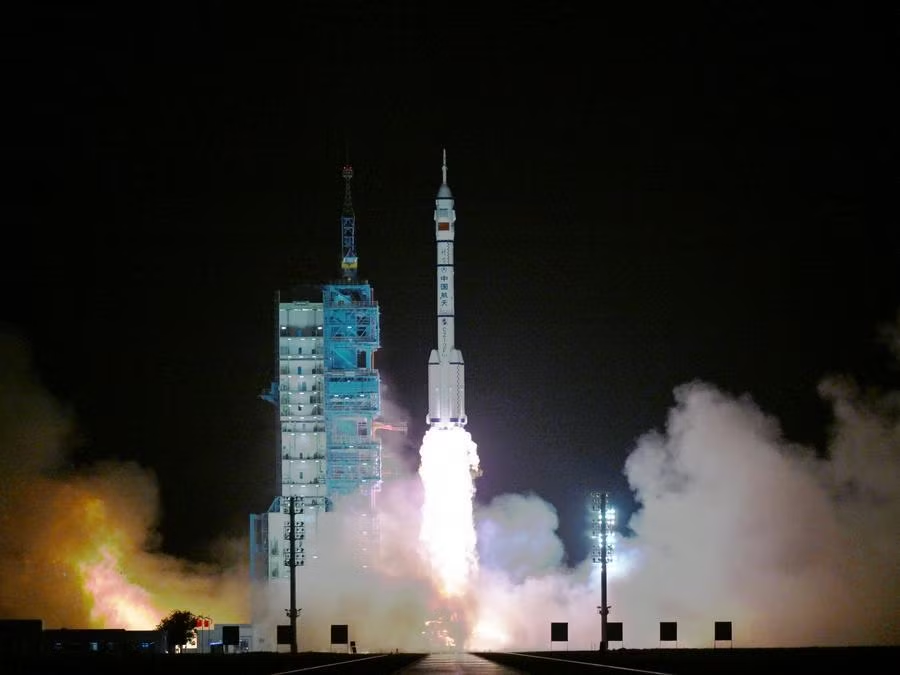
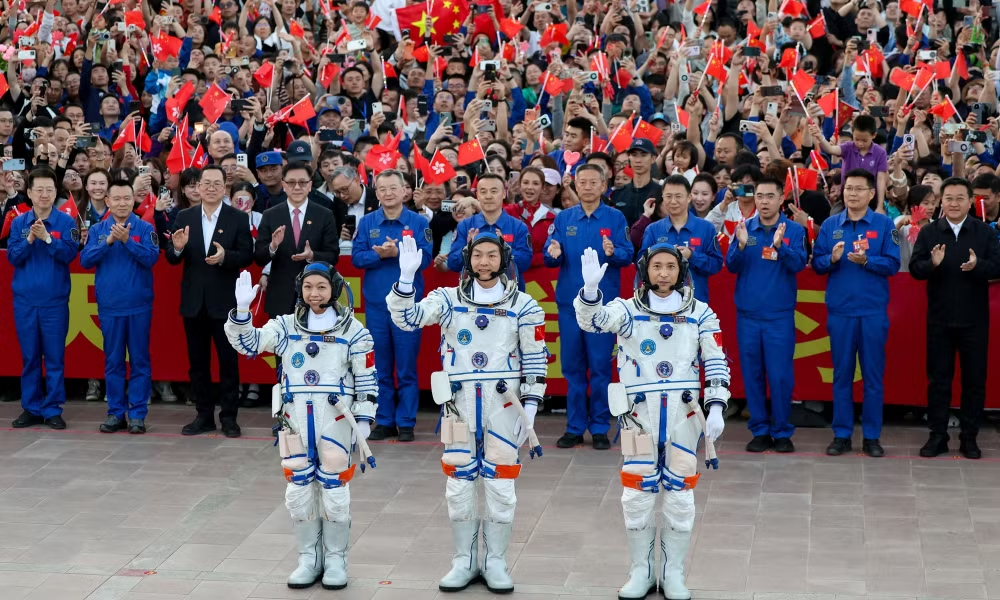
The launch took place at 11:08 PM on May 24th from the Jiuquan Satellite Launch Center in Northwest China. The Shenzhou-23 spacecraft was launched into space by a Long March-2F Y23 rocket, carrying three astronauts: commander Zhu Yangzhu, pilot Zhang Yuanzhi, and payload specialist Li Jiaying.
Among them, Li Jia Ying – a former Hong Kong police inspector – became the first astronaut from the special administrative region to participate in a Chinese space mission. The other two members are from the People's Liberation Army (PLA) astronaut force.
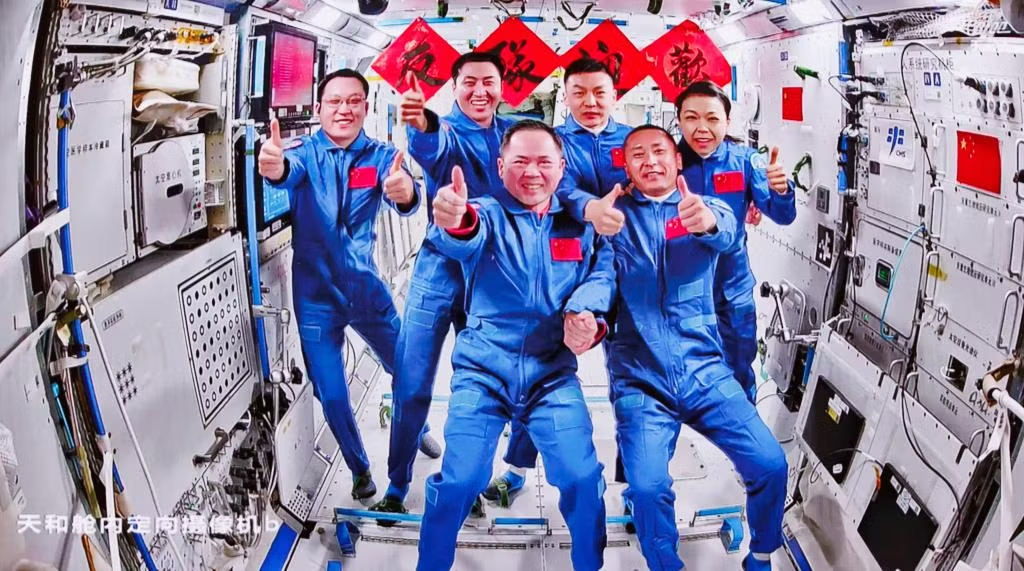
On the morning of May 25th, three astronauts entered the Tiangong space station and met with another group of three astronauts.
According to the China Manned Space Administration (CMSA), the Shenzhou-21 crew aboard the Tiangong space station opened the capsule at 5:13 a.m. on May 25 (Beijing time) and welcomed the new astronauts.
The two crews then posed for a commemorative photo, marking the eighth space encounter in the history of Chinese aerospace.
The mission lasted a record amount of time.
According to CMSA, one of the three astronauts will remain on the Tiangong space station for a year to conduct research on human physiology in a long-term space environment. The identity of the person undertaking this special task will be decided later, depending on the progress and requirements of the mission.
If completed, this would be the longest space flight in Chinese history, although still shorter than the world record of 14 and a half months set by a Russian cosmonaut in 1995.
Scientists believe that an extended stay on the Moon is particularly important to China's plan to send humans to the Moon before 2030. Researchers will monitor the effects of cosmic radiation, bone density loss, biomechanical changes, and psychological stress on astronauts under prolonged isolation.
Furthermore, the Shenzhou-23 mission also performed an automated approach and rapid docking procedure with the core module of the Tiangong space station. This is considered a crucial test in preparation for the lunar orbital docking technique between the Mengzhou spacecraft and the Yuelan lander in China's future lunar landing program.
The Moon Race Between China and the United States
The Shenzhou-23 launch took place amidst increasingly fierce space competition between China and the United States, particularly regarding the goal of returning humans to the Moon.
NASA is currently aiming to launch a crewed lunar landing mission in 2028 through its Artemis program, two years ahead of China's plan. Washington also hopes to establish a long-term presence on the Moon as a springboard for future Mars exploration missions.
Last April, four NASA astronauts made a historic flight around the Moon as part of the Artemis II mission – the first crewed flight to the Moon in over half a century.
Meanwhile, on May 23, billionaire Elon Musk and SpaceX successfully conducted a major unmanned test flight of the next-generation Starship rocket. This vehicle is expected to play a leading role in future US lunar missions.
The U.S. has repeatedly accused China of intending to " militarize ," exploit resources, and establish control over the Moon. Beijing strongly rejects these accusations, asserting that its space program serves peaceful purposes and scientific research.
Ambition to build a permanent base on the Moon
Although it has never sent humans to the Moon, China has made significant strides in the aerospace field in recent years.
Since 2021, Shenzhou missions have consistently sent groups of three astronauts to the Tiangong space station for a stay of approximately six months. Beijing is also training two Pakistani astronauts, one of whom may participate in a mission to Tiangong this year.
In 2024, China became the first country in the world to send a robot to collect samples from the far side of the Moon and successfully bring them back to Earth. This achievement is considered a major milestone in the country's space exploration program.
Beijing aims to build a permanent research base on the Moon by 2035 in cooperation with Russia. According to Wu Weiren, chief scientist of China's lunar program, the current timeline is set cautiously, suggesting that China could achieve faster progress than expected if tests are successful.
Over the past year, China has conducted a series of safety tests on key components for its lunar landing mission, including the Long March-10 super-heavy rocket, the Mengzhou spacecraft, and the Yuelan lander.
However, experts believe China still faces many significant challenges. With less than four years to achieve its 2030 goal, the country needs to perfect a range of entirely new technologies, from control software systems to equipment for landing and survival on the lunar surface.
Chinese astronauts, accustomed to operating in the relatively safe low Earth orbit environment of the Tiangong space station, will have to adapt to much harsher conditions on the Moon, including high radiation, weak gravity, and significantly greater technical risks.
The biological research is attracting attention.
In addition to technical objectives, China is also promoting a range of space biology research that has attracted international attention.
Chinese state media reported that Beijing is conducting the world's first "artificial embryo" experiment in space. A sample of human stem cells was transferred to the Tiangong space station this month via the Shenzhou-22 crew.
The experiment aims to study the feasibility of long-term human habitation, survival, and reproduction in space – a factor considered fundamental if humanity wants to establish a permanent base on the Moon or undertake long-duration flights to Mars.
Previously, the Shenzhou-22 mission had to end earlier than planned after the Shenzhou-20 spacecraft was damaged by space debris in orbit. This incident highlights the growing risks to space operations as the density of satellites and space debris continues to increase.
Nevertheless, the successful launch of Shenzhou-23 further solidifies China's increasingly prominent position in the global space race. With ambitions to send humans to the Moon before 2030 and build a permanent base by 2035, Beijing is gradually asserting its role as an emerging space power, directly competing with the United States in this most crucial strategic technology of the 21st century.
Source: https://cand.vn/trung-quoc-tang-toc-tren-duong-dua-toi-mat-trang-post811873.html

![[Image] Close-up view of the interchange connecting the two expressways and Long Thanh Airport.](https://vphoto.vietnam.vn/thumb/1200x675/vietnam/resource/IMAGE/2026/05/25/1779703378210_ndo_br_z7863716673926-224453a31600126cce10622af6290afd-4549-jpg.webp)
![[Image] Hanoi's urban life under the challenge of a "scorching hot" environment](https://vphoto.vietnam.vn/thumb/1200x675/vietnam/resource/IMAGE/2026/05/25/1779706979265_nang-nong-t5-2026-minh-duy-7-4636-jpg.webp)




















































































Comment (0)