


Each ancient house in Hoi An is not simply a collection of lifeless wooden blocks and bricks, but a story, a living memory representing hundreds of years of ups and downs of the once bustling trading port. Preserving the moss-covered tiled roofs, the weathered wooden frames, and the time-worn columns of the verandas is about preserving the soul of the town, its unique cultural identity, and the pride of generations of its people.
Concerns
The core area of Hoi An in Zone 1 has a total of 1,130 architectural and artistic relics. Among the types of relics, privately owned houses account for the largest number, with 930 relics, followed by community-owned relics with 13 relics and state-owned relics with 187 relics.
With each passing rainy season, residents living in the ancient houses of Hoi An endure days of anxiety. Even the most sturdy wooden structures cannot withstand high humidity, deep flooding, and termite infestations.
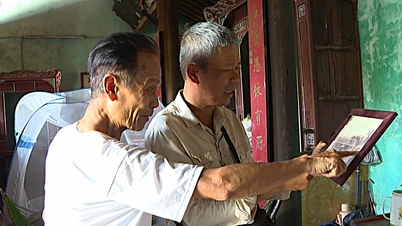
Located at 23 Tieu La Street, Minh An Ward, the old house of Mr. Duong Thanh Cuong's family is one of the historical sites currently in danger of collapse.
Every year, the Hoi An Cultural Heritage Conservation Management Center has to carry out inspections and implement temporary reinforcement measures to prevent the house from collapsing. However, these reinforcement measures are only temporary solutions.
The major flood of 2025 caused Mr. Cuong's house to tilt 10-15cm to the north, the yin-yang roof tiles to shift, and the wooden frame to move.
Mr. Cuong shared: “Every year the government inspects and reinforces the house. The family wants to renovate the house properly, but the cost is too high; besides, repairs must preserve the original condition, unlike conventional construction. These two issues are major difficulties.”
Not far from there, at 68 Tran Phu Street, the nearly 200-year-old house of the Ngo Thi Gan sisters is also facing a similar situation.


"We just hope the government will support the restoration of the house so that it can be sturdy and safe. The house is located right on Tran Phu street, often visited by tourists, and seeing it in this state of disrepair is a pity for such an old house," said Mrs. Gan.
Mr. Cuong and Mrs. Gan's house is just one of more than 30 ancient houses in Hoi An on the list of those urgently needing restoration investment. Although the Da Nang city government always has supportive policies, in reality, restoration work still faces many obstacles.
Shared responsibility
Restoring a historical monument requires significantly more capital than constructing a typical civil building. The materials used must meet specific standards to ensure the monument retains its original state.
Furthermore, many old houses are privately or collectively owned for generations; over time, descendants leave the area or divide the property, leading to a situation where a single house has multiple co-owners. When it comes to signing documents for restoration permits or contributing funds, the inability to reach a consensus among members causes the application process to be stalled for extended periods.
Furthermore, the approval process for restoration projects of national monuments and world heritage sites is extremely rigorous and involves multiple levels of assessment. Without close guidance, citizens can easily become discouraged by the complex administrative procedures.
Mr. Phan Van Quang, Deputy Director of the Hoi An Cultural Heritage Conservation Management Center, said that in recent years, extreme weather conditions have caused continuous storms and heavy rains, in addition to the pressure from the increasing density of tourists, which has accelerated the degradation process of the historical sites.
To address this comprehensively, we cannot rely solely on resources. Restoration and preservation are not just the responsibility of the government; they also require the collaboration and cooperation of the community and the owners of the historical sites themselves.


The government needs to be more flexible in providing financial support, simplify procedures for cases involving critically damaged old houses, and offer safe temporary housing solutions for residents during the repair process.
Conversely, the people, as the owners of the heritage, also need to raise awareness and cooperate closely with specialized agencies to protect the original architecture of the house.
According to Mr. Ha Vy, Deputy Director of the Department of Culture, Sports and Tourism of Da Nang city, Da Nang currently possesses a very large system of cultural heritage sites; at the national level alone, there are 84 relics. In recent years, the city government has paid great attention to the restoration and renovation of these relics.
However, under various influences such as natural disasters and development pressures, the restoration and preservation of historical sites presents a huge challenge. The Department of Culture, Sports and Tourism is finalizing a unified and effective mechanism for leveraging resources, including cultural target programs. Only then can preservation and promotion be truly effective.
Source: https://baodanang.vn/kho-voi-di-tich-tu-nhan-3339372.html





















































![[Video] Sunset at Lap An Lagoon – Where the sun sets over the fishing nets](https://vphoto.vietnam.vn/thumb/1200x675/vietnam/resource/IMAGE/2026/05/31/1780192137701_beach-landscape-sea-water-nature-grass-745871-pxhere-com.jpeg)




































Comment (0)