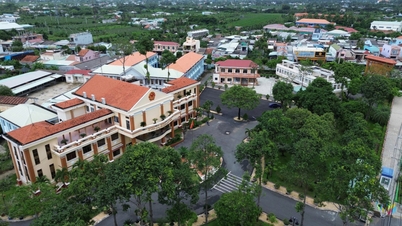
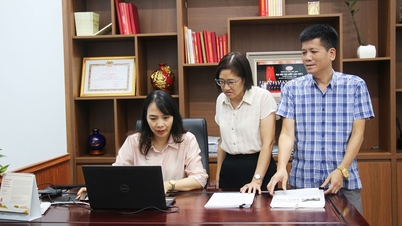
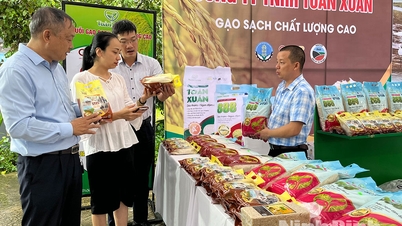
In Nhan Thang today, everyone can clearly feel the changes. The village roads have been widened and adorned with colorful flowers along the roadside, making the rural landscape even cleaner and more beautiful. Nhan Thang commune was established on the basis of merging three communes and towns of the former Gia Binh district. Before the merger, 2 out of 3 communes and towns had completed the new rural development programs (Binh Duong achieved advanced new rural commune status in 2024; Nhan Thang achieved advanced new rural commune status in 2021; Thai Bao commune has a roadmap to strive for advanced new rural commune status).
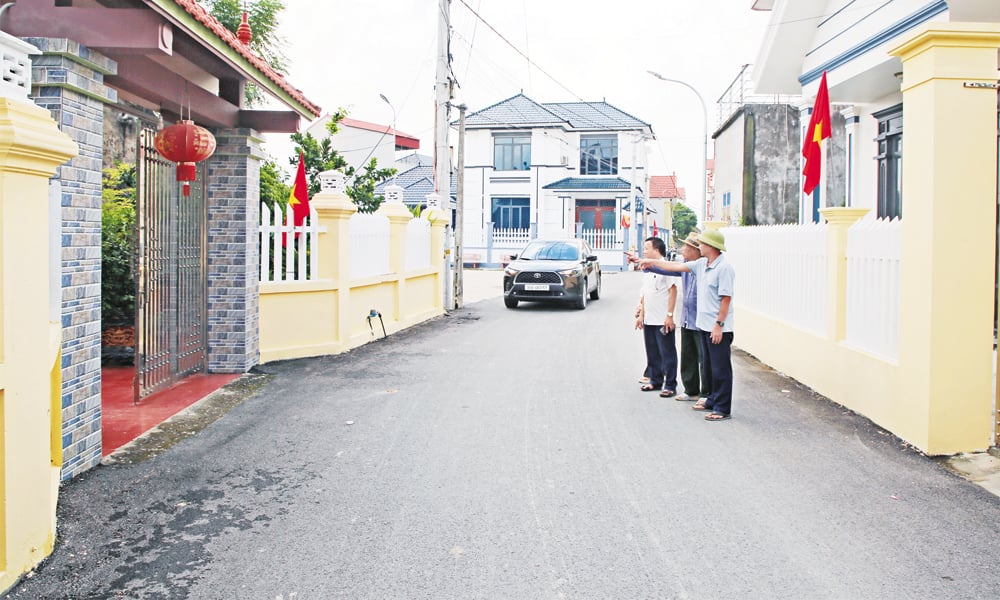 |
The family of Mr. Nguyen Ba Que, from Ngo Cuong village, voluntarily donated land to expand the village road. |
One of the factors that helped Nhan Thang achieve the criteria for building new rural areas is the movement of donating land for road construction, making the roads in the area longer and wider. Immediately after the local authorities decided to expand village roads to meet transportation criteria, Mr. Nguyen Ba Que was the first in Ngo Cuong village to readily demolish his fence and narrow his yard to donate land. Mr. Que said: “When village officials came to promote and encourage us, my family moved more than 25 meters of our fence and gate, handing over the land to the construction unit. The widened road not only helps people travel more conveniently, but my family also benefits.” Mr. Que also actively worked with village officials, the Fatherland Front Committee, and local organizations to encourage people to participate in donating land. In a short period of time, 45 households on both sides of the road voluntarily donated nearly 600 square meters of residential land to complete the main road of Ngo Cuong village, expanding it from 3.5 meters to 5 meters, with some sections reaching 7 meters.


In other villages such as Cau Dao, Huong Trien, Cam Xa, etc., many inter-village roads have also been simultaneously widened. Those households that did not have to donate land have voluntarily contributed labor and money to help rebuild fences for families whose properties were demolished. According to Mr. Nguyen Kim Huyen, Head of the Economic Department of Nhan Thang commune, the movement of donating land for road construction and new rural development has spread widely throughout the villages and hamlets. The voluntary land donations by residents without demanding compensation have created a significant resource for the local area to develop its rural transportation network. After three years of implementation, the entire commune now has 765 households participating in land donation with a total area of nearly 9,900 square meters. Currently, 100% of the main village roads have been renovated with a road width of 5 meters or more; 100% of village and inter-village roads and alleyways have been concreted according to their current condition. The intersections between the commune's main road and Provincial Road 285 and National Highway 17 are all equipped with traffic lights, ensuring safety for vehicles.
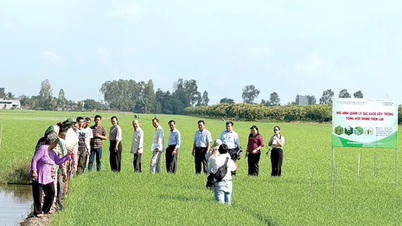
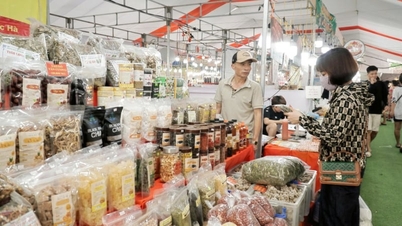
Along with focusing on transportation infrastructure, Nhan Thang commune also prioritizes solutions to improve income. The entire commune has converted 45.3 hectares of rice paddy land to fruit and vegetable cultivation, developing specialized agricultural models and high-tech agricultural applications; establishing several models of clean and safe agricultural production with stable markets, initially yielding high economic efficiency. Taking advantage of National Highway 17 running through the area, Nhan Thang commune encourages the development of trade and service industries. Supermarkets and convenience stores have been established from the commune center to the villages. Many markets, such as Ngu, Tay, and Bung, continue to be renovated and improved, effectively meeting the needs of goods circulation and serving the lives of the people. The commune has 1,270 households engaged in service businesses; 3 supermarkets and more than 20 convenience stores. The average per capita income in the commune reaches over 70 million VND/person/year. The poverty rate will decrease to 0.68% in 2024, and by June 2025, there will be no more poor households in the commune according to the central government's criteria.
From a purely agricultural area, Nhan Thang has transformed into a "livable rural area". The commune strives to achieve an average per capita income of 100 million VND/year by 2030. With the efforts of the entire political system and the spirit of unity of the Party Committee and the people here, Nhan Thang is continuing to strive to become a ward by 2030.



Source: https://baobacninhtv.vn/khoi-day-noi-luc-o-nhan-thang-postid427669.bbg