

Da Nang – After many years working as a nurse at the Dermatology Hospital, Mr. Tran Van Dung quit his job and returned to his hometown to raise black snails, generating billions of dong in revenue each quarter.
Early in the morning of the first day of August, 38-year-old Dung rode his motorbike more than 4 km from his home in Hoa Phu commune to his snail farm in Hoa Khuong commune, Hoa Vang district. Because he rented land next to rice fields, he had to follow a winding dirt road to reach the three ponds covering more than 5,000 square meters.
The sun-tanned man strolled around the pond, occasionally picking up a few snails clinging to the roots of the water lilies to check for intestinal disease. "If the snails are sick, they must be dealt with immediately to prevent them from affecting the others," he explained.
Pointing to a pond full of duckweed, he explained that he had released 180,000 snail hatchlings, feeding them 50 kg of vegetables and fruits daily. After more than three months, the snails mature and are ready for sale. If snails are scarce in other ponds, traders will buy the entire pond, then drain the water and harvest the snails. If the supply is abundant, they will choose feeding time to select and buy the larger snails first.
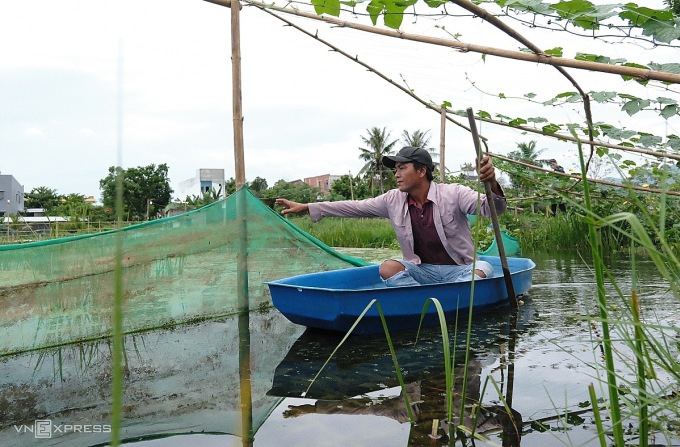
Mr. Tran Van Dung rows a boat to inspect his organic black snail farm in Hoa Khuong commune. Photo: Nguyen Dong
Dung graduated from the College of Medicine and Pharmacy (now Da Nang University of Medical Technology), and then worked as a nurse at the Da Nang Dermatology Hospital. Coming from a farming family, he wondered why the golden apple snail, an increasingly invasive species, was becoming less common while the black apple snail, a popular freshwater snail in Vietnam known for its sweet, crunchy meat, was dwindling. "Why not raise black apple snails?" he asked himself, and began researching the topic.
In 2019, Dung chose a different path – quitting his job in the medical field to return to his hometown and raise black snails. "I found the nursing profession stressful and the income not high, so I decided to return home to raise snails to have more time for my family and contribute to creating a source of clean food," Dung explained.
With the support of his wife, who also works in the medical field, and his parents, Dung borrowed capital, learned more about snail farming techniques from some snail farmers in Hoa Tien commune, and started raising snails in ponds lined with tarpaulin. He earned tens of millions of dong in profit from the first harvest, but later suffered a bitter defeat because "I was too greedy and stocked the ponds too densely, causing mass deaths." After that failure, he decided to raise snails in natural earthen ponds.
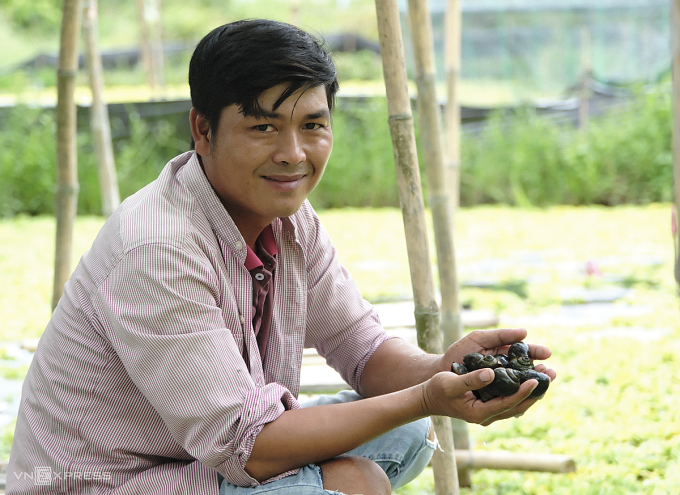
Mr. Dung with a batch of mature snails, waiting to be sold. Photo: Nguyen Dong
He rented three ponds and established a new ecosystem. The pond bottoms were dredged, minerals were added, lime was spread, and they were left to dry for five days. Then he filled the ponds with water and treated the middle layer by cultivating algae to help filter the water and provide a food source for snails. On the surface layer, he planted duckweed and water lilies, and built a trellis for gourds to provide shade.
The snails' food consists of various types of aquatic plants, vegetables, roots, and fruits. Every day, Mr. Dung walks around the three ponds to check on them and feed the snails. He didn't build a house on the ponds next to the fields, but instead installed cameras to monitor everything at all times.
According to Mr. Dung, the most difficult aspect of raising black snails is stabilizing the ecosystem for their growth, with the biggest concern being when heavy rains cause the pH level to exceed a certain threshold, leading to snail deaths. After the historic rainfall in October 2022 in Da Nang, the floodwaters overflowed the ponds, causing two-thirds of the snails to escape, while the rest gradually died due to the sudden change in their living environment.
After collecting the discarded snail shells, Mr. Dung started raising them again from scratch, gradually accumulating experience such as: the stocking density should not exceed 50-70 snails/m2, and the water source must always be stable and not polluted. Because he utilizes water from irrigation canals flowing from Dong Xanh and Dong Nghe lakes, he has to carefully prevent water from entering the lakes when farmers spray pesticides on their rice crops.
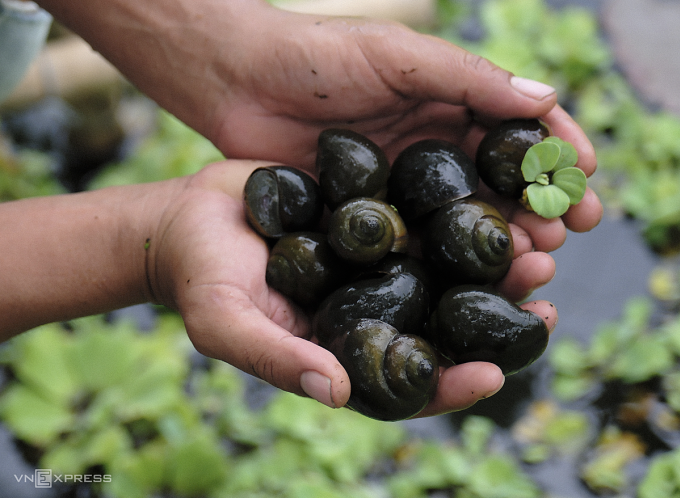
Adult black snails, approximately 30 snails per kilogram, sell for 80,000-90,000 VND per kilogram. Photo: Nguyen Dong
Over the past 10 months, Mr. Dung's snail farms have been stable, selling an average of tens of tons of snails every three months at a price of 80,000-90,000 VND/kg, generating billions of VND in revenue. He also sells snail eggs and breeding stock to other farms. He reinvests the profits back into his farms, planning to expand to one hectare.
"I'm planning to make products from snails like snail patties and smoked snails, which will sell well and provide a stable income," said Dung. Although raising snails often requires him to be out in the sun and get his hands dirty, it's less stressful than his time as a nurse and gives him more time to care for his four children when his wife is on night duty at the hospital.
Along with Mr. Dung, the black snail farming model is developing in Hoa Vang district with farms in Hoa Tien, Hoa Phong, and Hoa Khuong communes, providing an additional food source for eateries and restaurants in the tourist city.
Source link

![[Image] National Assembly discusses the implementation of the socio-economic development plan.](https://vphoto.vietnam.vn/thumb/1200x675/vietnam/resource/IMAGE/2026/04/20/1776696707422_ndo_br_img-20260420-185419-jpg.webp)
![[Photo] General Secretary and President To Lam meets with National Assembly delegates from ethnic minorities.](https://vphoto.vietnam.vn/thumb/1200x675/vietnam/resource/IMAGE/2026/04/20/1776696701056_a1-bnd-8331-3342-jpg.webp)


























































































Comment (0)