

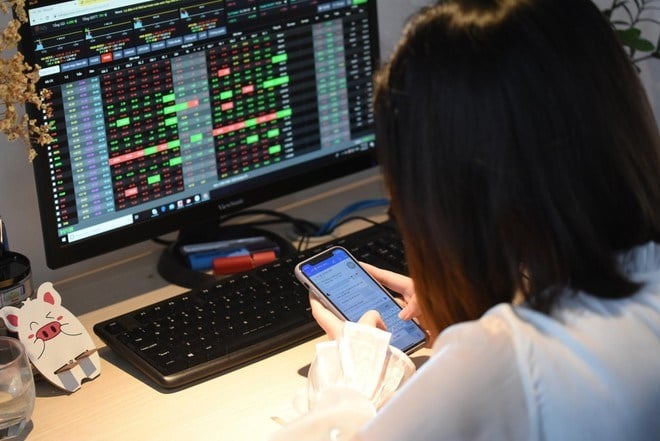
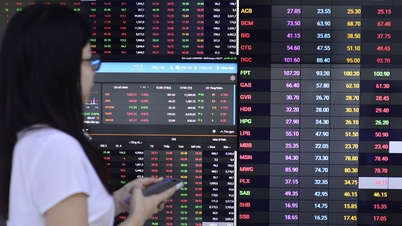
Closing out the final trading week of 2023, after a series of eight consecutive weeks of strong net selling, foreign capital returned to the market with net buying exceeding 300 billion VND.
However, looking at the whole year, the negative aspect of the stock market may stem from foreign investors, who intensified their capital withdrawals towards the end of the year.
According to statistics from the Ho Chi Minh City Stock Exchange (HOSE), in the 12 months of 2023, foreign investors sold a net of over 985.8 million shares, equivalent to a net withdrawal of VND 24,830.9 billion (approximately USD 1 billion). Prior to that, in 2022, foreign investors had made net purchases of VND 26,674 billion on the HOSE.
Specifically, foreign investors only had two months of net buying: January 2023 with a net purchase of VND 3,797 billion and March 2023 with a net purchase of VND 2,759 billion.
Conversely, foreign investors intensified net selling in the second half of 2023, peaking in December with net selling of VND 9,969 billion on the HOSE exchange, with strong net selling momentum in the last five months of 2023.
Observations show that in late 2022 - early 2023, foreign investors significantly increased their disbursements as the market underwent a deep correction from the 1,200-point level down to below 900 points.
The continuous net selling in the third and fourth quarters is believed to stem from typical short-term profit-taking on previously opened positions. In addition, foreign investors' net selling also comes from concerns about domestic risks such as pressure to repay bonds and declining corporate profits.
Amidst ongoing global macroeconomic uncertainties such as concerns about a global economic recession and escalating geopolitical tensions, foreign capital may continue to withdraw from risky asset classes and seek safer investment channels such as US government bonds and gold.
The continuous net selling by foreign investors will undoubtedly have a negative impact on the sentiment of individual investors in particular and the stock market in general.
In fact, the net outflow of foreign investment is not unique to Vietnam but is also happening similarly in other countries in the region.
In particular, the net outflow pressure from Southeast Asia is occurring as interest rates in developed countries, especially the US, have remained high for a longer period, leading to a tendency for capital to flow back to developed countries and out of frontier and emerging economies.
According to Dr. Nguyen Duy Phuong, Investment Director of DG Capital, net selling has been a familiar story for foreign investors throughout this year.
Even in November, when the market was performing very well, foreign investors were net sellers of over 3,500 billion VND. Therefore, we can see that while foreign capital inflows do have an impact, there's no need to be overly concerned about them potentially causing a market reversal.
Foreign investors are also market participants, and their actions are influenced by many factors. For example, at the end of last year, 2022, when the VN-Index fell sharply, foreign investors bought heavily. This year, when the market is basically in a recovery trend, foreign investors are selling.
The fact that cash flow has been able to absorb the net selling pressure from foreign investors in recent times shows that investor sentiment has become more stable and is not as heavily dependent on the actions of foreign investors as in the past.
Dr. Nguyen Duy Phuong - Investment Director of DG Capital - predicted: In terms of trends, foreign investors may soon return to net buying at the beginning of January 2024 after they complete their portfolio restructuring, and the principle is not to maintain a high proportion of cash in the portfolio for an extended period.
Source
![[Photo] Prime Minister Pham Minh Chinh presides over a meeting on private sector economic development.](/_next/image?url=https%3A%2F%2Fvphoto.vietnam.vn%2Fthumb%2F1200x675%2Fvietnam%2Fresource%2FIMAGE%2F2025%2F12%2F20%2F1766237501876_thiet-ke-chua-co-ten-40-png.webp&w=3840&q=75)

![[Photo] Prime Minister Pham Minh Chinh presides over the conference announcing the establishment of the International Finance Centre in Vietnam.](/_next/image?url=https%3A%2F%2Fvphoto.vietnam.vn%2Fthumb%2F1200x675%2Fvietnam%2Fresource%2FIMAGE%2F2025%2F12%2F21%2F1766309817714_ndo_br_dsc-3400-jpg.webp&w=3840&q=75)














































































Comment (0)