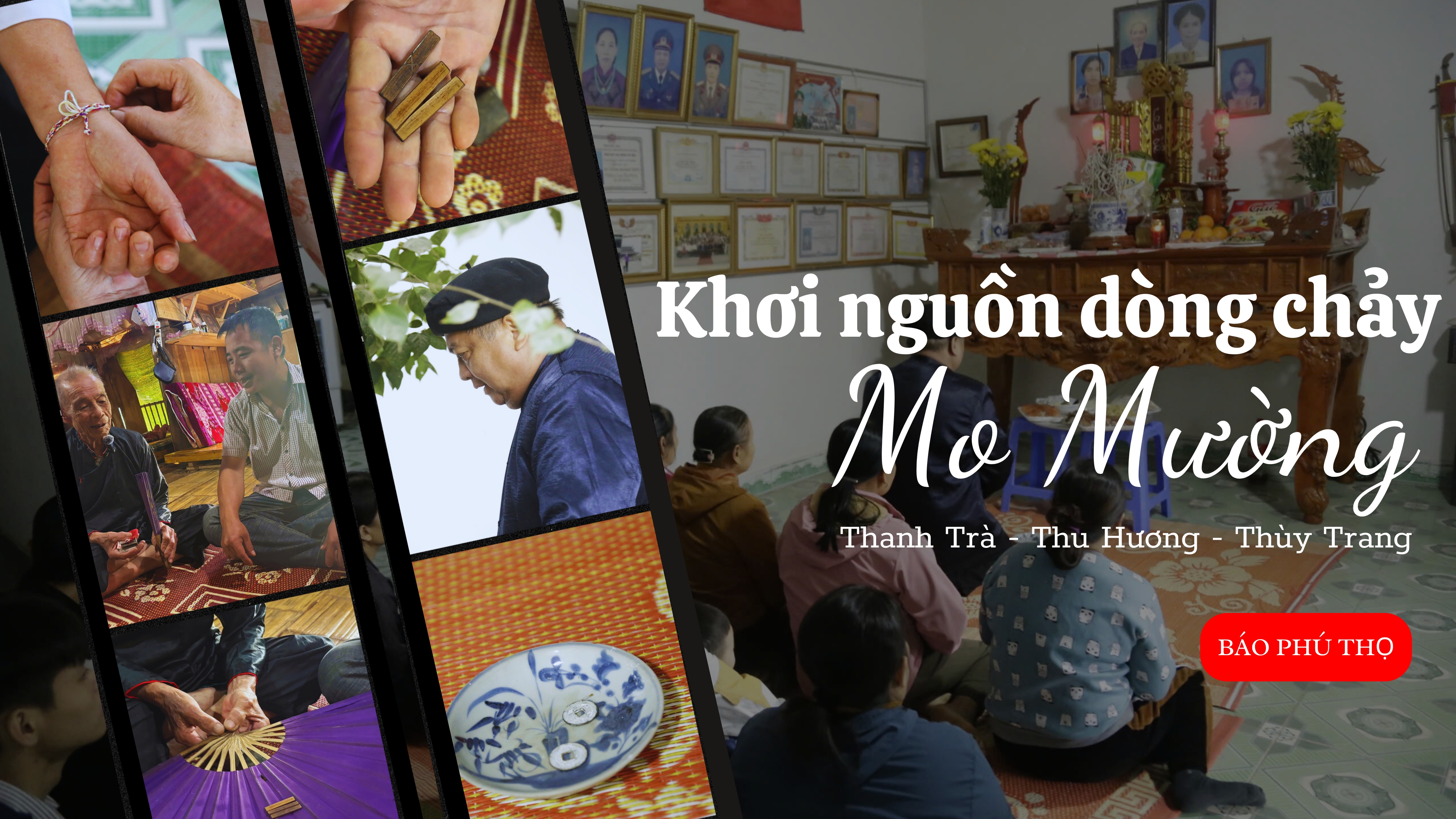
Editor's Note: Mo is one of the unique spiritual and cultural values, holding a central position in the spiritual life of the Muong people, encompassing cultural, historical, religious, and artistic values, reflecting the worldview and philosophy of life of the Muong people. In 2020, Muong Mo was selected as a heritage requiring the preparation of a national dossier to be submitted to UNESCO for inscription on the list of intangible cultural heritage in need of urgent safeguarding, and Phu Tho was one of the seven provinces participating in the dossier preparation. Keeping the flame alive and passing on the flame of the Mo heritage – something seemingly easy – is currently a crucial issue that needs to be addressed within the Muong community in Phu Tho.
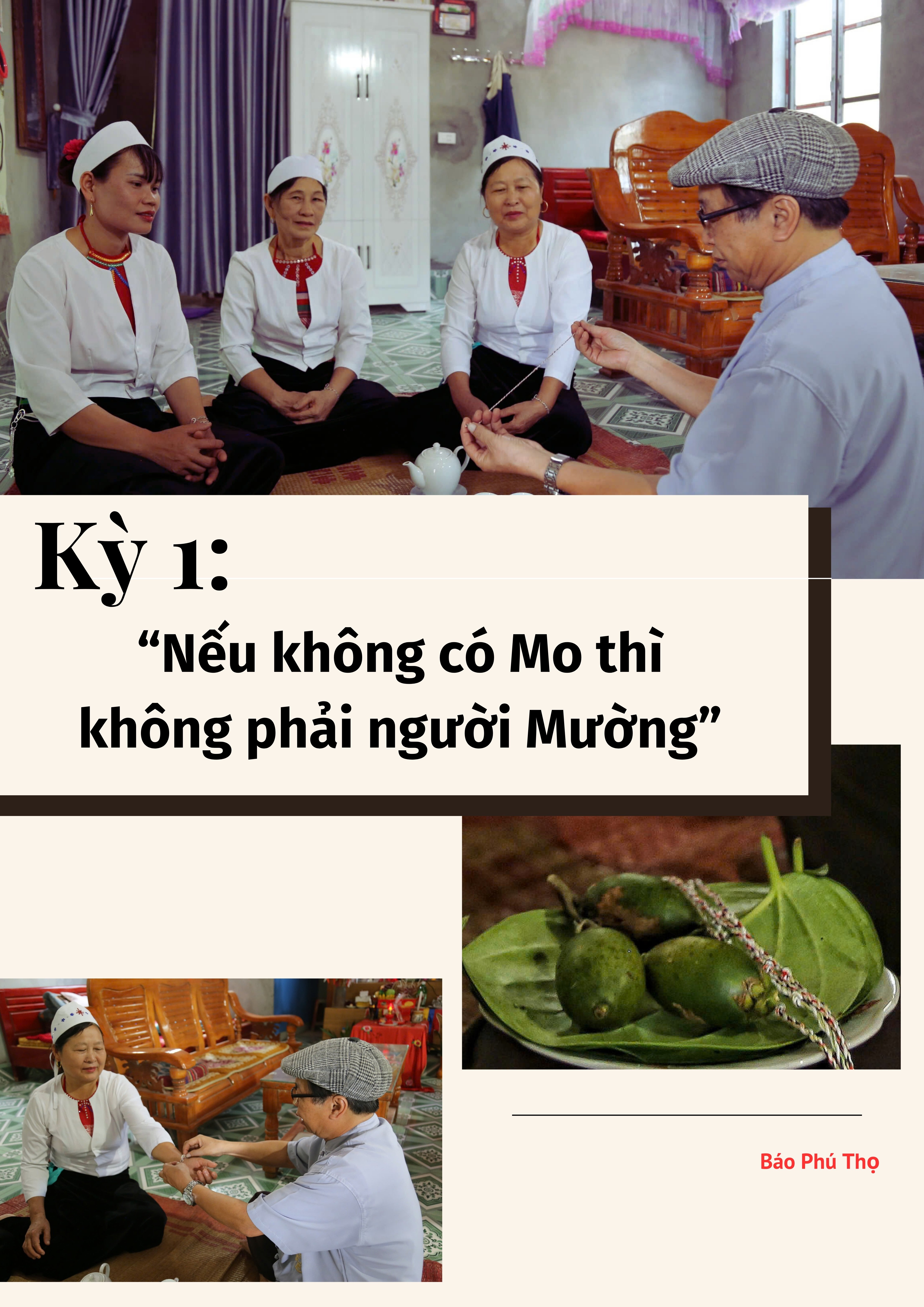
"Without the Mo ritual, one is not a true Muong person" - This is the firm assertion of the Muong people we met during our visit to Muong lands in the province. Having endured the ravages of time, the process of "purifying the impure and preserving the pure" to survive, along with the unique characteristics of Muong Mo and the stories of those Mo masters who have dedicated more than half their lives to their role as "inheritors," hoping to preserve and spread Muong Mo so that it endures through time, we understand the value of Muong Mo even more.
Mr. Mo is "legitimate and justifiable".
In the final days of the year, shaman Ha Van Rach, from Chieng area, Thu Cuc commune, Tan Son district, is always busy carrying his "bag" to perform rituals. As soon as he finishes a shamanic ceremony at one house, another is already waiting to take him. At the end of the year, people are moving into new homes, getting married, or reaching a certain age to pray for longevity... all these events require the shaman. Inheriting his father's profession at the age of 18, he initially assisted with the "cigarette-smoking" ritual, learning from the smallest steps and the simplest shamanic ceremonies. Only after turning 20 and mastering the various shamanic chants did Mr. Rach officially receive the ordination to become a shaman.
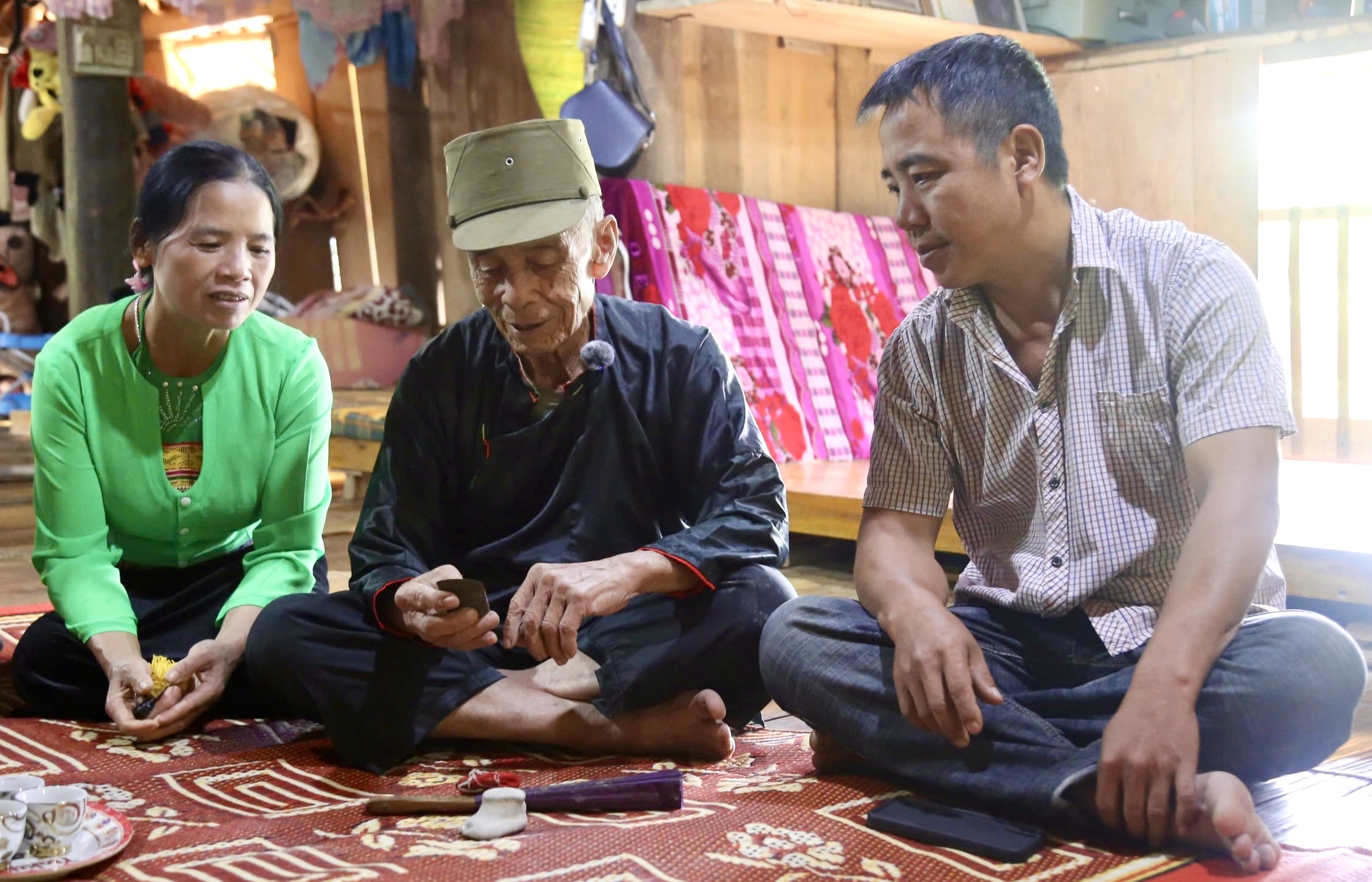
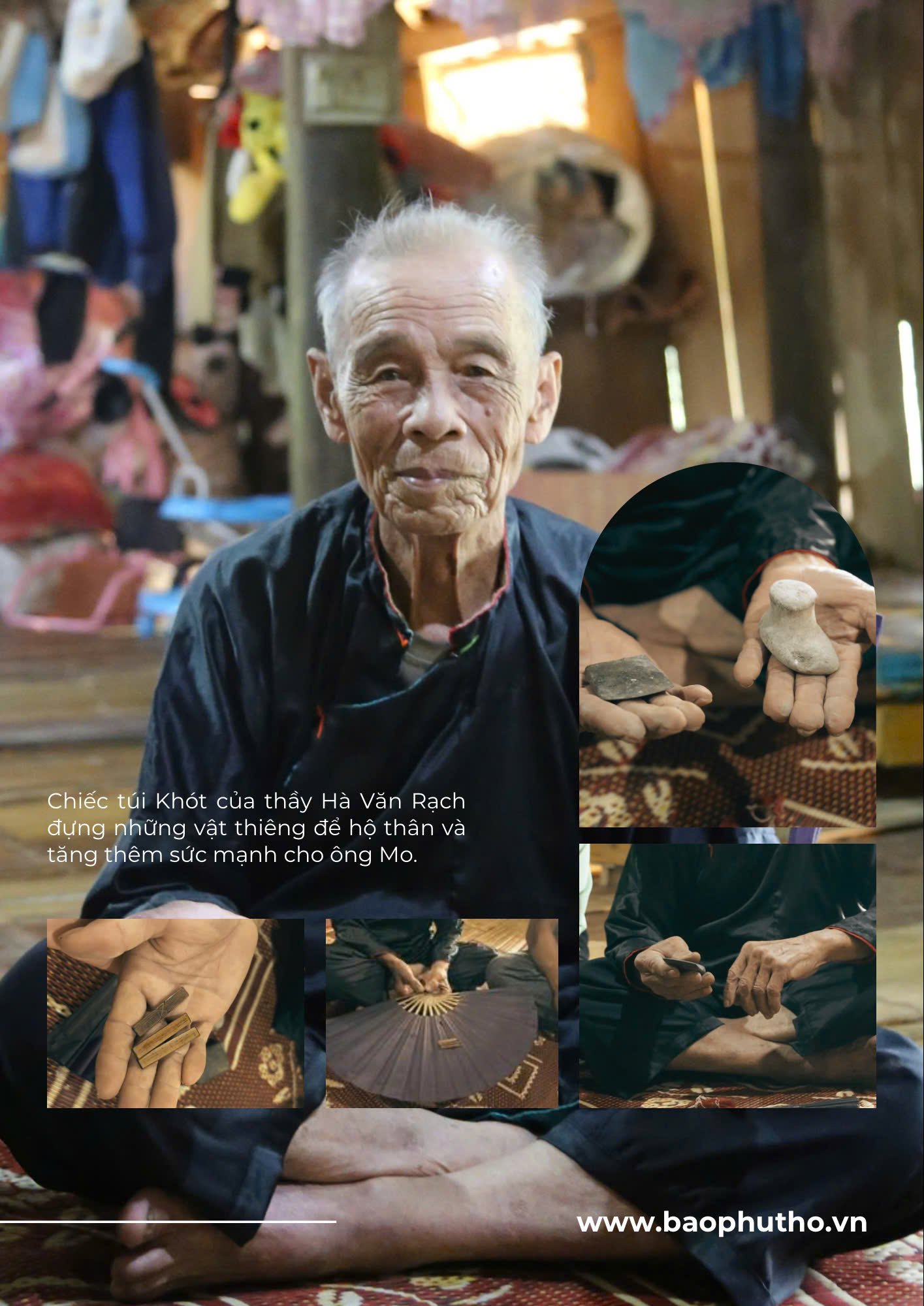
Shaman Ha Van Rach (in the middle), from Thu Cuc commune, Tan Son district, shares about the Khot bag used by shamans.
Following Mo Rach to a longevity-seeking ceremony, we witnessed the "majesty" and important role of the shaman in the lives of the Muong people. Everything was prepared by the host family, but nothing could begin until the shaman arrived.
Before the altar, the shaman opens his Khot bag containing sacred objects for protection and to enhance his power. Rach begins the ritual with the following items: a fan, an axe, a footprint-shaped stone, and a bamboo stick. According to Rach, these are indispensable tools for the shaman during the ceremony. The fan is for the shaman to hold while speaking, assisting in the activities throughout the ceremony; the axe symbolizes the sky; the footprint-shaped stone symbolizes the human foot to follow the guidance without getting lost; and the bamboo stick helps the shaman connect the yin and yang. Throughout the ceremony, all attendees follow Rach's instructions, neither noisy nor hurried, because, according to Rach, everything in shamanism follows a sequence and order.
If the Muong shaman represents the spiritual and cultural values in the lives of the Muong people, then the shaman is the central figure, playing an indispensable role in the practice of these rituals. The shaman is closely associated with the life of each Muong person from birth, through childhood and adulthood, until death, and is often likened to a second father, but this father possesses a different kind of "power" and "authority" than an ordinary person.
According to the inventory of Mo Muong heritage by the Department of Culture, Sports and Tourism, the province has 31 artisans practicing the Mo Muong cultural heritage in Tan Son and Yen Lap districts, and there are no female Mo masters. They are keepers of Mo knowledge, memorized tens of thousands of Mo verses, and are proficient in rituals, customs, and traditions; they are respected figures trusted by the community. You may also like  Leveraging local advantages through OCOP products.The One Commune One Product (OCOP) program is creating more opportunities for ethnic minority communities in the province to leverage their advantages, enhance the value of agricultural products, and gradually improve their livelihoods.  Lai Chau implements the "Support for Women's Entrepreneurship Project giai đoạn 2026-2035" (2026-2035).The People's Committee of Lai Chau province has just issued a plan to implement the "Support for Women's Entrepreneurship Project giai đoạn 2026-2035" in the province. The plan identifies women as the central focus, with innovation as the driving force, while prioritizing support for vulnerable groups such as ethnic minority women, women with disabilities, and women in remote areas.  Vietnamese Buddhism has always been a companion to the nation.(NLĐO) - National Assembly Chairman Tran Thanh Man affirmed that the Vietnam Buddhist Association is an important part of the great national unity bloc. |
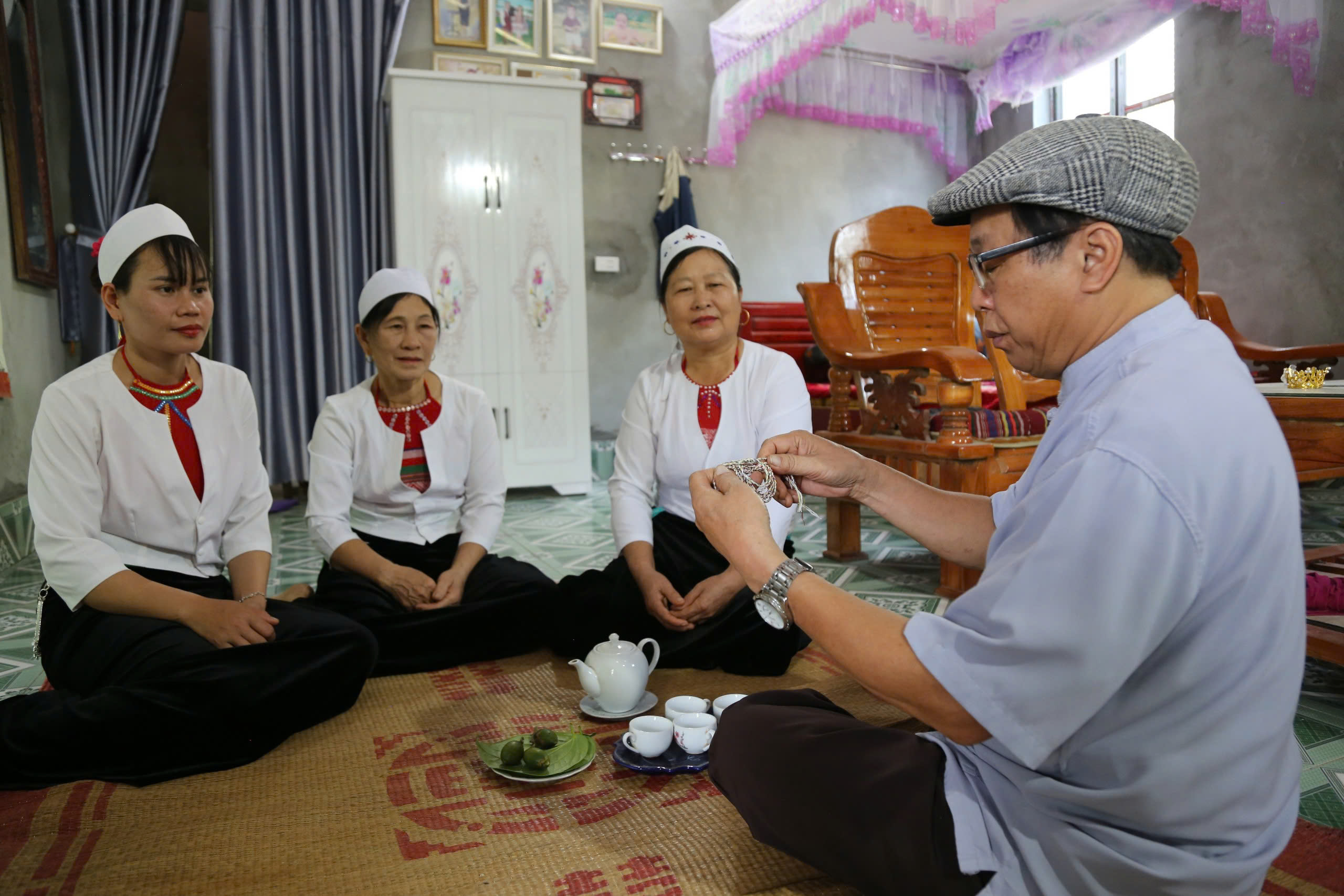
Distinguished artisan Nguyen Dinh Thuong (far right) is the only Mo artisan to have been awarded the title to date.
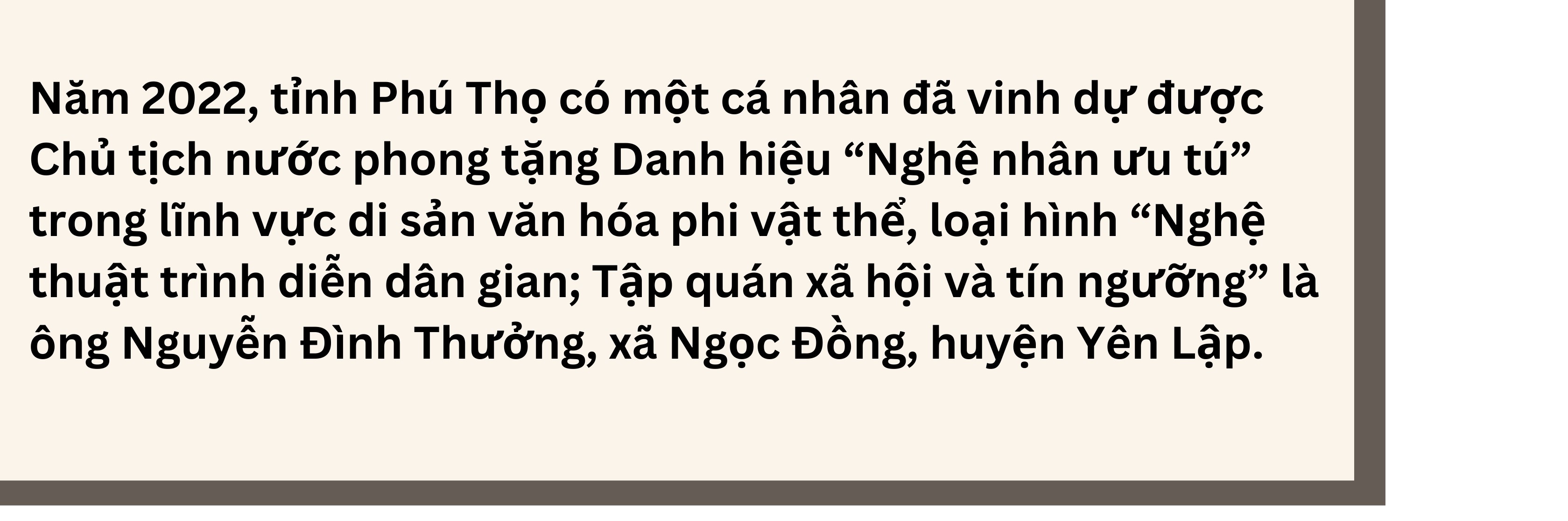
Mr. Thuong is the third-generation successor and has followed in his father's footsteps for 37 years, becoming a renowned Mo (spirit medium) in the district and beyond. He is always busy with both major and minor matters in the village and surrounding area. Besides the Mo rituals within his family, he plays a crucial role in the community's cultural activities, such as the rice harvest procession, the year-end forest closing ceremony, the year-end forest opening ceremony, and participates in Muong culture teaching classes as an instructor.
According to artisan Thuong: The shaman (Mo) is the person who presides over the activities of the Mo ritual. Each Mo ritual involves many people and many ceremonies. The shaman organizes the ritual, oversees the preparation of offerings, guides the participants, performs the rituals, and most importantly, performs the Mo chanting. The shaman is the person who has the ability to connect with the spirits and possesses the "power" to satisfactorily resolve all religious needs in the Mo ritual.
Mr. Thuong shared: "As a shaman and having been awarded the title of 'Outstanding Artisan' by the State, I feel even more responsible for promoting the value of this heritage by preserving and passing it on to future generations. As long as I have the health, I must try my best to ensure that the Muong shamanic tradition does not disappear."
The Muong people always cherish and value the presence of the shaman; therefore, being a shaman is not a profession. A profession would require an income, but the shaman's presence in the lives of the Muong people is responsible for connecting the "spirit world" (yin and yang), conveying people's hopes and desires, and reminding each person to live better each day. Not everyone can be a shaman, and being a shaman is not about getting rich.
These "folk" shamans
Traditionally, in many community matters, we understand that "A proper name leads to proper speech." However, in the Muong villages, even those who haven't been recognized as outstanding artisans, or even those not on the list of shamans, despite having 40-50 years of experience practicing Muong shamanism, are still respected and trusted by the people and appear in important family events. They are the folk shamans, with a "title" but lacking "official recognition."
According to 2021 data, Thanh Son district has 140,000 inhabitants from 32 ethnic groups. Of these, the Muong people account for 60%, approximately 84,000. Yet, in the 2023 heritage inventory conducted by the Department of Culture, Sports and Tourism, Thanh Son district was found to have no Muong shamans. Why this paradox? Despite the shaman's extremely important role in the lives of the Muong people.
For example, Mr. Dinh Van Thanh, born in 1955 and currently residing in Zone 11, Dong Chom, Tat Thang commune, is one of the leading figures practicing many forms of Muong culture, including Muong shamanism. His reputation extends far beyond Tat Thang and the surrounding areas. He participates in almost all local rituals as well as in Muong cultural preservation and training courses from the district to the provincial level.
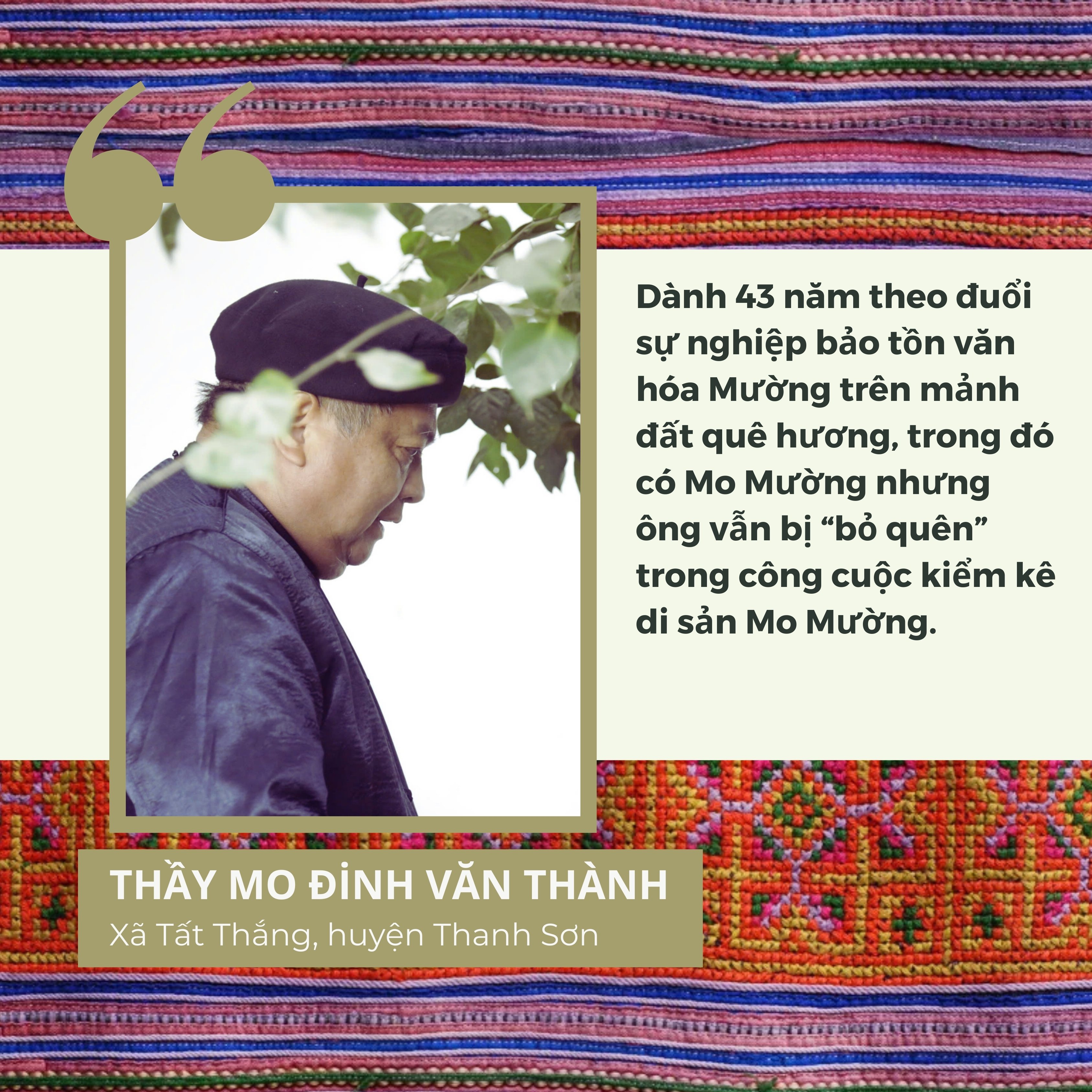



Despite dedicating 43 years to preserving Muong culture in his homeland, including Mo Muong rituals, and holding the positions of Party Branch Secretary and Head of the residential area, overseeing both spiritual and earthly affairs, artisan Thanh seems to have been "overlooked" in the ongoing inventory of Mo Muong heritage.
For example, Tu Vu commune, the capital of the Muong ethnic group in Thanh Thuy district, has a population of nearly 7,000 people. Comrade Khuat Dinh Quan, a cultural officer of Tu Vu commune, confirmed: "The commune does not have any shamans, but only three priests who specialize in handling spiritual matters, caring for the spiritual well-being and performing rituals for the local people."
Mr. Dinh Van Chien, born in 1967 and currently residing in Zone 18, is the most renowned shaman in Tu Vu commune. He is the sixth generation to be taught the rituals and ceremonies of the Muong people. Since 2007, Mr. Chien has traveled alone by motorbike throughout Hoa Binh, Son La, and Ninh Binh provinces to learn from masters of Muong culture, including the Muong shamans. It was truly a pilgrimage to rediscover lost pieces of his homeland's culture. Over 17 years, Mr. Chien has acquired a considerable knowledge of Muong culture, yet he remains only a shaman.
This shows that the figure of 31 artisans is only approximate. Within the Muong community, there are still many shamans who are "recognized by the people." They are the ones who "poured their hearts and souls" into preserving the proud heritage of the Muong people, though anonymous.
Being recognized as a shaman or being honored by the State is a source of pride for the individual shaman and the Muong community, affirming their contributions and encouraging them to continue contributing to the preservation of this heritage. However, honor is not the only factor determining the survival of this heritage. The development of life and society, along with cultural exchange between ethnic groups in the same area, has significantly impacted the cultural life of the Muong people. In reality, in Phu Tho province, the number of shamans is gradually decreasing and aging, causing many difficulties and limitations in the preservation of Muong shamanism – a living heritage. This issue will be discussed in the next installment.
Thanh Tra - Thu Huong - Thuy Trang
Source: https://baophutho.vn/khoi-nguon-dong-chay-mo-muong-225166.htm
![[Photo] National Assembly Chairman Tran Thanh Man attends the Conference to announce the Master Plan for Hanoi Capital City with a 100-year vision.](https://vphoto.vietnam.vn/thumb/1200x675/vietnam/resource/IMAGE/2026/06/29/1782709639728_ndo_br_1-jpg.webp)
![[Photo] General Secretary and President To Lam works with the Party Committee of the Government on the work of preventing and combating storms, floods, extreme natural disasters and climate change.](https://vphoto.vietnam.vn/thumb/1200x675/vietnam/resource/IMAGE/2026/06/29/1782729441945_a1-bnd-0385-9454-jpg.webp)
![[Image] A look back at the capital's preparations for the century-long master plan.](https://vphoto.vietnam.vn/thumb/1200x675/vietnam/resource/IMAGE/2026/06/29/1782750453122_quy-hoach-100-nam-minh-duy-1-2118-jpg.webp)