

(NLĐO) - An archaeological site in Spain has been identified as the first place in Europe to have footprints of a species belonging to the Hominidae family.
A study recently published in the journal Earth-Science Reviews has helped resolve one of the longest-standing debates in paleoanthropology: When did prehistoric humans arrive in Europe?
Sci-News quotes paleoanthropologist Luis Gibert from the University of Barcelona (Spain), the lead author of the study: "The migration timeline of Homo out of Africa has expanded significantly over the last four decades."
Homo is one of the four genera of the tribe Homo that still have surviving species today, and it is the genus to which we and our closest relatives belong.

1.32 million years ago, a species of the genus Homo conquered Europe - AI illustration: Anh Thu
Although some species of the genus Homo still retain ape-like features, generally all have crossed significant evolutionary boundaries to become nearly identical to modern humans in many respects.
In 1982, the oldest evidence of Homo in Asia identified using paleontological methods was 0.9 million years ago on the island of Java (Indonesia) and 0.7 million years ago in Italy, Europe.

Forty years later, the dating of the first Homo outside of Africa was extended to 1.8 million years ago through sites in the South Caucasus (a region on the border between Asia and Europe).
Additionally, evidence of Homo dating back 1.7-2.1 million years has been found in China and 1.5-1.3 million years ago in Java.
In Europe, later archaeological data also revealed some sites with traces of Homo dating back older than 0.77 million years.
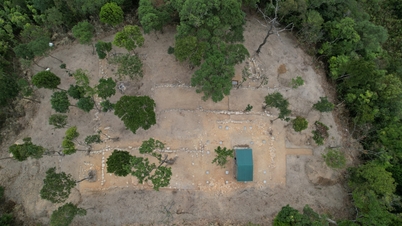
This time, the authors used stratigraphic dating, a method of dating based on the Earth's magnetic field state at the time of sediment formation, to study five sites in the Orce region of Spain.
These five sites are all stratified and lie within a sedimentary chain more than 80 meters long.
They identified three sites containing traces of Homo species, dating back 1.32 million years (Vente Micena site), 1.28 million years (Barranco León-5), and 1.23 million years (Fuente Nueva-3), respectively.
Of course, at this point in time, the human species that conquered Europe was not ours. At that time, many human species existed on Earth, the most prominent of which was Homo erectus, nicknamed "upright man," which emerged about 2 million years ago.
It wasn't until 300,000 years ago that Homo sapiens – or "smart humans," that we are – came into existence.

New findings suggest that the Strait of Gibraltar – a narrow strait connecting the Mediterranean Sea to the Atlantic Ocean – may have once been a crucial gateway for a major migration of various species from Africa to Europe, from apes to hippos.
Regarding the reason why humans arrived in Europe after Asia, the research team suggests that it was because they had to wait until they had the necessary technology to overcome maritime barriers, similar to what happened 1 million years ago on Flores Island in Indonesia.
The current Gibraltar route includes a sea lane stretching up to 14 km. However, it is likely that in the past, this distance was shorter at certain times due to intense tectonic activity in the area and large fluctuations in sea level, sometimes at very low levels.
Many other African animals also migrated through Gibraltar between approximately 6.2 and 5.5 million years ago, when the strait was much narrower than it is now.
Source: https://nld.com.vn/bat-ngo-ve-nguoi-chau-au-dau-tien-khong-phai-loai-chung-ta-196240717081610296.htm


































































![[Video] Sunset at Lap An Lagoon – Where the sun sets over the fishing nets](https://vphoto.vietnam.vn/thumb/1200x675/vietnam/resource/IMAGE/2026/05/31/1780192137701_beach-landscape-sea-water-nature-grass-745871-pxhere-com.jpeg)








































Comment (0)