

Contributing to the promotion of green economic development.
Since the policy to support and encourage agricultural and rural development was issued under Resolution No. 22/2021/NQ-HĐND dated December 9, 2021 (Resolution 22) of the Provincial People's Council, various levels, sectors, and localities have implemented many effective solutions.
In particular, the policy of supporting the conversion of forests into large timber forests has been seriously implemented by localities, achieving many important results, creating a strong shift in awareness, and raising the sense of responsibility of the entire political system and society. Many innovative and effective approaches suitable to the actual situation of localities have quickly been put into practice to contribute to increasing income for forest growers and promoting green economic development.
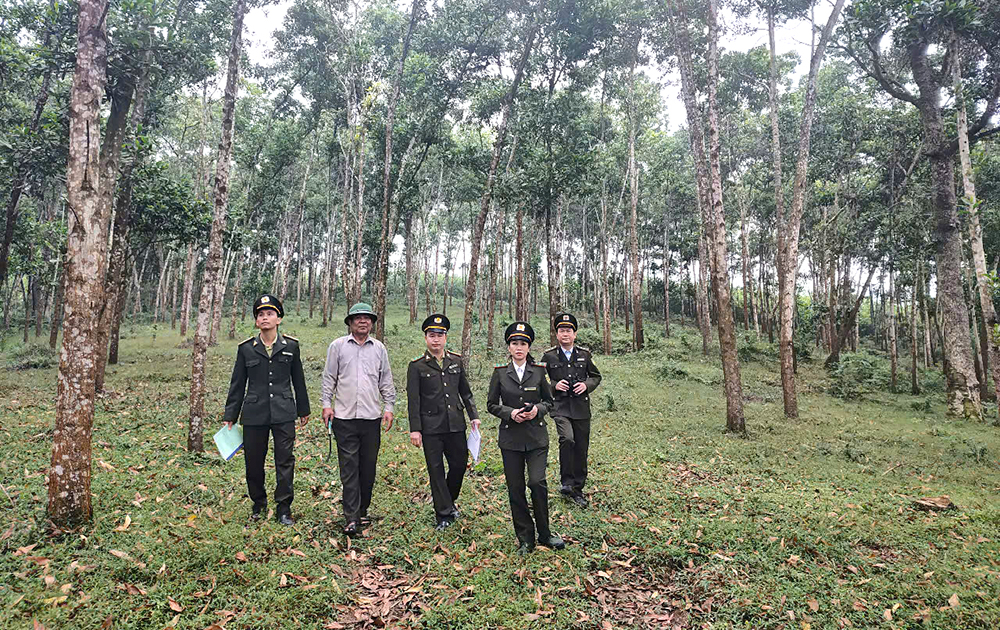
Local forest rangers are stepping up patrols and inspections of large-timber plantations in their areas.
Rethinking afforestation
Resolution 22 stipulates: Support for the conversion of large timber forests for cooperatives, cooperative groups, farm owners, and households. Conditions for support: Plantations of acacia mangium, acacia hybrid, and other tree species as announced by the Ministry of Science and Technology, the Ministry of Agriculture and Rural Development, or the Provincial People's Committee. Forests undergoing conversion must meet the prescribed standards and have a concentrated scale of 5 hectares or more; there must be a commitment with the commune-level People's Committee and the forest protection unit to harvest after 10 years of age. The first support payment is when the forest reaches 6 years of age or older and has implemented technical measures for conversion to large timber, at a rate of 7 million VND/ha; the second support payment is 5 million VND/ha three years after the first support payment.
Recognizing forestry as one of the locality's great potentials and advantages, in recent years, Cam Khe district has strengthened policies to encourage and promote economic development from forests, including large timber forests. The development of large timber forests with specific policies has brought practical benefits to the people.
Previously, the entire 16 hectares of forest belonging to Mr. Nguyen Xuan Hong's family in Van Khuc commune were planted with acacia trees, yielding small timber which, while profitable, did not generate significant economic value. Since 2020, thanks to the guidance and support from the district's forest rangers and the commune's People's Committee, his family has converted all 16 hectares to large-timber forest plantations. Mr. Hong stated: “Initially, I was quite uncertain about the economic benefits of large-timber forests, but after receiving guidance and instruction from the district's Forest Ranger officers, my family boldly followed suit. Now, seeing the acacia trees growing tall, I realize that my direction was correct. According to calculations, in just a few more years, when the acacia trees are over 10 years old, they will provide a high income. Furthermore, having converted the forest, my family receives financial support from the government's large-timber forest conversion program, which will provide additional funds for better tree care and growth.”
Not only in Cam Khe district, but Yen Lap district, a mountainous area with 80% ethnic minority population, along with its diverse terrain and large land resources, has many advantages in developing agriculture, especially forestry and perennial industrial crops, helping the people here to rise out of poverty. Identifying sustainable poverty reduction as one of the key tasks, with the goal of poverty reduction linked to the development of hill and forest economies, focusing on large timber trees, medicinal plants, and fruit trees, as a feasible solution, the district government has created all conditions to support people in developing hill and forest economies, providing capital and technical solutions, and promoting the role of internal resources and self-reliance in escaping poverty. Most localities in Yen Lap district focus on developing large timber forests, concentrated in the communes of My Lung, My Luong, Ngoc Dong, etc.
According to Comrade Do Manh Hiep, Deputy Head of the Yen Lap District Forest Protection Department, the people of Yen Lap in general, and especially the ethnic minorities in particular, have clearly recognized the benefits of forest economics, and therefore, they are ready to participate in forest planting and transformation projects. To date, along with active activities in protection, regeneration, and reforestation, the district's forest cover has risen to over 61%, and the movement to develop hill and forest-based economies by households has flourished.
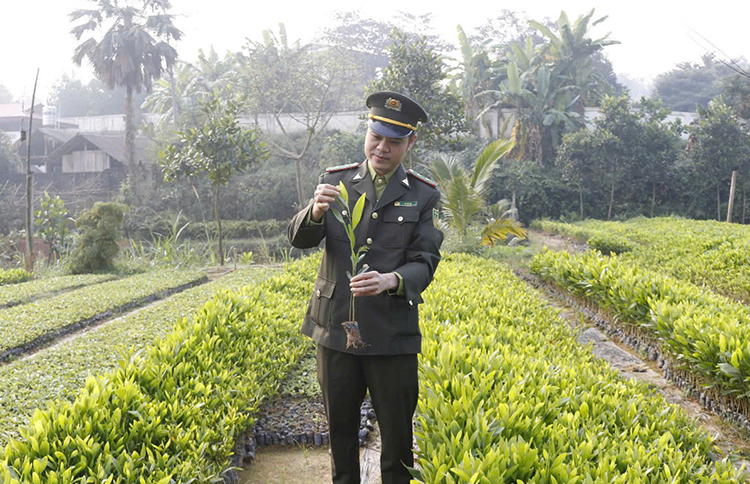
Phu Lam Forest Ranger Station inspects the quality of forestry seedlings for reforestation purposes.
Improving the quality of growing areas
Currently, the total planned forest land area is nearly 188,000 hectares, accounting for over 50% of the province's total natural area. The forest area is nearly 169,000 hectares. The forest cover rate reaches 39.7%; seedling production basically meets the needs for reforestation in localities throughout the province. Among these, acacia remains the main tree species.
Resolution 22 stipulates policies to support and encourage agricultural and rural development in the province, ensuring consistency with development requirements, production practices, and the province's agricultural, forestry, and fisheries development plan for the 2021-2025 period. Immediately after the resolution was issued, with the active participation of the province, all levels, sectors, and localities, the support and encouragement measures for agricultural and rural development were implemented. Many models and projects received support, creating favorable conditions for people, households, farm owners, cooperatives, and cooperative groups to invest in seedlings, fertilizers, access to cultivation and care techniques, and conditions for obtaining good agricultural practice certification, aiming towards building a high-value commercial agricultural sector.
We went to Ben Dam area, Yen Son commune, Thanh Son district to learn about the transformation of large timber forests. Working with the commune leaders, we learned that the fragmented forest areas of a decade ago have been replaced by vast green forests of various timber trees.
Pointing to the sturdy, well-built houses along the smooth concrete road, Mr. Nguyen Van Hoa happily shared: “Thanks to the attention of the authorities at all levels, my family has planted acacia trees covering nearly 20 hectares of forest. With the guidance and technical support of the district's Forest Protection Department officials, in the early years when the acacia trees were still young, my family planted short-term crops as intercrops to supplement our food supply, while also improving soil aeration and water retention, preventing erosion, and helping the acacia trees grow faster. Now, not only my family but most people in the Ben Dam area are reassured and can focus on developing forestry-based economic activities to have a more prosperous and fulfilling life.”
Comrade Truong Quang Dang, Head of the Forest Utilization and Development Department of the Provincial Forest Protection Sub-Department, stated: As one of the leading provinces in the country, Phu Tho has issued specific mechanisms to support people in transforming large timber forests. With specific goals and synchronized implementation from the provincial to local levels, the province's policy of transforming large timber forests has mobilized the combined strength of the entire political system to participate in forest management, protection, and development. The Forest Protection Sub-Department has coordinated with relevant agencies to effectively implement policies for the development of the forestry economy. In particular, social resources invested in forestry, especially the socialization of forestry, have been strengthened. Violations of regulations on forest management, protection, and development have been handled promptly, contributing to sustainable forest protection.
Part II: Removing "barriers" to achieve the goal
Economic Reporting Team
Source: https://baophutho.vn/ky-i-tro-luc-kip-thoi-226483.htm


![[Photo] The heat at the fireworks display site on the opening night of the Da Nang International Fireworks Festival 2026](https://vphoto.vietnam.vn/thumb/1200x675/vietnam/resource/IMAGE/2026/05/27/1779889741485_ndo_br_z7872039145157-fecaba5112f39e8352544099d7ef4738-5140-jpg.webp)
![[Photo] The courage of new recruits of Brigade 144 on the training ground.](https://vphoto.vietnam.vn/thumb/1200x675/vietnam/resource/IMAGE/2026/05/27/1779881651341_anh-man-hinh-2026-05-27-luc-18-32-52.png)






















































![[Photo] The courage of new recruits of Brigade 144 on the training ground.](https://vphoto.vietnam.vn/thumb/402x226/vietnam/resource/IMAGE/2026/05/27/1779881651341_anh-man-hinh-2026-05-27-luc-18-32-52.png)
























Comment (0)