

With a rapidly aging population and more highly skilled young people unwilling to work in factories, the era of ultra-cheap Asian labor is coming to an end.
The workplace features floor-to-ceiling windows, a café serving matcha tea, and free dance and yoga classes. Monthly, workers gather for team-building activities like beer, go-karting, and bowling. This isn't a description of a Google workplace, but rather a garment factory in Vietnam.
Asia, the world 's factory, is witnessing a new trend: young people, in general, are unwilling to work in factories. This is why manufacturing companies are trying to create more attractive work environments. This also raises concerns for Western companies that rely on the region's cheap labor to produce inexpensive consumer goods.
The "twilight" of cheap labor in Asia is descending, testing the globalized production model that has provided the world with inexpensive goods for the past three decades. Americans accustomed to affordable fashion and flat-screen TVs may soon have to factor in higher prices, according to the WSJ .
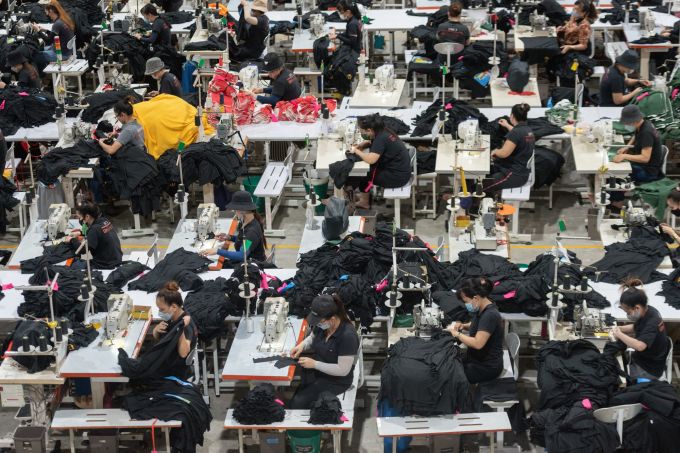
Workers at the UnAvailable factory in Ho Chi Minh City. Photo: WSJ
Paul Norriss, co-founder of the clothing company UnAvailable in Ho Chi Minh City, said that nowhere else on the planet can provide what you want. "People will have to change their consumption habits, and so will brands," he said.
Norriss said that workers in their 20s – the traditional workforce of the garment industry – often work for a few years and then leave. He hopes that improving the working environment can salvage the situation. "Everyone wants to be an Instagrammer, a photographer, a stylist, or work at a coffee shop," he said.
To cope with the labor shortage crisis, Asian factories have had to raise wages and implement sometimes costly strategies to retain workers, from improving meal quality to building kindergos for workers' children.
Toy manufacturer Hasbro says labor shortages in Vietnam and China have driven up costs. Barbie doll maker Mattel, which has significant manufacturing facilities in Asia, is also struggling with higher labor costs. Both companies have raised prices on their products. Nike, which manufactures most of its shoes in Asia, said product prices have increased due to higher labor costs.
Manoj Pradhan, an economist in London, warns that American consumers accustomed to relatively stable prices relative to their disposable income will have to reconsider. "There's a major demographic reversal," he says.
Beginning in the 1990s, China and subsequently other manufacturing hubs in Asia integrated into the global economy. Countries once associated with images of poor farmers became manufacturing powerhouses. Durable goods like refrigerators and sofas became more affordable.
But now those countries face a generational problem. Younger, better-educated workers familiar with Instagram and TikTok are deciding that life and work shouldn't take place within factory walls.
Another demographic shift is also playing a significant role. Young people in Asia are having fewer children and at a later age. This means they face less pressure to have a stable income by their 20s. The booming service sector offers less strenuous job options such as shop assistant in a shopping mall and hotel receptionist.
This problem is particularly serious in China, where urban youth unemployment reached 21% in June despite labor shortages in factories. Multinational companies have been shifting production from China to countries like Malaysia, Indonesia, Vietnam, and India. But factory owners there say they are also struggling to attract young workers.

Yoga class for workers in Ho Chi Minh City - Unavailable. Photo: WSJ
According to data from the United Nations International Labour Organization, factory workers' wages in Vietnam have more than doubled since 2011, reaching $320 a month, three times the rate in the United States. In China, factory wages increased by 122% from 2012 to 2021.
Earlier this year, Nguyen Anh Tuan, 25, a high school graduate, quit his job as a mechanic at an auto parts manufacturer in the outskirts of Hanoi to become a Grab driver. He earns less per hour than he did at the factory, but says the change was worthwhile because he's now his own boss.
"The supervisors were often harsh, which made me very stressed," Tuan said about his three years working at the factory. He said he would only consider returning if his old salary of $400 a month was doubled.
To obtain cheap labor, manufacturers used to simply move to less expensive locations. But that's no longer easy. There are countries in Africa and South Asia with large labor forces, but they lack political stability, or good infrastructure and a trained workforce.
For example, clothing brands have struggled to expand into Myanmar and Ethiopia, only to have operations disrupted by political instability. Bangladesh was once a reliable destination for clothing manufacturing, but restrictive trade policies and congested ports have limited its appeal.
India has a huge population, and companies are looking to it as a replacement for China. But even in India, factory managers are beginning to complain about the difficulties in retaining young workers. Many young people prefer farm life supported by state welfare programs or choose freelance work in the city rather than living in factory dormitories. Engineers are leaving the factories to join the information technology industry.
Asian factory owners are trying to make work more attractive, including subsidizing kindergartens and funding technical training programs. Some are moving factories to rural areas, where people are more willing to do manual labor. But this puts them further away from ports and suppliers, and forces them to adapt to rural life, including the absence of workers during the harvest season.
Christina Chen, the Taiwanese owner of furniture manufacturer Acacia Woodcraft Vietnam, moved her factory out of southern China four years ago hoping for easier recruitment. She initially considered industrial zones near Ho Chi Minh City but heard warnings about high turnover rates and soaring wages.
Therefore, she chose rural areas in northern Vietnam. Her workers are typically in their 40s and 50s, and some are not good readers. This requires explaining tasks verbally and using visual illustrations. In return, her workforce is more stable.
Christina Chen values young employees. She invites them to participate in the decision-making process, meets with visiting American buyers, and shares photos of the company's furniture in stores across America. According to her, automation is part of the process, but human ingenuity is still essential for many things.
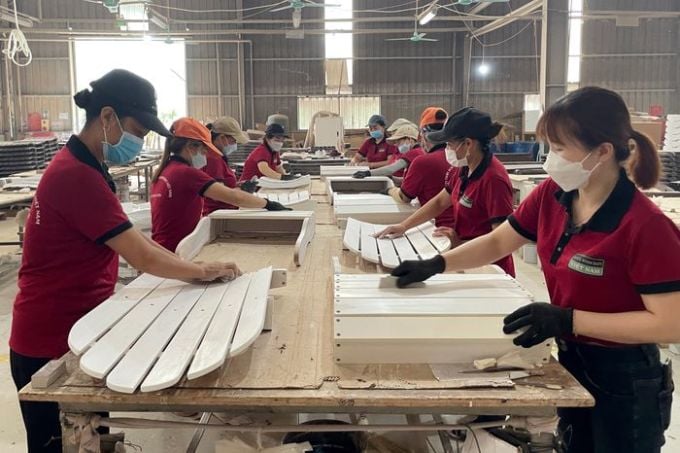
Workers at Acacia Woodcraft Vietnam. Photo provided by the company .
In Asia, the labor landscape has changed considerably compared to two decades ago. In 2001, Nike reported that over 80% of its workers were Asian, typically 22 years old, single, and raised in farming families. Today, the average age of Nike workers in China is 40 and in Vietnam is 31, partly due to the rapidly aging workforce in Asian countries.
Maxport Limited Vietnam, a Nike supplier established in 1995, has witnessed increasingly fierce competition for workers. Now, they are striving to improve the working environment, with factory windows bathed in sunlight and thousands of trees surrounding the facility. Young workers are being trained for advancement.
However, they still struggle to attract young people. Senior compliance officer Do Thi Thuy Huong said the training program for high school graduates ended partly because very few of them accepted jobs afterward. Approximately 90% of Maxport's workers are 30 years old or older.
In Malaysia, factories are dropping uniform requirements – something young workers hate – and redesigning workspaces. Syed Hussain Syed Husman, chairman of the Malaysian Employers Federation, a representative of manufacturers, said businesses are trying to make factories more attractive by expanding partitions, incorporating more glass structures, providing natural light and music, creating an environment similar to Apple's office.
Susi Susanti, 29, from Indonesia, tried working in a factory after graduating from high school. But she hated being pressured by the managers to work faster. She told her mother that she needed to do something different.
After a six-month training course, she could speak basic Mandarin Chinese and began caring for an elderly couple in Taiwan. Her salary was three times higher than what she earned working in factories back home, which made her feel less exhausted. "When the people I'm caring for get better, I can relax," Susi said.
Phiên An ( according to WSJ )
Source link


![[Photo] Prime Minister Pham Minh Chinh presides over a meeting on private sector economic development.](/_next/image?url=https%3A%2F%2Fvphoto.vietnam.vn%2Fthumb%2F1200x675%2Fvietnam%2Fresource%2FIMAGE%2F2025%2F12%2F20%2F1766237501876_thiet-ke-chua-co-ten-40-png.webp&w=3840&q=75)

![[Photo] Prime Minister Pham Minh Chinh presides over the conference announcing the establishment of the International Finance Centre in Vietnam.](/_next/image?url=https%3A%2F%2Fvphoto.vietnam.vn%2Fthumb%2F1200x675%2Fvietnam%2Fresource%2FIMAGE%2F2025%2F12%2F21%2F1766309817714_ndo_br_dsc-3400-jpg.webp&w=3840&q=75)






























































































Comment (0)