

During the process of researching and adjusting the master plan for Ho Chi Minh City until 2040, with a vision to 2060, the Department of Planning and Architecture (QH-KT) of Ho Chi Minh City will study the development orientation of the area surrounding Tan Son Nhat International Airport (TSN Airport) with an airport city model, along with the city's urban development orientations, as a legal basis for implementing the overall adjustment of related sub-area planning projects.
Lack of service appeal
According to the Ho Chi Minh City Department of Planning and Architecture, the road, rail, metro, and air transport systems at Tan Son Nhat Airport are currently not integrated and developed synchronously, failing to effectively meet the airport's current and future operational capacity. Overcrowding and congestion occur not only frequently within the terminals but also in the surrounding road transport system.
Of the four districts bordering Tan Son Nhat Airport, Tan Binh District serves as the gateway to terminals T1, T2, and T3 (currently under construction). Currently, this area in general, and Tan Binh District in particular, is primarily comprised of existing residential areas, with scattered public and commercial facilities interspersed within the residential zones, and some warehouse areas integrated within military land. The area has yet to develop diverse and attractive commercial and service clusters to meet the needs of Tan Son Nhat Airport passengers, and lacks planned facilities or areas with the scale and functions appropriate to the airport's master plan.
According to the Ho Chi Minh City Department of Planning and Architecture, in order to effectively utilize the opportunities that Tan Son Nhat Airport brings to the surrounding area, the relevant districts (including Tan Binh, Tan Phu, Go Vap, and Phu Nhuan) need to proactively implement solutions aimed at effectively developing the urban area around the airport, ensuring dynamic development and achieving sustainability for activities within and around the airport in terms of economics , society, and environment, in line with the airport city model, thereby increasing feasibility and effectiveness in urban development.
Accordingly, it is necessary to study and apply the results of the planning adjustment conference based on the development orientation of the airport urban area - the inter-district area surrounding Tan Son Nhat Airport - to urban management and local socio-economic development.
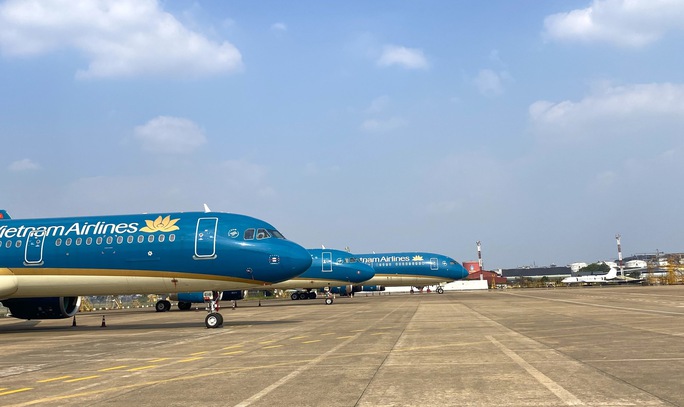
The current aircraft parking area of Tan Son Nhat International Airport.
Special policies are needed.
Several solutions for developing urban areas around Tan Son Nhat Airport have been suggested to local authorities, emphasizing land use planning and urban spatial development, urban transportation, and the organization of high-quality products, services, and commerce.
Accordingly, it is necessary to review land plots with potential for project development, especially large areas managed by the state and defense land no longer needed, to prioritize the planning of additional functions serving Tan Son Nhat Airport. In addition, the areas surrounding metro stations 2 and 5, along both sides of Truong Son Street and along the Cong Hoa - Truong Chinh route need to be reviewed to add commercial, public, and logistics services; and to include areas for international exhibitions and conferences, with functions such as hotels, condotels, and officetels... with a high land use ratio to increase land use efficiency.
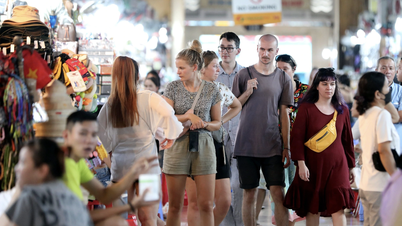
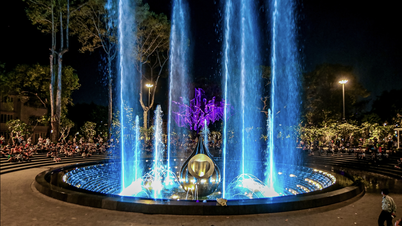
Simultaneously, organize nighttime economic activities combining entertainment, food , and cultural services, or suitable urban areas around the airport with a plan for organizing dedicated transportation directly connected to the airport. Develop food streets and duty-free commercial streets to attract air travelers. To facilitate travel, specialized transportation options such as electric trams, taxis, and express buses should be considered, connecting from various directions to the airport, with priority given to connecting to Metro Line 2 (currently under construction) with the Tan Son Nhat airport urban area.
Dr. Du Phuoc Tan, from the Ho Chi Minh City Development Research Institute, believes that the need to develop a night market model in Tan Binh district is urgent, integrated into the airport city model, and will enhance its ability to attract more tourists. The products offered at the night market are also crucial.
According to Architect Do Nguyen Phong, M.Sc., from the Institute of Construction Planning, in the immediate future, adjusting the functions and indicators of some areas and routes is one of the effective solutions, but it must be based on a comprehensive strategic study and specific objectives to maximize the potential and strengths of Tan Binh District in conjunction with the important transportation hub of Tan Son Nhat Airport. Ho Chi Minh City needs special mechanisms and policies to encourage investment, streamline regulations, provide policy support, and most importantly, work alongside businesses and the people.
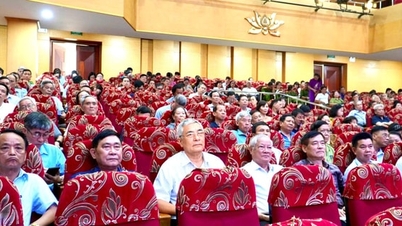
The Ho Chi Minh City Department of Planning and Architecture, in coordination with the Tan Binh District People's Committee, organized a workshop on local-level urban planning and management orientations associated with the international airport city model, applying it as a pilot project for Tan Son Nhat Airport. Following this, the Chairman of the Ho Chi Minh City People's Committee, Phan Van Mai, assigned the Department of Planning and Architecture to lead and coordinate with the People's Committees of the districts and relevant departments and agencies to study the workshop's results to consider long-term development orientations for the area surrounding the airport during the process of preparing and appraising the revised master plan for Ho Chi Minh City until 2040, with a vision to 2060. The districts are also tasked with researching urban development solutions around the airport during the process of preparing and revising the overall zoning plans for their respective districts.
Source

![[Photo] General Secretary and President To Lam and the President of the Philippines hold talks.](https://vphoto.vietnam.vn/thumb/1200x675/vietnam/resource/IMAGE/2026/06/01/1780286997787_anh-man-hinh-2026-06-01-luc-11-09-43.png)























































Comment (0)