

 |
Deposit interest rates are on par with lending interest rates.
Statistics from the Vietnam Bond Market Association (VBMA) show that in April 2026, successful bond issuances by banks had to accept very high interest rates. Accordingly, MSB, Bac A Bank , and Techcombank had to pay bond interest rates of up to 8.4 - 8.9% per year. At the same time last year (April 2025), Techcombank and MSB only had to pay bond interest rates of 5.2 - 5.3% per year.
Rising interest rates are the main reason for the sharp decline in the proportion of bank bond issuance in the first four months of this year. According to VBMA statistics, while in the first quarter of 2025, 100% of corporate bonds issued on the market belonged to the banking sector, by the first quarter of 2026, bank bonds only accounted for 30%, while real estate bonds rose to the leading position with a rate of 60%.
According to Mr. Dinh Quang Hinh, Head of Macroeconomics and Market Strategy at VNDirect, the average interest rate on privately issued bonds by banks in April 2026 reached 8.5% per annum, representing an increase of 1.6 percentage points compared to the end of 2025 and 3.1 percentage points compared to the same period last year, indicating significant liquidity pressure and increased capital costs in the banking sector.
According to a report by the State Bank of Vietnam (SBV), the average lending interest rate of domestic commercial banks, updated as of March 2026, is 7.4 - 9.7% per year, an increase of 0.3 percentage points compared to February 2026 and 0.7 percentage points compared to the end of 2025.
FiinGroup analysts also believe that current bond issuance interest rates are close to lending yields, narrowing the profit margin, and this is the reason for the decline in bond issuance by banks.
Although bonds remain an important tool for banks to supplement medium- and long-term capital, experts believe that rising interest rates have put pressure on capital costs and profit margins, causing the pace of bank bond issuance to remain cautious in the second quarter, instead of increasing sharply as in previous years at this time.
In the first quarter of 2026, despite strong capital pressure at times (especially to serve the Lunar New Year), banks mainly prioritized flexible funding sources (deposits, interbank funds, OMO) to address tight liquidity issues, instead of resorting to bond issuance, resulting in less active corporate bond issuance by this group during the quarter.
Rising interest rates are also the reason why public bond issuance in the first quarter of this year has seen the rise of many non-financial enterprises such as Transimex Joint Stock Company, Coteccons Construction Joint Stock Company, and BAF Agriculture Joint Stock Company. Meanwhile, in previous years, public bond issuance was usually the exclusive domain of banks. Of course, the increased diversity of issuers in public bond issuance is partly due to Decree 245/2025/ND-CP, which came into effect in September 2025, allowing businesses in many other sectors to seek bond issuance as a way to raise capital.
Statistics from the Q1/2026 financial reports of 27 listed banks show that nearly half of them experienced a decline in capital mobilization and had to rely more heavily on other capital mobilization channels outside the primary market, including bond issuance and the interbank market.
However, according to experts, the interbank market is also approaching its limit, while bond interest rates are becoming expensive, which will impact the cost of capital.
Dr. Can Van Luc, chief economist at BIDV and member of the National Financial and Monetary Policy Advisory Council, stated: “Banks wanting capital for lending are forced to raise funds from various sources, including issuing bonds. Furthermore, long-term lending carries high risks, requiring banks to increase their provisioning ratios, leading to higher capital costs.”
 |
Businesses and banks will postpone their issuance plans.
According to FiinGroup, the bond market typically accelerates in the second and third quarters of each year, when demand for production and project implementation increases, and credit institutions step up fundraising to support credit growth and ensure liquidity safety indicators.
However, this year, with interest rates remaining high, market activity is likely to be quieter in both the manufacturing and banking sectors. Issuers will be more cautious in implementing their fundraising plans, waiting for clearer signals regarding interest rate policies and the macroeconomic situation.
"High interest rates continue to push issuance costs higher, which could slow down businesses' fundraising plans. However, the extent to which interest rates affect corporate bond issuance plans will depend on each company's profile," FiinGroup analyzed.
Although caution is expected to prevail in the corporate bond market in the coming period, experts also believe that the control of real estate credit this year will force developers to turn more to corporate bonds to compensate for the shortfall in bank credit.
Similarly, Mr. Nguyen Duc Thong, General Director of SSI Securities Company, added that the Vietnamese economy currently relies heavily on bank credit. Meanwhile, the capital market (including the stock market and corporate bond market) currently accounts for only about 15-20% of the total capital of the economy. Mr. Thong expects that in the future, the capital market will become an effective fundraising channel for all types of businesses.
For real estate businesses, turning to bonds in the coming period is not only due to a credit shortage, but also because of the large volume of maturing bonds, approximately 125,000 billion VND.
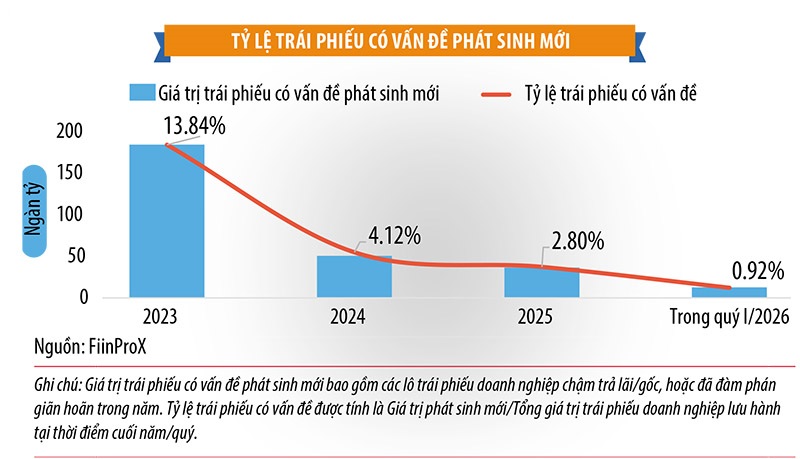
However, rising interest rates are increasing the risk of bad debts in real estate bonds. Data from FiinGroup shows that in the first three months of this year, the entire market had 12,800 billion VND of problematic bonds, an increase of 6.3% compared to the same period last year. Of that, 54.6% of the value of problematic corporate bonds came from the real estate sector.
The rate of newly arising problematic bonds has decreased since 2024, indicating that the debt repayment capacity and financial strength of issuers have improved significantly in recent years.
However, the sharp increase in interest rates in the first quarter of 2026 and the likelihood of it remaining high in subsequent quarters could put pressure on debt repayment capacity, forcing issuers of floating-rate bonds to rebalance their finances or negotiate with bondholders to postpone or convert debt obligations.
VIS Rating analysts believe that the tightening of credit by banks and the increase in lending interest rates in 2026 will lead to a deep differentiation in credit profiles. Accordingly, only large real estate developers with a substantial portfolio of completed projects will be able to access bank capital, while those facing protracted legal issues or deeply involved in resort real estate projects will continue to face liquidity pressure in 2026.
This situation forces real estate developers to more aggressively promote three other fundraising channels besides credit, including corporate bonds.
For investors, Mr. Nguyen Quang Thuan, Chairman of FiinGroup, advises against chasing high interest rates, but rather to understand the nature of the issued bonds, especially their legal status.
This expert warns that recently, forms of online savings disguised as bonds have emerged. Without strict supervision, there is a risk that in the next few years, serious cases related to speculative bonds with interest rates of 12-14% per year will appear.
According to experts, when investing in corporate bonds, investors must pay attention to and understand the financial health of the company, carefully examine the bond issuance terms and the company's credit rating.
Source: https://baodautu.vn/lai-suat-dat-do-ngan-hang-chun-tay-phat-hanh-trai-phieu-d595015.html

















































































































Comment (0)