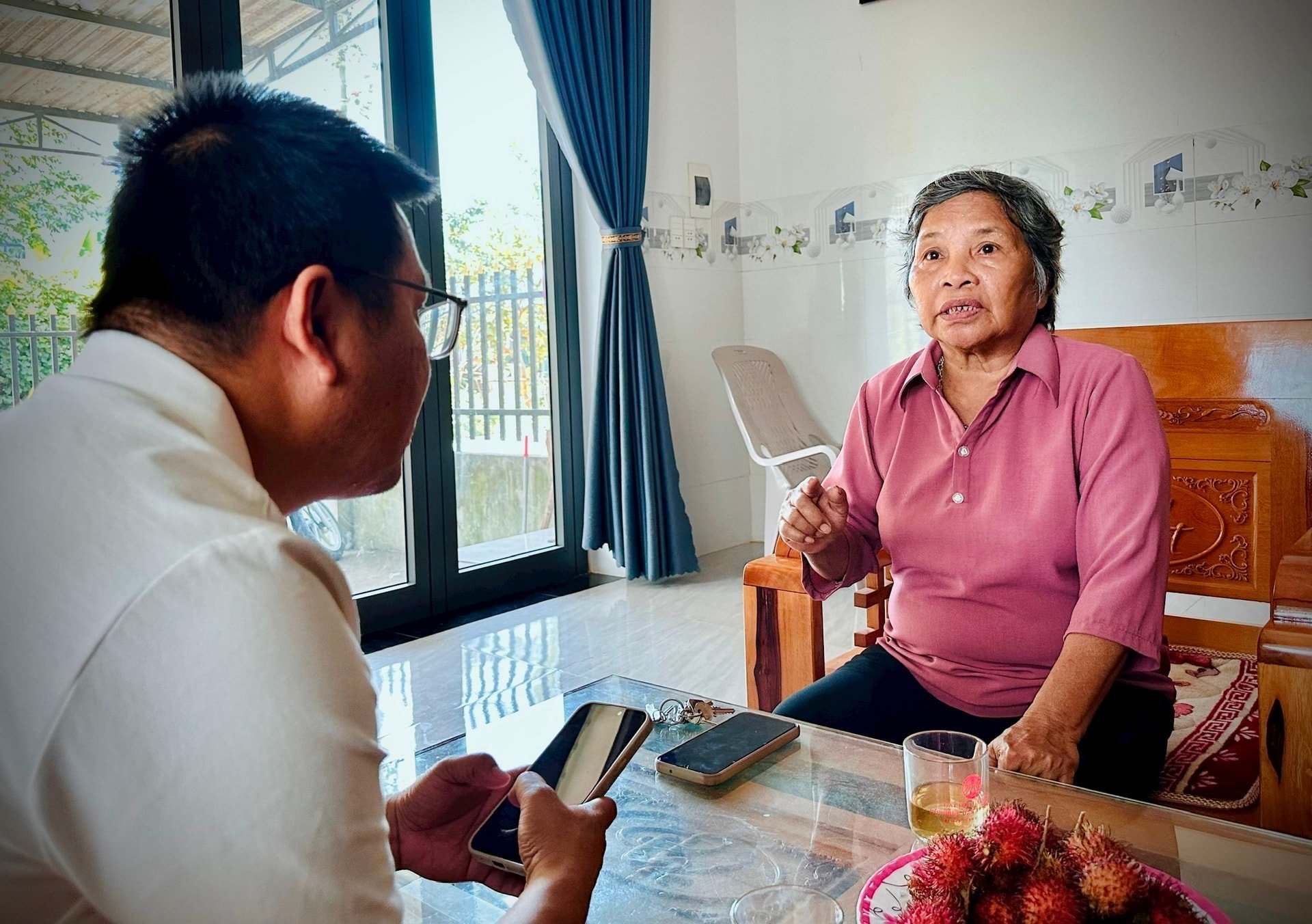
Ms. Ho Thi Anh Tho recounts her journey as a journalist in the period after the liberation of the country, with many stories both joyful and sad. Photo: ALANG NGUOC
Climbing poles to… broadcast.
For over 22 years working at the Dong Giang District Radio and Television Broadcasting Station (now part of the District's Culture, Sports and Radio and Television Center), Ms. Mai Thi Hong Dinh (born in 1964, of the Co Tu ethnic group, residing in Prao town) still vividly remembers the days she and her colleagues trekked through forests and waded through streams to cover events. Many trips, even now, send shivers down her spine when she recounts them, especially the near-death experiences of escaping sudden, fierce floods from upstream.
Ms. Dinh recounted that in 1977-1978, the radio station's office was located deep in the forest near Ta Xi village, now part of Prao town. At that time, the station had only three staff members, who handled both cultural and informational work, as well as journalism and broadcasting.
Therefore, each person had to handle multiple tasks simultaneously, from gathering news and writing articles to broadcasting and technical processing. In the post-liberation period, the district-level radio station only had one receiver connected to a microphone for reading and broadcasting through a few loudspeakers located in the district center.
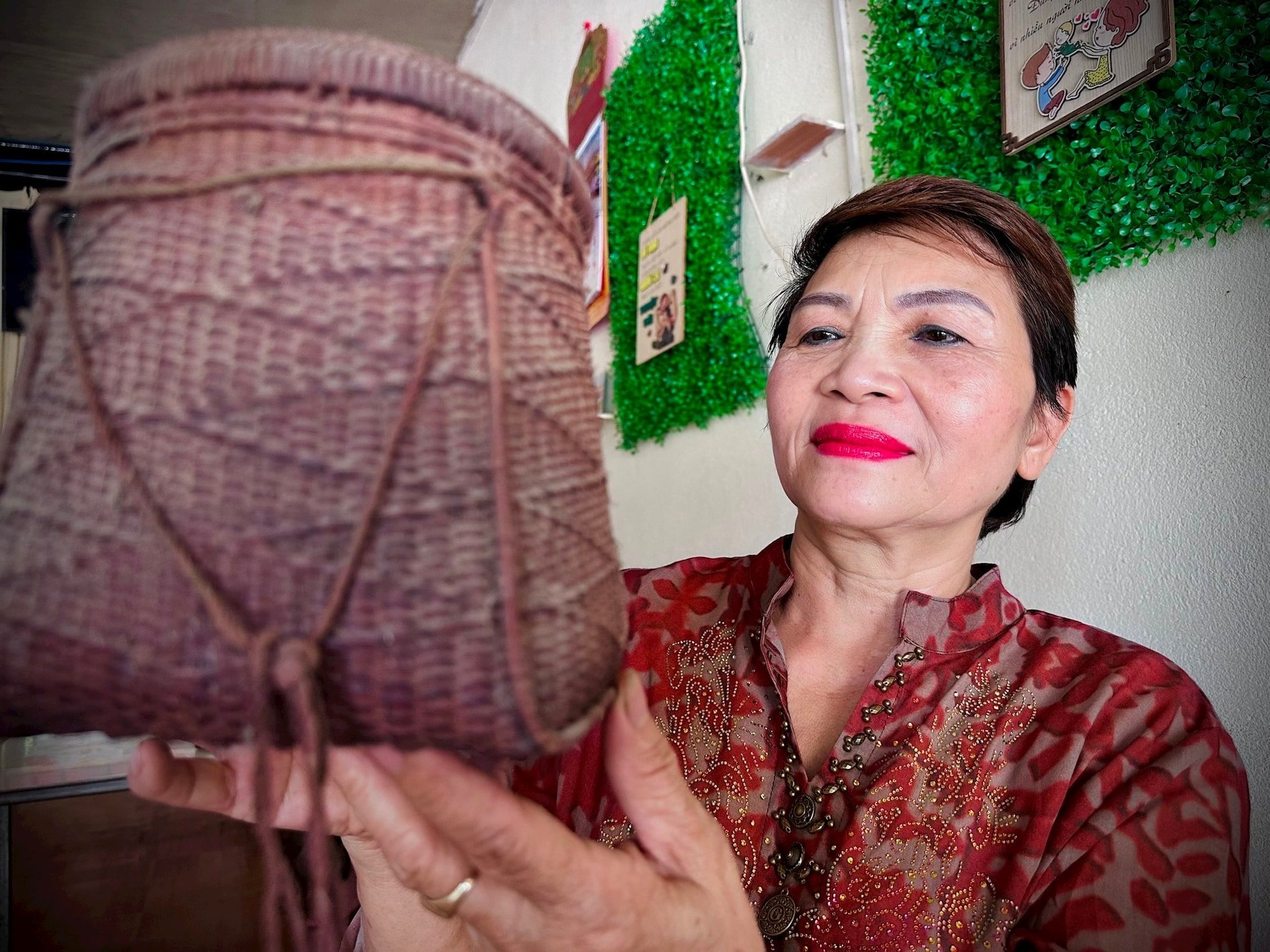
Ms. Mai Thi Hong Dinh cherishes mementos – gifts from the people during her fieldwork trips in the past. Photo: ALANG NGUOC
Due to a shortage of personnel, there were times when Ms. Dinh had to join her male colleagues in cutting trees, digging holes, and even climbing poles to pull wires and set up loudspeakers.
Thanks to her small stature and light weight, for many years afterward, Ms. Dinh always volunteered to climb the poles so that her two male colleagues could hold the supports, minimizing shaking and ensuring safer installation of loudspeakers at high altitudes. Some days, climbing the poles was exhausting, but upon returning to the office, there was nothing to eat, so the colleagues had to share a pot of cassava and pick vegetables from the garden to fill their stomachs.
“Back then, our job was to handle the live broadcast of programs through the loudspeaker system. Every late afternoon, we would prepare news segments, then read and broadcast the program ourselves, which lasted 15 minutes. It mainly consisted of news from the district and content about policies, laws, and exemplary economic development models, collected from newspapers, especially Nhan Dan Newspaper, Lao Dong Newspaper, and Quang Nam - Da Nang Newspaper,” Ms. Dinh recalled.
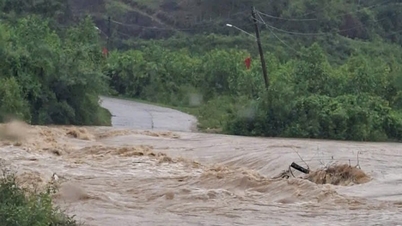
Ms. Dinh will never forget a reporting assignment from 1985. At that time, she and a female colleague named Ho Thi Huong (now living in Da Nang City) were assigned to Tu commune to investigate the lives of the local people and report on a unit's rice and food aid program for the residents. After finishing their work, they were heading home. It was late afternoon when, while crossing the Na Hoa ford, a sudden flood came, and the water rose very quickly.
“Huong and I were swept away by the flood, adrift in the water, luckily we managed to cling to a tree branch. This place was far from any residential area, so we couldn't call for help. At that moment, we thought we were going to die. But we still clung to the branch, struggling against the raging flood. It was almost an hour later before someone spotted us and called for help,” Mrs. Dinh recalled.
Journalism is always a valuable profession.
Once, I heard Ms. Ho Thi Anh Tho (born in 1957, of the Xe Dang ethnic group, residing in Song Tra commune, Hiep Duc district) recount that around 1976, while working at the Phuoc Son district radio station, she and a group of mountainous region officials went down to the province for a meeting.
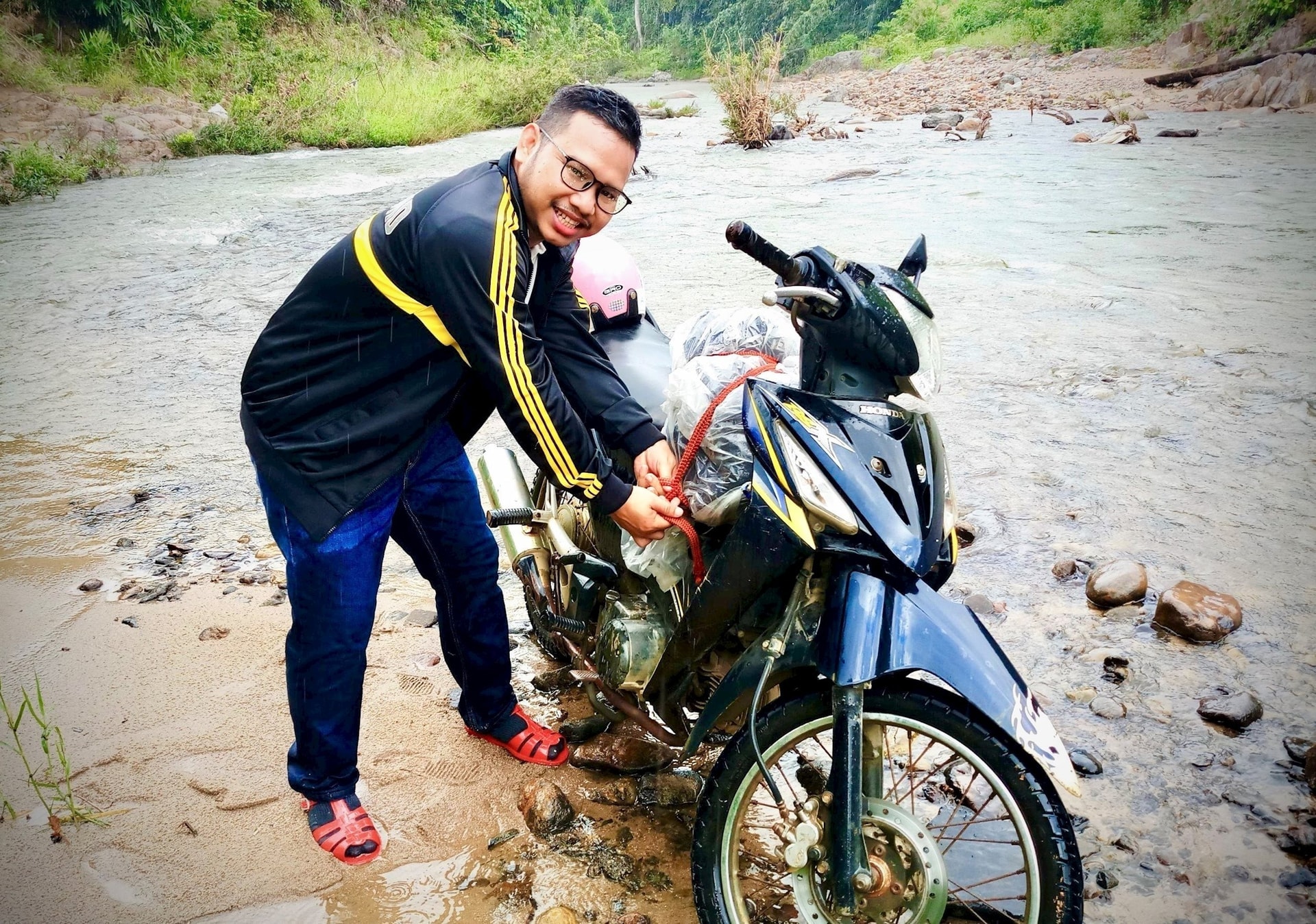
A reporting trip to a remote, border area by a reporter from Quang Nam Newspaper. Photo: DANG NGUYEN
Back then, the road to Phuoc Son was not yet open, so all journeys required walking for many days, following mountain trails. On the way back, at the border between the Phuoc Son and Hiep Duc forest areas, they encountered a sudden flood. Unable to cross the river, the Phuoc Son officials had to stay right at the edge of the forest. That evening, the whole group had to go without food and sleep in the cold mist. Early the next morning, everyone woke up early to climb back up the mountain and trek through the forest.
During her time at the radio station, in addition to broadcasting programs, Ms. Tho also worked with her colleagues to lay wires and install loudspeaker systems to serve listeners in the mountainous region.
Later, in her free time, she wrote more news articles. In 1986, when she first arrived in Hiep Duc, the unit's office had to temporarily borrow a private house. All the reporters and editors of the station had to stay and live in that tiny house, which was very difficult. Besides handwritten news reports, those working in local radio at that time often used the trick of cutting small pieces of newspaper containing the content to be read and attaching them to the program materials for broadcasting.
Ms. Tho's journey working at the radio station lasted more than 14 years, from 1976 to 1990, before she transferred to work as an official in Song Tra commune (Hiep Duc district). During her time at Phuoc Son and then Hiep Duc radio stations, Ms. Tho traveled to the villages almost every month to learn about the lives of the local people.
The long distances and difficult terrain meant that these "news-gathering" expeditions were entirely on foot. On one occasion, Ms. Tho and a colleague asked to hitch a ride on a timber truck to K7 (Phuoc Tra, Hiep Duc) for work, but they only made it halfway before heavy rain hit, the truck got stuck in the mud, and they had to roll up their trousers and walk all day.
“The road to K7 was all deep forest. Because we didn't bring any food, we both had to go hungry for many hours. Luckily, we came across a villager's house late at night, and we went in to ask for food; otherwise, we would have collapsed in the forest,” Mrs. Tho recounted.
Ms. Tho said that journalism, regardless of the era, is always valuable. By fulfilling its mission of disseminating information, journalism contributes to raising public awareness, providing people with new knowledge to improve their livelihoods, build better lives, and reduce poverty.
During her time as Deputy Secretary of the Party Committee of Song Tra commune in the years after the 1990s, in meetings with the people, she often used inspiring stories from newspaper articles to promote and encourage participation; especially in caring for the development of education, preserving culture, and exemplary collective economic models… making the journey of building a new life more enriching and practical.
Source: https://baoquangnam.vn/lam-bao-o-nui-thoi-bao-cap-3157042.html










































































Comment (0)