There is a lack of understanding regarding enrollment.
The inscription of heritage in general, and intangible cultural heritage in particular, is an institutionalized task under the 2003 Convention on the Protection of Intangible Cultural Heritage and the Law on Cultural Heritage. Inscription is understood as placing heritage into lists/catalogs with terms, conditions, and criteria as stipulated in current international documents and Vietnamese law. Based on her experience in preparing and evaluating dossiers for intangible cultural heritage at UNESCO and national levels, Professor Dr. Nguyen Thi Hien, School of Interdisciplinary Sciences , Vietnam National University, Hanoi, stated that, in practice, the Law on Cultural Heritage and several subordinate legal documents have already established regulations on inscription.
Accordingly, after the inscription, the State has paid more attention to investment capital for projects protecting intangible cultural heritage. Local authorities also have budgets to implement protection projects. The inscription also impacts awareness and serves as a great source of encouragement for the community to work together to preserve, protect, and promote the value of heritage. Many organizations, units, and individuals interested in heritage have contributed their efforts and money to work with the State and the community to protect and promote heritage.
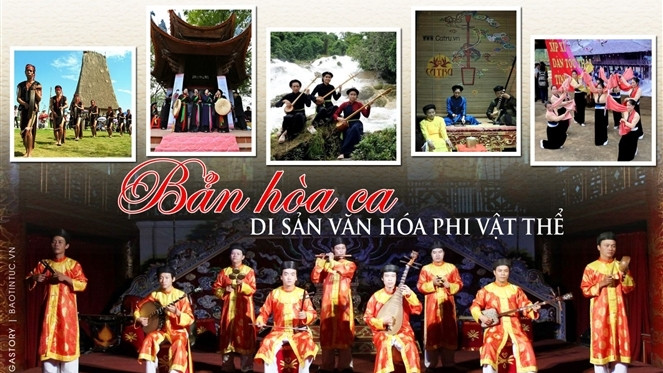 The registration of intangible cultural heritage carries more cultural significance and value than ranking or classification.
For example, in the case of Phu Tho Xoan singing, after being included by UNESCO in the list of Intangible Cultural Heritage in need of urgent safeguarding (in 2011), the government, agencies, organizations, artisans, and people in the province have made concerted efforts to implement many specific measures and approaches as committed in the registration dossier. As a result, after only 6 years, Phu Tho Xoan singing was restored and transferred to the list of Representative Intangible Cultural Heritage of Humanity (in 2017).
The draft Law on Cultural Heritage (amended) focuses on three main contents in the policies already approved. These include perfecting regulations on the principles, subjects, procedures for inventorying, identifying, registering, and managing, protecting, and promoting the value of intangible cultural heritage. According to Minister of Culture, Sports and Tourism Nguyen Van Hung: “We must have tools to establish criteria for each level; from there, we can better protect and promote heritage through registration and ranking.”
However, in reality, the management and support of resources for protecting heritage after inscription also present many challenges. For some intangible cultural heritages, the development and implementation of national action programs as committed in the dossiers submitted to UNESCO have not been carried out synchronously and regularly, such as the Gong Culture Space of the Central Highlands, Ca Tru, Vi Giam folk songs, and the practice of worshipping the Mother Goddess of the Three Realms of the Vietnamese people...
Professor Nguyen Thi Hien pointed out: “There is discrimination and comparison between heritage sites, especially intangible cultural heritage. Some localities have treated inscription as an ‘international brand’ to use for various purposes such as promotion, tourism development, or setting records… This is due to an incomplete understanding of inscription and its true purpose.”
A useful tool for protecting heritage.
In light of the draft Law on Cultural Heritage (amended), Phan Thanh Hai, Director of the Department of Culture and Sports of Thua Thien Hue province, believes that with intangible heritage, the issue of registration and revocation of registration (if it no longer meets the criteria) needs to be approached with extreme caution. “We need to anticipate the situation where localities use the registration of heritage as an achievement but do not genuinely create conditions for the community to preserve and promote the heritage. We also need to anticipate the situation where some forms of intangible cultural heritage are disguised as registered heritage, for example, after the Practice of the Mother Goddess Worship of the Three Realms was registered by UNESCO, superstitious elements proliferated, in the form of spirit mediumship.”
Clause 2, Article 16 of the draft Law on Cultural Heritage (amended) stipulates that the Chairman of the Provincial People's Committee is responsible for developing a plan to protect and promote the value of intangible cultural heritage after its inscription within the province. For intangible cultural heritage already inscribed and distributed across two or more provinces, the Provincial People's Committee submitting the scientific inscription dossier is responsible for leading the development of a plan to protect and promote the value of the heritage, obtaining the consensus of the People's Committees of the remaining provinces before promulgation. Associate Professor Dr. Nguyen Quoc Hung, former Deputy Director of the Department of Cultural Heritage, believes this needs careful consideration, because heritage that is not/has not yet been inscribed still needs to be protected and promoted.
According to many experts, UNESCO's inscription of intangible cultural heritage does not necessarily reflect outstanding global or international values, but rather emphasizes the function and significance of the heritage to its custodian community, which considers it as its identity and a continuation across generations. Based on these criteria, the inscription carries more cultural significance and value than ranking or classification. Inscription plays a crucial role in adjusting and supplementing legislation, as well as changing the way heritage is perceived, protected, and promoted.
To avoid the "misunderstanding" that inscription makes a heritage site more unique and valuable than one that has not been inscribed, according to Professor Dr. Nguyen Thi Hien, the draft Law on Cultural Heritage (amended) needs specific provisions on the purpose of inscription, aiming for better heritage protection and sustainable development.
Source: https://daibieunhandan.vn/lam-ro-muc-tieu-ghi-danh-de-bao-ve-di-san-tot-hon-post365890.html



![[Image] A brilliant symphony and explosive power in the skies of Da Nang.](https://vphoto.vietnam.vn/thumb/1200x675/vietnam/resource/IMAGE/2026/05/31/1780196945787_anh-man-hinh-2026-05-31-luc-10-08-51.png)



















![[Video] Sunset at Lap An Lagoon – Where the sun sets over the fishing nets](https://vphoto.vietnam.vn/thumb/340x192/vietnam/resource/IMAGE/2026/05/31/1780192137701_beach-landscape-sea-water-nature-grass-745871-pxhere-com.jpeg)



































































Comment (0)