

 |
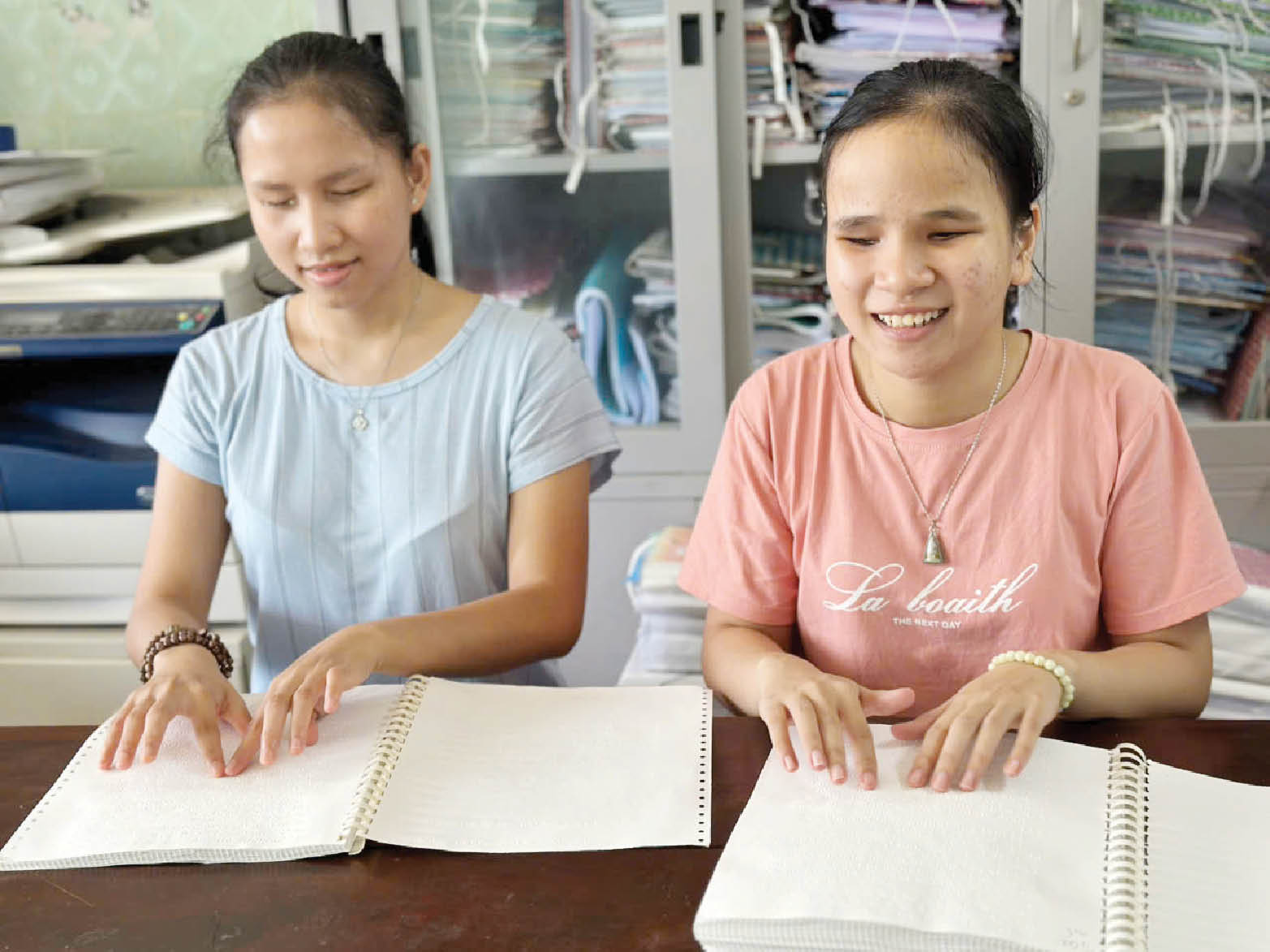
| Promoting a reading culture among the visually impaired aims to promote inclusion and equality. |
"The Light" from Reading Culture
In the quiet space of the library, Thu Ngan (17 years old, a visually impaired student at the Hue City Center for Education and Vocational Training for Blind Children) silently runs her finger over the tiny Braille characters spread across the thick, slightly rough pages. “I often go to the library to read books. Thanks to that, I feel I gain more knowledge, communicate better, and express my thoughts more clearly,” Ngan shared.
Mr. Vu Van Tuan, Head of the Center for Education and Vocational Guidance for Blind Children and Vice President of the City's Association of the Blind, said: “The center has a Braille library for the visually impaired with textbooks, science books, fairy tales, literature, and the 'New Life' magazine – the voice of the Vietnam Association of the Blind. In recent years, technology has become a powerful tool to help the visually impaired access reading culture more easily. Several assistive devices, text-to-speech software, and smartphones with screen readers are helping the visually impaired read more types of books than ever before.”
Audiobooks are now a very useful tool for the visually impaired because of their accessibility, simple operation, convenience for listening anywhere, anytime, and the ability for multiple people to listen together. Another advantage is that audiobooks have expressive voices and simulated sounds such as wind and rain, making the reading experience even more engaging.
The Sunflower Audiobook Library is a familiar audiobook channel for the visually impaired. This online library has provided thousands of free books in a variety of genres, from textbooks and life skills books to science books and literary novels. The emergence of audiobook channels like the Sunflower Library has met a large part of the reading needs of the visually impaired. Not only does it enhance the knowledge of listeners, but exposing visually impaired children to audiobooks from an early age can help them avoid the risk of developing autism and self-isolation.
Blind people still have a "thirst for books".
However, not everyone is as fortunate as Ngan, whose library at the Center has many books for the visually impaired. Currently, many visually impaired people, especially in remote areas or the elderly, still do not have access to suitable reading materials.
“Older visually impaired people, due to limitations in technology use, have limited access to audiobooks and still maintain the habit of listening to the radio to follow the news. For younger people, despite the advantage of good access and quick adoption of technology, the reading material is still limited due to copyright issues and high audiobook fees. In addition, the cost of producing Braille books for the visually impaired is quite high, and copyright issues make it impossible to convert all existing knowledge into Braille,” Mr. Tuan added.
According to the World Blind Union, less than 1% of books in developing countries are converted into accessible formats such as Braille and audiobooks. In Vietnam, the number of books published with versions for the visually impaired is still very modest.
To address the "book shortage" for the visually impaired, a coordinated effort is needed among relevant agencies, social organizations, and the community. Specifically, the publishing industry should promote the production of audiobooks and e-books with integrated screen reading technology, expand the parallel publication of Braille books in libraries and schools, and develop more platforms providing free audiobooks specifically for the visually impaired. Establishing small communities to support each other in spreading reading culture through sharing and exchanging books, assisting each other in accessing technology, and listening to the thoughts and reading needs of the visually impaired is also crucial.
Source: https://huengaynay.vn/van-hoa-nghe-thuat/lan-toa-van-hoa-doc-cho-nguoi-khiem-thi-157485.html


![[Photo] Prime Minister Pham Minh Chinh receives the Chinese Ambassador to Vietnam](https://vphoto.vietnam.vn/thumb/1200x675/vietnam/resource/IMAGE/2026/04/05/1775397481797_ndo_br_dsc-5512-jpg.webp)






































































Comment (0)