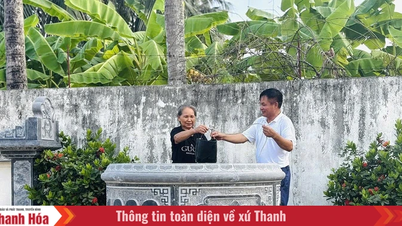
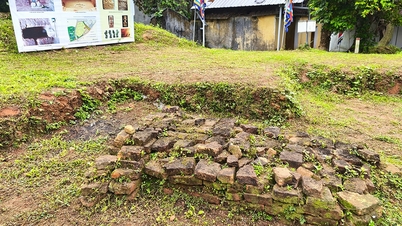
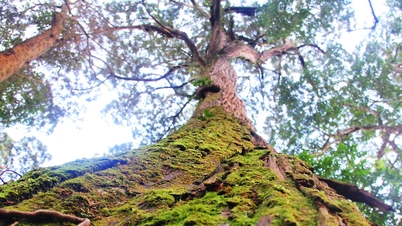
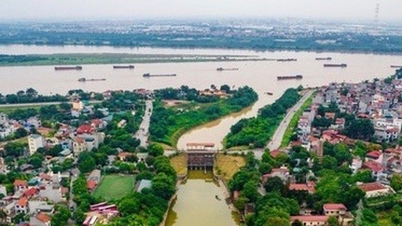
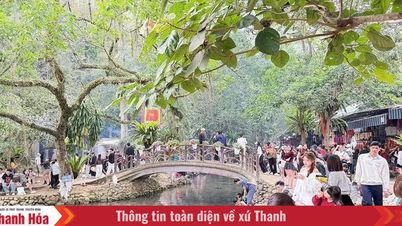
The village well in Ha Do village, which is over 100 years old, has been restored and renovated.
From the receding seas, the alluvial deposits of the Chu and Ma rivers, accumulated over thousands of years, formed the fertile land known as Ha Do. "Where the land is good, birds will flock," and the first inhabitants came to settle, establish villages, expand the fields, and cultivate abundant land, building lasting historical and cultural values.
Mentioning Ha Do brings to mind a proud tradition of studiousness. During the imperial examinations of our country in the feudal era, Ha Do village proudly had 19 people who passed the exams, from the intermediate to the advanced levels.
Even during the years when the French colonialists implemented a policy of deliberate ignorance, the spirit of learning in Ha Do never faded. In 1913, a school was built in Ha Do. The school had two classes, each with 25-30 students, all young people from the area. Excellent and dedicated teachers from all over came to teach there. Among them, Teacher Ngo Duc Mau not only taught literacy but also combined it with spreading progressive ideas to the students and young people.
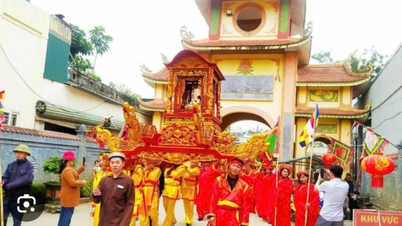
The people of Ha Do are both enthusiastic and diligent in their work and passionate about culture and arts. Since ancient times, the cultural and artistic movement in this area has been quite rich and vibrant. During festivals and holidays, the village organizes cultural and artistic activities such as lantern dances, traditional opera, flower songs, and burning flowers, creating a joyful atmosphere for the people after months of hard work. With these positive values nurtured and preserved, in 2003, Ha Do village was recognized as a cultural village.
In today's bustling town, Ha Do still retains the peaceful charm of a North Central Vietnamese village, with its rice paddies, coconut groves, and village wells reflecting the passage of time. Although the old communal house and temple no longer exist, the beautiful religious beliefs and the principle of "drinking water, remembering the source" are still preserved by the people.

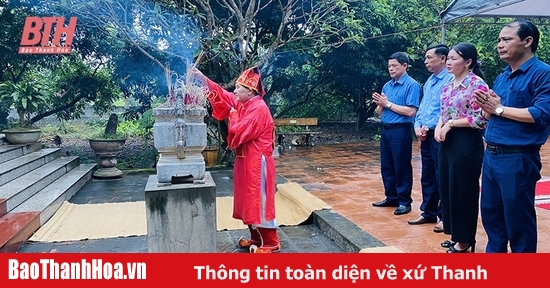

The old shrine no longer exists, so the villagers have used the old cultural center as a place of worship for Cao Son Dai Vuong. On every holiday, festival, or on the 15th and 1st day of the lunar month, the villagers still come to the cultural center to offer incense and small offerings to express their devotion and pray for health and peace... The incense smoke continues to burn, serving as a connection between the present and their roots.
Upon entering this simple worship space, many are delighted to hear the story of the ancient stone turtle resting solemnly before the altar. Mr. Mai Trong Dang, head of Ha Do village, said: “This was originally an artifact from the old village temple. After the temple was demolished, the turtle was lost for many years, until it was accidentally found in 2025 during the construction of the model new rural village.”
It was Mr. Dang who bathed and cleaned the turtle. After a village meeting, they decided to move the turtle into the Cao Son Dai Vuong shrine. Although some people came to inquire about buying it, the village resolutely refused. For them, the turtle is not just an ancient artifact but also a memory of the village, a testament to the old temple, and a symbol of the continuation of tradition.
Besides the shrine dedicated to Cao Son Dai Vuong, Ha Do village also preserves two ancient stone wells, over a hundred years old. These wells stand as silent witnesses of time, holding the memories of the village and the memories of countless generations of Ha Do people.
Mr. Dang recalled: “The presence of the village well reminds us of the arduous, difficult, yet joyful, united, and affectionate times of Ha Do village. At that time, not every household could afford to dig a well, so the village well became a shared space. Every day we would go to the well to bathe, wash clothes, and then carry water home for use. The sense of community and neighborly love was nurtured from that experience.”
Today, Ha Do continues its journey of development. Alongside socio-economic achievements, the title of "Cultural Village" remains a solid foundation; the tradition of valuing education is preserved and extended, crystallizing in successive generations of children. Ha Do village remains one of the exemplary "nuclei," making positive contributions to the cultural, artistic, and sports movements of the commune.
Ha Do is the first village in Hoang Loc commune to achieve the model new rural standard since the commune was established and operates under the two-tiered local government model. Ha Do Party Secretary Le Van Phu affirmed: “Building on the tradition of a cultural village, with the spirit of ‘the people know, the people discuss, the people do, the people enjoy,’ along with the support of the State, the attention and favorable conditions created by the leaders of Hoang Loc commune, and the responsible contributions of the people, especially the heartfelt generosity of those who have left their hometowns and of businesses, Ha Do has effectively mobilized resources to invest in building a model new rural village.”


Looking back on the journey so far, in the hearts of the people here, Ha Do is not just a place name but also a source of pride and a symbol of cultural and historical significance. In that village, the tradition of studiousness, patriotism, resilience, and compassionate way of life, preserved through generations, has crystallized into an inherent strength. This is also the foundation for Ha Do today to confidently move forward on its new journey.
Text and photos: Hoang Linh
Source: https://baothanhhoa.vn/lang-ha-do-xua-va-nay-293375.htm