The silent "road construction soldiers"
Many of us have undoubtedly experienced the North-South journey on trains. And to ensure the safety and peace of mind of passengers, there are people who silently and selflessly dedicate themselves day and night to the job of inspecting railway tracks and tunnels.
One day in mid-June, we visited the Le Son road (Van Hoa commune, Tuyen Hoa district) to listen to and experience the work of road and tunnel patrolmen, thereby gaining a better understanding of the "hidden aspects" of this unique profession.
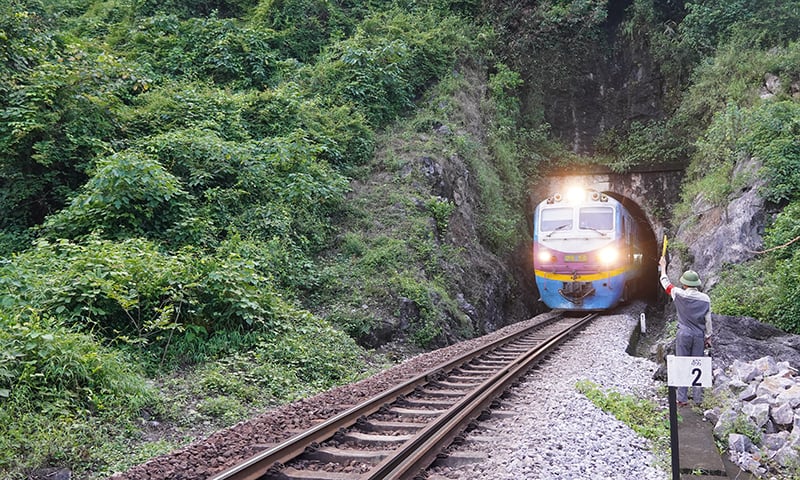
The Le Son Railway Bridge and Tunnel Management Unit is managed by Team 2 of Quang Binh Railway Joint Stock Company. Their main tasks include managing, patrolling the tracks and tunnels, guarding level crossings, and maintaining 37.2 km of railway tracks. Notably, on the section managed by Quang Binh Railway Joint Stock Company, there are 5 tunnels located in Tuyen Hoa district, built during the French colonial period with a total length of 684m. The Le Son Railway Bridge and Tunnel Management Unit manages 2 of these tunnels: tunnel number 4 (over 100m long) and tunnel number 5 (194m long). This is one of the most complex and treacherous sections of the railway line passing through the province. Because the track is located at the foot of the mountains and right on the banks of the Gianh River, it poses a risk of rockfalls or landslides during the rainy season, compromising train safety.
The Le Son Road Supply and Demand Office is located at the end of the fields in Van Hoa commune, next to the Gianh River, but hidden among a range of silver-gray limestone mountains. Without a guide, it would be very difficult to find. Because of its remote and isolated location, the people working there couldn't hide their surprise and joy when we visited and asked to stay overnight to learn about and experience their work.
 |
Deputy Team Leader Nguyen Duy Hieu and Station Chief Mai Dinh Hai, who have spent decades working in the bridge and railway industry and the Le Son railway line, enthusiastically shared: “Since the Dong Hoi-Vinh commuter trains stopped operating, although dozens of trains pass through here every day, very few stop here. And even if they do stop, no one is allowed to get off. Therefore, we are only used to watching passengers pass by, and rarely get to welcome visitors.”
Loneliness is perhaps the most accurate word to describe the lives of the railway track and tunnel inspectors here. At the Le Son Railway and Bridge Construction Unit, the loneliness stems not only from the lack of visitors but also from geographical isolation. Within the old headquarters compound, the inspectors have managed to set aside a communal room, furnished with beds and blankets, to welcome guests, but the room is rarely used.
At the Le Son railway bridge and track maintenance station, the rainy and stormy seasons are the most dangerous. Almost every year, the workers are constantly worried about landslides and falling rocks affecting train safety. But the saddest and loneliest days are the Lunar New Year. Many, due to the demands of their work, have spent New Year's Eve right on the railway tracks five or six times…
In 26 years, I walked more than four times around the Earth.
Following tunnel patrol officer Tran Ngoc Khanh, who is in charge of tunnel number 4, we experienced "going on shift" with him. Khanh explained that "going on shift" is a technical term in the railway industry, similar to "starting a shift" in other technical fields. For tunnel patrol officers like him, "going on shift" means working continuously for 12 hours, requiring strict adherence to schedules and intense concentration. Each day there are two shifts, with two people rotating. The handover time is about 15 minutes to hand over tunnel patrol equipment and sign the status report for the next person on duty.
Together with Mr. Khanh, we walked steadily along each sleeper. While we had to be careful with every step to avoid tripping, Mr. Khanh's steps were steady, his eyes meticulously observing each bolt and screw beneath the rails and sleepers. With his skilled eye, a quick glance was enough for Mr. Khanh to identify any loose bolts and tighten them with a wrench. Mr. Khanh is 49 years old this year, and his entire youth has been dedicated to the railway industry. Starting as a track repair and maintenance worker, he received specialized training before becoming a tunnel patrol officer.
For over 10 years, his footsteps have left their mark on the tunnels and railway tracks in Tuyen Hoa, covering a considerable length. Khanh recounts the duties of a tunnel patrolman: Upon receiving a signal requesting passage for a train through the tunnel, he or his colleagues quickly put on their "professional gear" including flags, signal lights, whistles, and flares, and promptly set off to check the safety of the railway tunnel. Once they reach the end of the tunnel and the station on the other side, he informs the requesting unit that it is safe so they can order the train to proceed.
“The Le Son Railway Station currently has 19 track inspectors and 15 tunnel inspectors, the youngest being 30 years old and the oldest 55. All have many years of experience, a passion for their work, and a high sense of responsibility. The Le Son Railway Station is considered to have relatively rugged terrain, with the Gianh River on one side and rocky mountains on the other, posing a risk of falling rocks onto the tracks or blocking tunnel entrances during the rainy season. However, overcoming these difficulties and hardships, the railway line has always been kept safe over the years, ensuring smooth and safe train journeys on the Trans-Vietnam railway,” shared Mai Dinh Hai, Head of the Le Son Railway Station. |
After the train passed, he had to patrol the tunnel again before returning to his post. The signal requesting passage sounded again, and regardless of the time of day, Khanh and the other tunnel patrol officers had to set out to check. This work repeated itself throughout the day, with an average of 25 trains passing through each day.

The Ministry of Foreign Affairs received a copy of the Letter of Credence for the U.S. Ambassador to Vietnam.On the afternoon of July 2nd, at the Ministry of Foreign Affairs headquarters, Mr. Le Cong Dung, Director of the State Protocol and Foreign Interpretation Department, received a copy of the Letter of Credence from Ms. Jennifer Wicks, Ambassador of the United States of America to Vietnam.

Ambassador Nguyen Quoc Dung visits and works in Minnesota, USA.From June 28-30, the Vietnamese Ambassador to the United States, Nguyen Quoc Dung, paid a visit and worked in Minnesota.

Vietnam encourages US businesses to expand investment in high technology.On the morning of June 26th, at the Government Headquarters, Deputy Prime Minister Ho Quoc Dung received Mr. Jeff Place, Supply Chain Director of Coherent Group (USA). During the meeting, the Deputy Prime Minister affirmed that Vietnam encourages US businesses to expand investment, especially in high-tech, innovation, and semiconductor industries.
After passing through tunnel number 4, we arrived at the guard station at the very end of the tunnel, which was also the time for the shift change. The next person to take over the shift was a relatively young officer named Hoang Duc Hien. Hien took over the second shift at 6 PM and, with 12 hours of continuous duty, he couldn't get any sleep that night. The tunnel patrolmen confided that, to maintain alertness and clarity of mind during their shifts, they had to snatch sleep and rest when off duty to ensure the health of the next shift. Being on duty in the deep mountains and absolutely forbidden to leave their post even for a few minutes, the tunnel patrolmen had to carry their own food and water.
At the Le Son Road and Bridge Construction Site, the most experienced road and tunnel inspector is Mr. Le Hai Chau, 52 years old. He is a small but sturdy man with a quick and agile demeanor. Mr. Chau says he has been in the profession for 26 years. On average, he walks more than 6,000 km each year. Thus, with 26 years dedicated to the road and tunnels, he has walked 156,000 km, equivalent to nearly four times around the Earth…
Phan Phuong
Source: https://baoquangbinh.vn/xa-hoi/202506/lang-le-nghe-tuan-duong-ham-o-le-son-2227400/