

 |
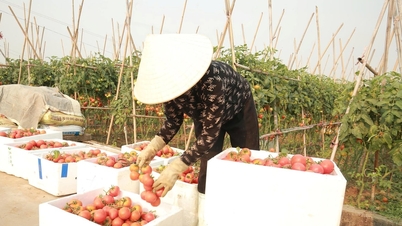
| Ms. Le Thi Thin harvests vegetables from her family's garden. Photo: An Nhon |
This model not only provides a source of fresh vegetables for the market, but also helps many families stabilize their lives, raise their children to adulthood, and contribute to a new look for neighborhood 4C.
From barren land to a green vegetable farming area.
One afternoon in early March 2026, we had the opportunity to visit a specialized vegetable farming area in neighborhood 4C. Under the gentle late afternoon sun, the rows of vegetables appeared lush and green. Rows of mustard greens, sweet cabbage, spinach, amaranth, lettuce, and many other herbs thrived, creating a rare "green patch" amidst the bustling residential area.
According to long-time residents, more than 30 years ago, this area was still quite undeveloped. Houses were sparse, many plots of land were vacant, and overgrown with weeds. Around 1994, people from many provinces and cities began to come and settle here. Recognizing the fertile land, they invested in plowing and trying to grow some types of vegetables. At that time, vegetable farming was mainly on a small scale, primarily for family meals. When there was a surplus of vegetables, people would take them to the market to sell and earn extra income.
Over time, the locals realized that the climate and soil here were very suitable for growing green vegetables. Meanwhile, the rapid development of industrial zones in the province and surrounding areas led to an increasing number of workers, and the demand for green vegetables surged. Recognizing this potential, some pioneering households invested in larger-scale vegetable farming and achieved considerable economic success. From there, many other households learned from them and followed suit, gradually forming the specialized year-round vegetable farming area that exists today.
When vegetable farming began to generate stable income, people boldly invested in infrastructure and applied new techniques to production. Initially, they dug or drilled wells to secure a reliable water source for irrigation instead of relying entirely on rainwater. Later, many households invested in machinery for production, significantly reducing labor.
Over the past 10 years or so, automatic irrigation systems have become widely used. This has made the work of vegetable growers much easier. Simply flipping a switch automatically sprays water throughout the garden. In addition, many households use netting to cover the entire garden to protect against heavy rain, intense sunlight, and harmful insects. Thanks to these solutions, the yield and quality of vegetables have improved significantly.
Mr. Dong Van Quang, Party Secretary and Head of Ward 4C, said: Currently, the specialized vegetable farming village here covers an area of more than 10 hectares with over 100 households participating in production. The vegetable growing area is mainly concentrated in groups 43, 44, 45, 54... The vegetables from Ward 4C are currently supplied to many large wholesale markets in Dong Nai province and Ho Chi Minh City, and then distributed to smaller markets to serve consumers.
“Over the past period, local authorities and organizations have regularly disseminated information and provided guidance to help people produce efficiently. At the same time, they have created conditions for farmers to participate in technical training courses and access preferential loans to invest in developing models… Thanks to this, many families have achieved stable lives and have the means to provide their children with a full education,” Mr. Quang shared.
After more than three decades of formation and development, the specialized vegetable farming area in Ward 4C has significantly contributed to changing the lives of the local people. What were once barren lands have now become lush green vegetable gardens. Temporary houses have gradually been replaced by sturdy, spacious buildings… This demonstrates the resilience and determination of the hardworking farmers of Trang Dai.
Examples of overcoming difficulties
Following the local officials, we visited the nearly 2,000 square meter vegetable garden of Ms. Le Thi Thin's family (Group 43). This vegetable farming model has been the main source of income for her family for many years.
Mrs. Thin recounted: Twenty-six years ago, after getting married, she and her husband left their hometown in Nam Dinh and moved to Dong Nai to start a new life. With their dowry from their parents and some borrowed capital from relatives, they bought this large plot of land to begin their new life. In the early years, the family faced many difficulties. Lack of capital and experience meant that vegetable farming was ineffective. Low yields and uncertain markets often led to financial losses for the family.
Learning from their initial failures, the couple decided to adopt a "slow but steady" approach. They diligently learned from experienced vegetable growers and sought to establish a stable market for their produce. Thanks to their perseverance and effort, their vegetable garden gradually developed steadily. The quality of their vegetables ensured that traders regularly purchased them. As a result, their family's finances improved, allowing them to renovate their house and provide for their children's education.
Currently, her eldest son has graduated from university and works in the field of automotive repair, while her daughter is in the 9th grade.
The story of how Mr. Nguyen Van Anh and his wife, Mrs. Ton Thi Loan (Group 44), built their business is also a prime example of the resilience of the people here.
In 1990, Mr. and Mrs. Anh left their hometown of Nam Dinh and moved south to seek opportunities for a better life. After many years of wandering, in 1998, the family decided to settle in Trang Dai. At that time, the area was still wild, sparsely populated, and vegetable farming was not yet developed. Nevertheless, Mr. Anh boldly bought a 2,000 m² plot of land to start growing vegetables.
With their diligent and inquisitive nature, the couple tirelessly weeded, improved the soil, and tended to their vegetable garden every day. Besides learning from experienced farmers, he actively participated in technical training courses organized by the local authorities and furthered his knowledge through books, television, and the internet. As a result, their vegetable farming model became increasingly effective. From this income, the couple built a spacious house and raised their two children to adulthood.
“My eldest daughter is currently working at a school in the province, and my son, after finishing high school, has become a motorcycle mechanic and has a stable job. Seeing our children grow up and become independent makes my wife and I very happy,” Mr. Anh shared.
An Nhon
Source: https://baodongnai.com.vn/kinh-te/202603/lang-rau-xanh-giua-long-do-thi-d4a20e5/
![[Photo] General Secretary and President To Lam presides over a working session with the Central Policy and Strategy Committee on the development of the materials industry.](https://vphoto.vietnam.vn/thumb/1200x675/vietnam/resource/IMAGE/2026/05/21/1779359935432_a3-bnd-3129-1412-jpg.webp)






































































Comment (0)