



Tourism students doing internships at tourism businesses. (Photo: HANOI OPEN UNIVERSITY)
Retaining the current workforce, attracting those who have left, and providing additional training to ensure a quality workforce are urgent challenges facing Vietnam's tourism industry.
Insufficient in quantity, weak in quality.
The COVID-19 pandemic, which has lasted for more than three years with complex developments, has severely disrupted the tourism supply chain and negatively impacted the workforce in the tourism industry. According to the Vietnam National Tourism Administration, in 2021 alone, only 25% of the workforce in the industry worked full time, 30% were laid off or had their employment contracts terminated, 35% were temporarily laid off, and 10% worked intermittently.
The phenomenon of labor migration and the "brain drain" of tourism personnel to other industries has been intense, not only during the pandemic but also in the post-pandemic period. This is due to many people's lingering concerns about the industry's instability and dependence on major external shocks like the Covid-19 pandemic. Meanwhile, many workers who have switched industries have found stable new jobs and are therefore reluctant to return. This poses a significant challenge for the tourism industry in recovering and improving the quality of its workforce to meet the demands of an increasingly competitive market.
Reports from 46 out of 63 localities nationwide on the state of human resources in tourism show that most provinces and cities that are major tourist destinations, such as Hanoi , Ho Chi Minh City, Khanh Hoa, Quang Ninh, Ninh Binh, etc., are facing labor shortages. Only a few localities, such as Da Nang, Thua Thien Hue, and Ca Mau, assess that their human resources are temporarily able to meet the requirements of serving tourists due to the slow recovery of tourist numbers and low hotel occupancy rates.
According to calculations by the Vietnam National Tourism Administration, with the current growth rate, the tourism industry needs 40,000 new employees and 25,000 employees requiring retraining each year. However, schools only train 20,000 students annually, and the proportion of professionally trained tourism workers remains low, accounting for only 43% of the total tourism workforce, with nearly half lacking foreign language skills.
Thus, Vietnam's tourism workforce is not only severely lacking in quantity but also weak in quality. Dr. Do Thi Thanh Hoa, Deputy Director of the Institute for Tourism Development Research, stated: The workforce in Vietnam's tourism industry still falls short in many aspects of meeting the demands of tourism development in the context of a knowledge-based economy and increasingly deep international integration. The number of personnel is still small, the structure is not synchronized, and practical skills do not match qualifications. There is a shortage of highly qualified and skilled personnel, and an increasing lack of leading figures to serve as the core for training young talent. Knowledge of integration, foreign languages, computer skills, creativity, leadership, management, administration, and practical experience are limited and do not correspond to the development requirements of the industry.
Developing high-quality human resources.
Speaking at the seminar "Vietnam's Tourism Human Resources in the New Context - Challenges and Prospects" organized by the Institute for Tourism Development Research, Dr. Pham Le Thao, from the Travel Management Department of the Vietnam National Tourism Administration, stated that to restore tourism human resources, it is necessary to continue implementing policies to support businesses in maintaining operations, such as providing credit support, reducing taxes and fees, etc., to help businesses attract workers back. In addition, it is necessary to conduct surveys and research on the current state of human resources in businesses, thereby clearly identifying the quantity, structure, and quality requirements to develop specific plans for training and developing tourism human resources.
To ensure a sufficient and high-quality workforce, experts believe it is essential to invest in the tourism workforce training system. According to Associate Professor Dr. Bui Thanh Thuy, Head of the Tourism Department at Hanoi University of Culture, relevant ministries, sectors, and localities need to adjust the planning of the tourism training network to ensure it aligns with the development of each region; invest in schools under the Ministry of Culture, Sports and Tourism to serve as the core for training tourism personnel at all levels in key tourism centers. Simultaneously, establish tourism training departments in local vocational schools; and encourage the opening of tourism training facilities in private enterprises and those with foreign investment, in accordance with the law. It should be noted that, due to the diverse nature of tourism labor at various levels, from simple (professional) to complex (supervision, management), the tourism training system must ensure continuous training from lower to higher levels and diversify training methods: on-site, distance learning, collaboration with businesses to establish practical training schools, on-site learning and testing; training through joint programs or franchise programs, online training, etc., creating a favorable environment for learners. Emphasis should be placed on training vocational skills linked to integration needs, prioritizing the development of new skills in tourism labor to meet development demands, including green labor skills, sustainable work, and responsibility, to keep pace with regional development, while also enhancing foreign language proficiency and soft skills such as communication and teamwork in a multicultural environment.
For tourism businesses, in order to retain current employees, attract new ones, and encourage experienced and skilled tourism professionals who have left to return, establishing appropriate salary levels and a friendly, civilized working environment is extremely important.
Dr. Ha Thanh Hai, Director of Lang Co Tourism Co., Ltd., emphasized: Providing income commensurate with employees' abilities and having a salary and bonus policy linked to each individual's task completion based on business results is the key to minimizing employee turnover. In addition, it is necessary to build a welfare system with clear terms: working hours, rest hours, overtime, working on holidays, rewards for outstanding employees…; social insurance contributions, gifts on holidays, birthdays, vacation allowances… to retain employees and encourage long-term dedication.
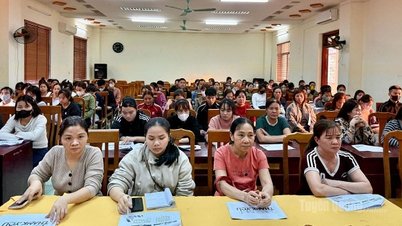
The collaboration between businesses and schools in training and recruiting high-quality human resources is crucial. Businesses can build and maintain cooperative training relationships with vocational training institutions, secondary and higher education colleges specializing in tourism, and universities offering tourism and hotel management programs at the undergraduate level. This can be done in various ways, such as: providing facilities (locations) for students to learn and practice skills; participating in the training process; and accepting students for paid internships. This cooperation not only helps address labor shortages during peak seasons but also creates the best recruitment source for businesses, as students have already received vocational training, acquired knowledge, and become familiar with the work and practical experience.
Source




![[Photo] Rich in color and flavor, Spring Fair - Nhan Dan Newspaper Trade Union](https://vphoto.vietnam.vn/thumb/1200x675/vietnam/resource/IMAGE/2026/03/05/1772699709633_img-2781-2340-jpg.webp)


















































































Comment (0)