After discussing green and blue landscape painting, we will now talk about ink landscape painting and literati painting. In the history of Chinese painting, there is a peculiar phenomenon: poets played an extremely important role. It can be said that without poets, Chinese painting would have a completely different appearance.
Wang Wei, an outstanding poet of the Tang Dynasty, was also a painter, [but] perhaps not many people know about his latter role. Most people cannot answer what kind of paintings he created. In fact, he holds a very high position in the history of Chinese painting, being the founder of ink landscape painting and also the progenitor of literati painting.
Wang Wei, whose courtesy name was Vimalakirti, was from Qizhou , Taiyuan Province (now Qizhou County, Shanxi Province). His name itself reveals him to be a devout Buddhist. Among the Chinese literati, the most beloved Buddhist figure was Vimalakirti. Wang Wei separated the three characters in "Vimalakirti," taking "Wei" as his given name and "Maji" as his courtesy name.
Wang Wei passed the imperial examination at the age of 20. Because of his musical talent, he was appointed as the Grand Music Minister, a minor official in charge of music in ceremonial rituals. Later, due to a theatrical performer's unauthorized performance of the golden lion dance, which was reserved only for the emperor, he was implicated and demoted to a merchant military officer in Jizhou.
In the 27th year of the Kaiyuan era, Wang Wei returned to the capital and served as an official in the imperial court. Later, he was promoted to the fifth-rank position of Minister of the Treasury, in charge of weapons and ceremonial regalia. He was then transferred to the position of Minister of the Ministry of History, in charge of official personnel. Although his official career was smooth, Wang Wei, having studied Zen Buddhism, was indifferent to fame and fortune, had few desires, and was not keen on power. He followed the natural order of things, devoting his affection to the mountains and rivers, living a life of semi-official, semi-reclusive living. Initially, he lived in seclusion in the Zhongnan Mountains, and in his old age, he lived in seclusion at Wangchuan Lantian at the foot of the Zhongnan Mountains. He would either spend his days playing the zither, reciting poetry, and singing on the flute, or practicing Taoism and Buddhist meditation, returning to his true nature and harmonizing with the natural world.
But life did not depend on Wang Wei's will. Just as he was enjoying a life of leisure, a storm arose in society. This was the rebellion launched by An Lushan when Wang Wei was 54 years old, and Wang Wei became a prisoner of the rebels.
After Wang Wei was captured, deep down, he was willing to be a loyal subject and did not want to submit to the rebels, but he could not resist An Lushan's threat and could not fight to the death. He once wrote the poem "A hundred officials are restless, longing for the day of audience" ¹ , clearly expressing his political stance, and it was this very poem that saved his life after Emperor Suzong suppressed the rebellion.
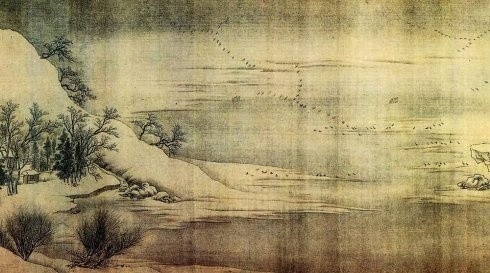 |
Jiang Gan's Snowy Dew – Wang Wei, Tang Dynasty. Photo: old888 |
In his final years, Wang Wei lived in solitude and suffering. “Sparrows sing in the deserted village, roosters crow in the empty house, loneliness returns, sighs and laments” ² . Perhaps at this time only painting could alleviate some of the sorrow in his heart.
He wrote: “Old age breeds laziness in reciting poetry, Today and tomorrow old age will follow closely behind. The painter's former profession is still attached, Bearing the name of a scholar, he utters a few ambiguous words.”3
Most of Wang Wei's ink landscape paintings that have survived to this day are copies made by later generations. Two notable examples are "Jiang Gan Xue Ji Tu" (Snow Stops Falling at Jiang Gan) and "Chang Jiang Ji Xue Tu" (Snow Covers the Yangtze River).
--------------
1. Excerpt from the poem "Ngưng Bích Trì," reference translation in Wang Wei's Selected Poems, translated by Giản Chi, Literature Publishing House, 1995.

2. Excerpt from the poem "Revenge for the mistakes of the officials."
2. Excerpt from the poem "Randomly Composed, Part 6," reference translation in Wang Wei's Selected Poems, op. cit.
Source: https://znews.vn/bi-kich-doi-nguoi-va-di-san-nghe-thuat-cua-vuong-duy-post1660556.html
![[Image] Schools organize meetings and introduce teaching models to students admitted to grade 10.](https://vphoto.vietnam.vn/thumb/1200x675/vietnam/resource/IMAGE/2026/06/25/1782368077271_ndo_br_z7970052192242-1ec8daeb77a6eed1a4e9f58c564ddd3e-jpg.webp)

![[Image] Ho Chi Minh City: Ma Lang area, Chicken-Rice Market about to change its appearance](https://vphoto.vietnam.vn/thumb/1200x675/vietnam/resource/IMAGE/2026/06/25/1782377698627_ndo_br_m1-jpg.webp)
![[Photo] General Secretary and President To Lam receives Palestinian Ambassador Saadi Salama](https://vphoto.vietnam.vn/thumb/1200x675/vietnam/resource/IMAGE/2026/06/25/1782365384740_a1-bnd-9423-8322-jpg.webp)