

Waking up after a night's sleep, 11-year-old PNC from Hanoi couldn't smile properly, her left eye wouldn't close completely, and her face was noticeably asymmetrical. Her family panicked and rushed her to the Department of Traditional Medicine and Rehabilitation at the National Hospital for Tropical Diseases.
The examination results showed that the child had peripheral facial nerve paralysis (cranial nerve VII) due to exposure to cold. According to the patient, the day before, while going to school, she took off her jacket and wore only a thin shirt all day in the extremely cold weather.
Dr. Le Nguyen Long, Head of the Traditional Medicine and Rehabilitation Department, said that after a week of treatment with medication combined with physical therapy and rehabilitation, the child's facial muscle movement improved significantly.
Not only children, but also the elderly are susceptible. Mr. NVN (58 years old, from Hanoi) experienced a sore throat and left ear pain when the weather turned cold and was diagnosed with otitis media at a nearby medical facility. Three days later, his condition did not improve, and he began to have facial asymmetry, difficulty speaking, and inability to close his eyes completely.
Fearing a stroke, his family took him to the National Hospital for Tropical Diseases. A CT scan of the brain ruled out cerebral vascular damage, but doctors determined he had left peripheral facial nerve paralysis due to complications from acute otitis media, along with vocal cord paralysis. The patient had a history of hypertension and several underlying conditions that weakened his immune system. After 10 days of intensive treatment, his condition improved significantly.
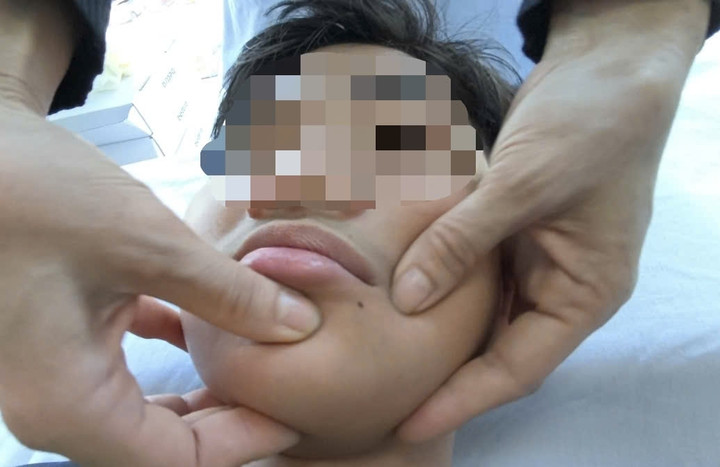
The extremely cold weather in recent days has caused many people to suddenly experience facial paralysis.
Similarly, Mrs. BTT (83 years old, from Hanoi) experienced facial asymmetry and inability to close her eyes completely after returning from breakfast in cold weather and was diagnosed with peripheral facial nerve paralysis (cranial nerve VII).
According to Dr. Long, cranial nerve VII controls facial muscle movement and is involved in taste transmission, tear secretion, and saliva secretion. This nerve passes through a narrow bony canal in the temporal bone, making it very sensitive and prone to edema.
When the head, face, and neck are suddenly exposed to cold, blood vessels constrict, causing ischemia, triggering an inflammatory response, leading to edema and nerve compression, resulting in disrupted nerve impulse transmission to the facial muscles. Cold weather also creates conditions for viruses, especially herpes simplex type 1 (HSV-1), to reactivate, worsening inflammation and causing sudden facial paralysis.
Patients often experience symptoms quickly; in many cases, upon waking up, they notice a crooked mouth, an uneven smile, difficulty speaking, drooling or tearing on the affected side, inability to close the eye completely, and a dull pain behind the ear. These symptoms develop over a few hours to one or two days but do not cause any disturbance of consciousness.
Dr. Long noted that facial paralysis caused by cold exposure is usually not accompanied by weakness in the limbs, numbness on one side of the body, or central speech disorders like stroke. However, because the drooping of the mouth is quite similar to stroke, many people easily mistake it, leading to delayed hospitalization or incorrect treatment. The golden time for treating peripheral facial nerve paralysis is the first 72 hours, aiming to reduce edema, protect the myelin sheath, and increase the chances of complete recovery of facial muscle function.
To prevent illness, doctors advise people to keep their head, face, and neck warm when going out in cold weather; avoid having fans or air conditioners blowing directly on their faces, especially while sleeping; and avoid showering late at night or suddenly pouring cold or hot water on their heads and faces.
When symptoms such as a drooping mouth, facial asymmetry, or inability to close the eyes completely appear, patients should go to a specialized medical facility for examination, to rule out stroke, and to receive timely treatment.
Besides medication, patients need to protect the affected eye with artificial tears, cover the eye while sleeping, combine physical therapy, facial muscle exercises, and traditional medicine methods such as acupuncture and massage. Doctors advise against self-treating with unproven folk remedies at home.
Source: https://baolangson.vn/liet-day-than-kinh-so-7-do-ret-dam-5074589.html

































































































Comment (0)