


Artificial intelligence (AI) offers many promising prospects for banks as it makes daily tasks more efficient. Complex analysis and risk modeling are also performed more easily and quickly thanks to this tool.
According to Business Insider , AI has actually been revolutionizing Wall Street for years, with most transactions now being executed by algorithms. By processing received information, analyzing it, and making buy or sell decisions, algorithms are helping to execute 60-75% of daily transactions on Wall Street, the financial center of New York City. However, the question now is whether this percentage could be higher and whether AI will completely take over human jobs in profit-making?
The race to apply AI
Wall Street is anticipating a significant impact from AI on financial trading. According to a survey by JPMorgan, one of the world's oldest financial services firms based in New York, 53% of traders believe AI or machine learning will be the most influential technology in trading over the next three years (compared to 25% in 2022).
According to new data from the US consulting firm Evident, at the most developed banks, approximately 40% of job openings are related to AI, such as data and quantitative engineers, administrators, etc.
Eigen Technologies, a New York-based global technology company that provides AI services to banks such as Goldman Sachs and ING, said that AI requests from banks increased fivefold in the first quarter of 2023 compared to the same period last year.
Alexandra Mousavizadeh, CEO and co-founder of Evident, said that the release of ChatGPT by Open AI (US) in November 2022 made bank leaders more aware that AI is a game-changer in the banking sector because of its many prospects. Mousavizadeh emphasized: "The cost of AI talent has increased significantly. An AI race has begun."
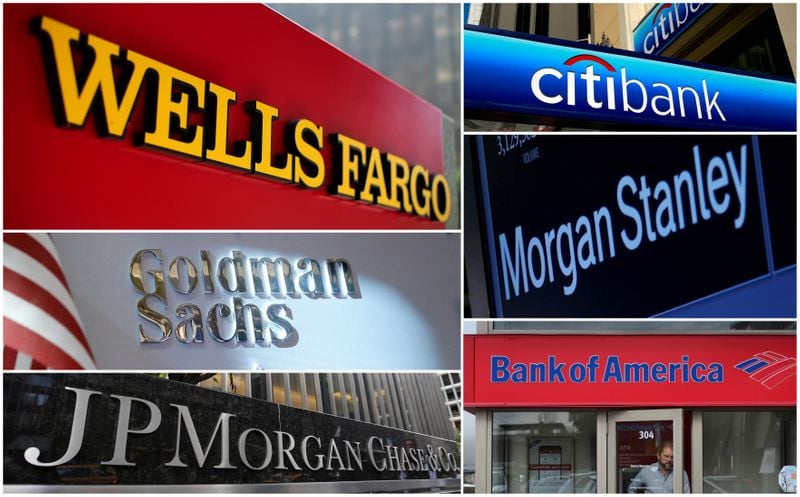
More and more banks on Wall Street are adopting AI technology.
A prime example of AI usage in the finance and banking sector is the development by Deutsche Bank, Germany's largest private banking group, of a product capable of analyzing whether its clients' investments are at risk. The bank also uses this tool to find funds, stocks, and bonds that suit the needs and desires of each client.
Kirsten Anne Bremke, Head of Global Data Solutions at Deutsche Bank, is a positive advocate for the integration of artificial intelligence and human intelligence.
The multinational banking and financial services group ING (Netherlands) is using AI to screen potential defaulters. Meanwhile, Morgan Stanley is in the race to use AI, experimenting with new AI technologies using Large Language Models (LLM). Morgan Stanley currently holds a patent for a model that uses AI and machine learning to determine whether information from the US Federal Reserve (Fed) indicates a dovish or hawkish policy, thereby helping them predict monetary policy actions.
JPMorgan also has similar plans. In a patent application filed in May, the bank stated that it had created a product like ChatGPT capable of assisting investors in selecting suitable stocks. Evident data shows that through global advertising, JPMorgan recruited 3,651 AI-related positions between February and April, nearly double that of rivals Citigroup and Deutsche Bank.
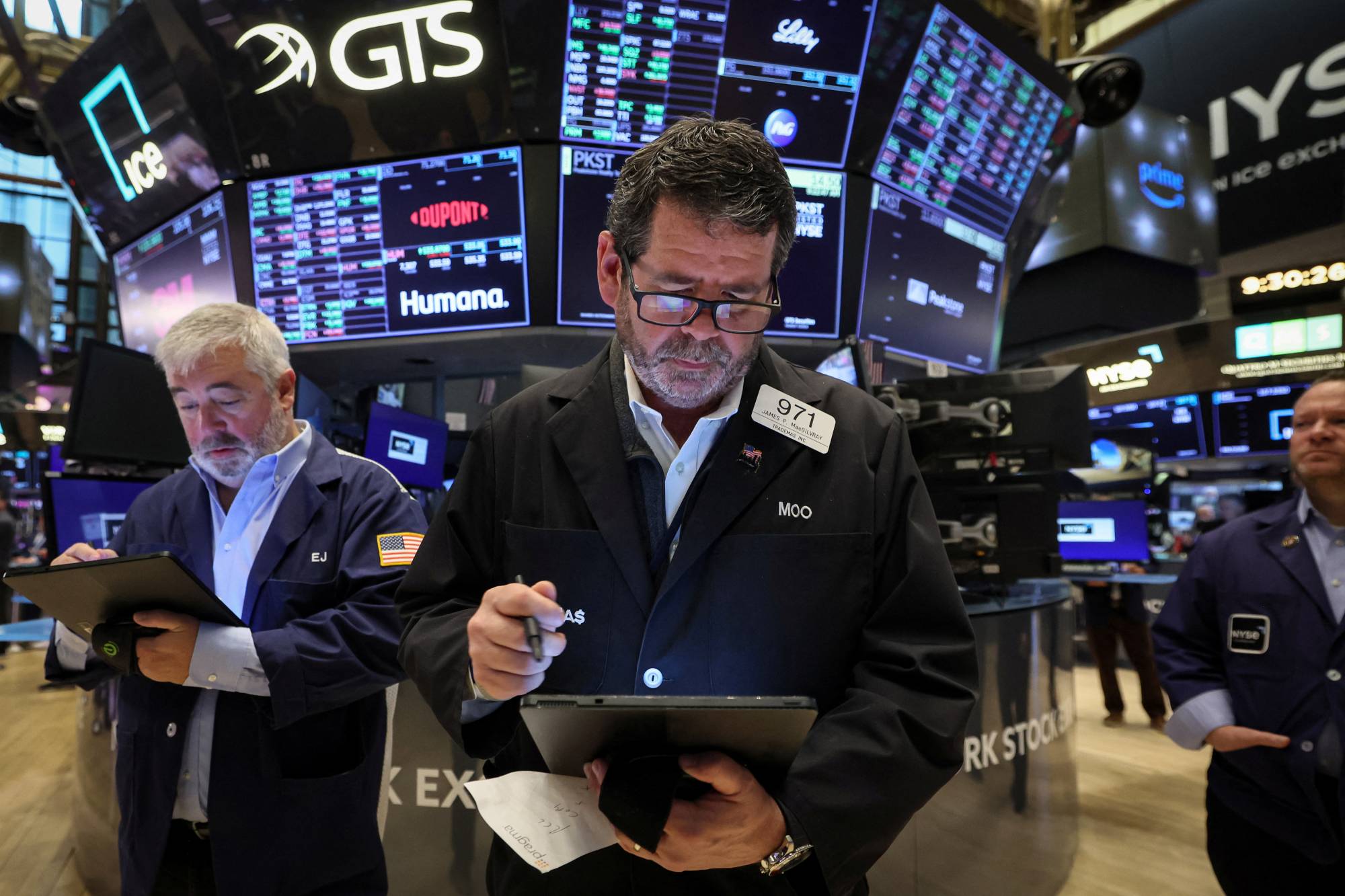
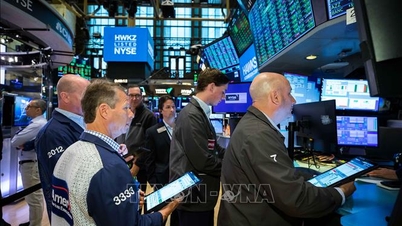
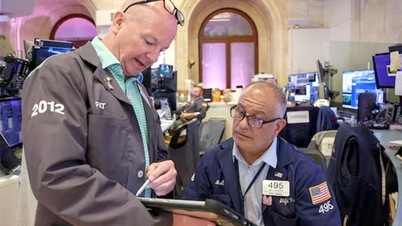
Traders at the New York Stock Exchange
Steven Burrows, director of the multinational law firm Fieldfisher, said that banks are using AI to provide more suitable risk hedging solutions through tools such as interest rate swaps and equity derivatives, allowing them to offer better prices to clients. Meanwhile, Yuriy Nevmyvaka, head of machine learning research at Morgan Stanley, said: "Every business, trading department, and investment team is trying to gain a deep understanding of AI."
Wells Fargo, a US bank, is using big language models to help determine what information customers need to report to regulators, while also helping them improve their business processes. Meanwhile, BNP Paribas, a French bank, is using chatbots to answer customer inquiries and employing AI to detect and prevent fraud and money laundering. Similarly, Cast, the AI-powered monitoring and analysis tool of Societe Generale (France), uses its computing power to scan for potential wrongdoing in capital markets.
Governments around the world are racing to find ways to regulate AI tools.
Transparency and efficiency
While the increased application of AI in the finance and banking sectors brings positive changes, it also poses significant challenges to the financial market: from the risk of job losses to the transparency and efficiency of this technology.
First, the risk of future job losses will increase significantly. Goldman Sachs analysts fear that 300 million full-time jobs globally could be automated by AI. That number could include 35% of the business and financial sector in the US.
Billionaire Warren Buffett, Chairman of Berkshire Hathaway Inc., expressed concern at the company's annual shareholders' meeting on May 6th, stating: "When something can do all sorts of jobs, I feel a little worried. Because I know we can't reverse this trend." Sharing this view, Brian Moynihan, CEO of Bank of America, assessed that AI could bring enormous benefits and reduce many tasks, but it's crucial to understand how the workflow and decision-making process works.

While the application of AI has positive impacts, it also comes with challenges.
Secondly, transparency is a particularly important issue when expanding the use of AI in the banking and finance sector. Banks are obligated to conduct transactions and make transaction decisions based on verified information. According to expert Anne Beaumont, a partner at the law firm Friedman Kaplan Seiler Adelman & Robbins LLP (USA), once AI is widely used, it becomes very difficult to explain to customers and regulators what data the bank relied on to make decisions and whether the use of that data was justified.
Furthermore, according to Professor Alan Blackwell, a computer science and technology professor at the University of Cambridge (UK), banks need to use big data from various sources to "train" AI tools, and many problems will arise from this.
Third, the cost of developing and operating AI tools is very expensive. Lewis Z. Liu, founder and CEO of Eigen Technologies, stated that the estimated cost of using large-scale language models to answer client questions is around $14 per question, while the cost for lawyers to answer is only around $6 per question.
While the role of AI in Wall Street trading is not new, many analysts are talking about a future where AI could completely replace humans in financial transactions and generate profits, especially given the booming and widespread application of AI. Today, banks are in an enthusiastic race to develop and apply AI to increase business efficiency, thereby driving rapid changes in the banking and finance industry in the near future. However, consulting firms all agree that banks need to clearly identify which areas AI will create superior value in order to develop a clear AI application strategy. In addition, they need to focus on employee training, recruiting more experts, and establishing a new risk management framework to address issues related to AI, the unclear policy environment for AI application, and issues related to data accuracy.
Source link

![[Photo] Head of the Central Propaganda and Mass Mobilization Department visits and congratulates the Ministry of Health and the Military Traditional Medicine Institute.](https://vphoto.vietnam.vn/thumb/1200x675/vietnam/resource/IMAGE/2026/02/24/1771938483290_img-2682-3562-jpg.webp)





























![[Image] A dreamy "livable city" under pink clouds](https://vphoto.vietnam.vn/thumb/1200x675/vietnam/resource/IMAGE/2026/02/24/1771930060937_tp4-jpg.webp)
![[Photo] White pear blossoms bloom across the border of Pho Bang](https://vphoto.vietnam.vn/thumb/1200x675/vietnam/resource/IMAGE/2026/02/24/1771927665653_a8-8280-jpg.webp)






































































Comment (0)