


Living heritage in community life
Along the major rivers of the Northern Delta, many traditional rituals have emerged to honor water resources, among which the water procession ceremony at the Forest Temple (Bo De Ward, Hanoi ) is a ritual deeply rooted in ancient culture.
Taking place annually during the Lantern Festival (the 15th day of the first lunar month), the water procession at the Forest Temple is a spring festival activity that attracts widespread community participation.
It is a cultural ritual that embodies multiple layers of meaning: honoring nature, showing gratitude to one's origins, and preserving the spiritual connection of the communities living along the Red River.
Vietnamese cultural history is closely linked to its major rivers. The Red River, with its alluvial deposits accumulated over thousands of years, not only formed a fertile delta but also nurtured a unique system of folk beliefs.
Within that ritual system, the water procession ceremony (also known as the bathing ceremony) holds special significance.

For agricultural communities, water is the source of crops and a condition for sustaining life. Taking water from a large river to offer to the gods is a deeply symbolic act: people entrust their faith in the harmony between nature and community life.
The water procession ceremony is therefore both a spiritual ritual and a cultural philosophy. Water is considered the essence of heaven and earth, possessing purity, the ability to cleanse and bring blessings to the community.
At the Forest Temple, this ritual has been maintained through many generations, becoming an indispensable part of the spiritual life of the people in the Gia Thuong - Bo De region, where many layers of cultural sediment along the Red River are still preserved.
The Forest Temple is dedicated to the Four Sacred Deities, the Two Goddesses, the patron saints and deities of the land, and the temple's guardians who have contributed to maintaining religious activities at the site. The Forest Temple is a center for practicing the Mother Goddess worship culture and organizing many important local cultural events.
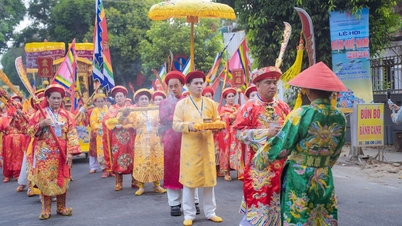
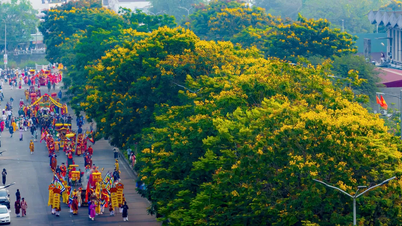
The festive atmosphere is prepared days before the official ceremony takes place. Local people dress up in traditional costumes, prepare dragon palanquins and banners, and practice procession rituals to ensure the ceremony is solemn and orderly.
The water procession team usually consists of healthy young men and women, carefully selected to reflect the solemnity of the ceremony. As the procession sets off, the sound of drums, traditional music, along with ceremonial flags and lion dances, creates a vibrant atmosphere of the new spring.

The most important part of the ceremony is fetching water from the Red River. Traditionally, the water must be taken from the middle of the river, considered the cleanest and purest. The water is placed in a large porcelain jar, respectfully carried on an eight-sided palanquin, and carried to the temple with the reverence of the community.
The moment the sacred water is placed in the temple is the most sacred moment of the ceremony. In that instant, people express their good wishes: praying for national peace and prosperity, favorable weather, abundant harvests, and a peaceful and prosperous life.
After being brought back, the water is filtered and used as sacred water during religious ceremonies at the temple, and is also distributed to locals and visitors as a symbol of blessings at the beginning of the year.
This year, the festival is even more significant as it coincides with the announcement of the City-level Historical and Cultural Relic Ranking Certificate for Gia Thuong communal house and Rung temple, according to Decision No. 1168/QD-UBND dated February 28, 2025, of the Hanoi People's Committee.
The procession of the Certificate of Relic from Gia Thuong communal house to Rung temple marked an important milestone, affirming the historical and cultural value of the area within the cultural flow of Thang Long - Hanoi.
According to artisan Hoang Xuan Mai, the head priest of the Rung Temple, the water procession is a way for people to express their gratitude to the deities, Buddha, and the Holy Mother, while also conveying their hopes for a year of favorable weather, abundant harvests, and a peaceful life. The water is taken from the middle of a large river to symbolize the purity and blessings of nature.
For the locals, the water procession has become a part of their generational cultural memory. Ms. Le Thi Hanh, a resident of Gia Thuong, said that this tradition has existed for a long time, passed down by the elders.
In recent years, the festival has been organized on a larger scale, attracting a large number of locals and tourists, contributing to the revival of many traditional cultural values.

Preserving the cultural heritage
In the context of a rapidly changing modern society, traditional rituals like the water procession at the Forest Temple hold special significance. They are not only religious activities but also a way to preserve community memories and educate the younger generation about traditions.
Through the ceremony, participants are reminded of the principle of "drinking water, remembering the source," and the harmonious relationship between humans and nature – a core value of Vietnamese culture.
As artisan Hoang Xuan Mai, the caretaker of the Rung Temple, shared, heritage is not something that lies dormant within the temple grounds, but only truly comes alive when it is inherited and practiced by the community in daily life.
The water procession at the Forest Temple is therefore not only a traditional ritual, but also a vivid testament to the vitality of national culture in contemporary life.
Amidst the increasingly vibrant urban life of Hanoi today, the sacred water carried from the Red River to the Forest Temple still carries the enduring message of tradition: preserving our roots, cherishing nature, and safeguarding the cultural identity of the community through generations.

Source: https://baovanhoa.vn/van-hoa/linh-thieng-le-ruoc-nuoc-den-rung-208652.html



![[Podcast] News April 18th: Prosecution recommended for fake milk production ring that profited over 39.5 billion VND.](https://vphoto.vietnam.vn/thumb/402x226/vietnam/resource/IMAGE/2026/04/18/1776529373899_hnm-1cdn-vn-2026-04-18-7f25856c3e-_suagia-1776297813538-1776319789174-1776392501457-17763925017911244622126.jpeg)












































Comment (0)