

Diamonds and peridot are two gemstones that could compete for the title of the deepest-forming gemstones beneath the Earth's surface.
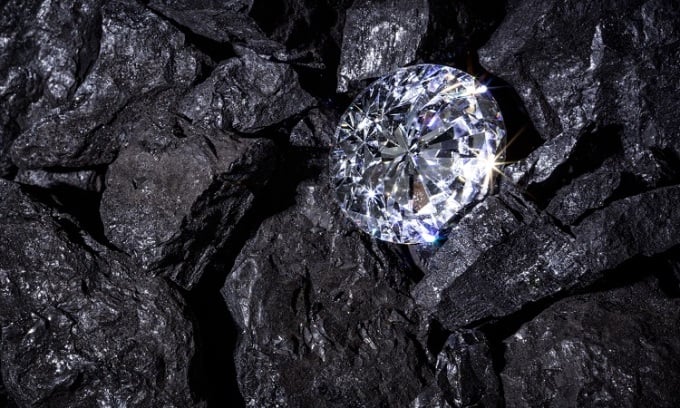
Diamonds formed in the Earth's mantle billions of years ago before being pushed to the surface. Photo: Live Science
According to Lee Groat, a mineralogist at the University of British Columbia, the deepest-formed gemstone known to researchers is the diamond, highly valued for its beauty, industrial applications, and the scientific data it contains. However, scientists still don't fully understand how diamonds form. Laboratory tests show that diamonds only crystallize under extremely high pressure. Most natural diamonds are found in the upper mantle, at depths of 150-300 km, where pressure can reach over 20,000 atmospheres.
For a long time, diamonds competed with peridot for the title of the deepest-forming gemstone. Peridot is a form of the mineral olivine that makes up more than half of the upper mantle, extending from the base of the crust to a depth of 410 km. But in 2016, scientists described a collection of ultradeep diamonds located 660 km underground, and another batch in 2021 was identified as coming from a depth of 750 km. "It's very difficult to determine whether diamonds or peridot are the deepest-forming gemstones," Groat told Live Science on October 22.
To arrive at these estimates, scientists study the diamond's crystal structure as well as impurities, mineral fragments, or fluids encased within the stone during its formation. The presence of bridgmanite and iron-nickel-carbon-sulfur minerals reveals to researchers that ultradeep diamonds likely originate in the underlying mantle, which is composed of approximately 75% bridgmanite, and that they develop from liquid metal surrounded by methane. At this depth, the pressure can exceed 235,000 atmospheres.
Diamonds are also believed to be extremely ancient. Some estimates suggest that diamonds on Earth today formed 3.5 billion years ago. Their long lifespan stems from the strength of their chemical bonds. Diamonds are composed of carbon, and because they form under high pressure, a large force is needed to break their bonds. Heating diamonds to over 900 degrees Celsius will cause them to transform into graphite.
Gemologists don't need to dig deep into the earth to study diamonds, as the deepest drill hole ever made is the Kola superdeep borehole in Russia (12.6 km). Instead, diamonds are brought to the surface by a unique type of magma called kimberlite. Kimberlite magma is typically volatile, erupting at speeds of 30 m/s and carrying diamonds from the surrounding rock. In this way, gemstones formed billions of years ago erupt to the surface within a few months, or even a few hours.
Beyond their aesthetic value and natural hardness, which can be used for blades, drill bits, and polishing powder, diamonds contain invaluable scientific information, according to Ananya Mallik, an experimental gemologist at the University of Arizona. In many cases, diamonds are the only source that helps researchers understand the Earth's internal structure and the processes occurring within it.
An Khang (According to Live Science )
Source link

![[Image] National Assembly discusses the implementation of the socio-economic development plan.](https://vphoto.vietnam.vn/thumb/1200x675/vietnam/resource/IMAGE/2026/04/20/1776696707422_ndo_br_img-20260420-185419-jpg.webp)
![[Photo] General Secretary and President To Lam meets with National Assembly delegates from ethnic minorities.](https://vphoto.vietnam.vn/thumb/1200x675/vietnam/resource/IMAGE/2026/04/20/1776696701056_a1-bnd-8331-3342-jpg.webp)








































































































Comment (0)