In the mornings, walking along the canals in rural areas, it's easy to spot groups of people wading in the water to collect periwinkle snails. Groups of 3-5 or more people work together to collect these snails. Each person has a specific task: some collect, others sort. The work starts from 7 a.m. and lasts until 4-5 p.m., requiring continuous immersion in the water. Collecting periwinkle snails demands diligence and hard work.

Locals collect snails. Photo: TIEU DIEN
According to many people who collect periwinkle snails, periwinkle snails usually live in saltwater or brackish water. They often cling to branches at the bottom of rivers and canals, burying themselves in the mud to hide for extended periods. The rainy season is also when periwinkle snails thrive. Because they prefer shallow water, they tend to congregate along canal banks when the water level rises. Periwinkle snails are small, so they need to be raked to catch them.
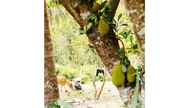
The tools used for collecting snails are quite simple: a small boat for easy transportation, a homemade rake, a basket, and a bag for collecting snails. The rectangular rake, about 60cm wide, is made of iron to increase contact with the canal bottom. The net is made of mesh, about 70cm long, to hold the snails while raking. The snail collector immerses himself in the water so that the rake's mouth is in contact with the ground, then uses his hands to scoop the snails into the net. After dragging it for about 5-7 meters, when the net is full, the collector empties the snails into a basket to wash away the mud, debris, and leaves. To wash the snails, a basket with holes just large enough for the snails to pass through is used, with a mesh bag attached underneath to hold the snails. Each rake can collect 2-5kg of snails. After washing and sorting, the harvested snails are put into bags to be sold to traders.
Mr. and Mrs. Ho Van Viet, residing in Vinh Binh hamlet, Vinh Tuy commune, have been involved in the snail harvesting profession for over 6 years. Following the tide from dawn until nearly dusk, Mr. Viet remains immersed in the water. Slowly, step by step, his hand carefully scraping the muddy soil, after every few meters a pile of snails is neatly caught in his net. He then hands the snails to his wife to put in a basket and clean. Mr. Viet said: "Snail harvesting isn't difficult, but it's very hard work that requires stamina and perseverance. I have to immerse myself in cold water for many hours, moving from one canal to another, and while harvesting, I might step on broken glass shards underwater."
With years of experience in collecting periwinkle snails, Mr. Viet knows where and when to collect them by observing the water levels. Every day, at dawn, he and his wife go to the canals in their small boat to collect snails, returning home in the evening. During the shrimp harvesting season, when the shrimp ponds dry up, a thick layer of periwinkle snails lies scattered on the surface. Many farmers abandon their ponds or use snail-killing chemicals. Mr. Viet and his wife buy them back at 2,000 VND/kg and then collect them themselves to sell to traders at 5,000 VND/kg. Each snail-collecting session yields about 4-10 bags, each bag containing 70kg. Mr. Viet said: "Collecting periwinkle snails is like receiving a blessing from heaven. Some days we collect a lot, some days less, from 100-300kg, sometimes even more. With hard work, my wife and I can earn up to a million VND a day."
After spending half the day submerged in the water, Mr. Thai Van Trang, a resident of Dong Hoa commune, collected nearly 3 bags of periwinkle snails, expecting to earn over 500,000 VND. Mr. Trang shared: “Every day, my wife and I travel around in our boat, buying snails and using our free time to collect them to earn extra income. On a slow day, I earn about 500,000 VND, and on a good day, up to a million VND. Thanks to this job, my family's finances are more stable than before.”
SMALL FIELD
Source: https://baoangiang.com.vn/-loc-troi-tu-oc-dinh-a488151.html
![[Photo] General Secretary and President To Lam receives Palestinian Ambassador Saadi Salama](https://vphoto.vietnam.vn/thumb/1200x675/vietnam/resource/IMAGE/2026/06/25/1782365384740_a1-bnd-9423-8322-jpg.webp)

![[Image] Ho Chi Minh City: Ma Lang area, Chicken-Rice Market about to change its appearance](https://vphoto.vietnam.vn/thumb/1200x675/vietnam/resource/IMAGE/2026/06/25/1782377698627_ndo_br_m1-jpg.webp)

![[Image] Schools organize meetings and introduce teaching models to students admitted to grade 10.](https://vphoto.vietnam.vn/thumb/1200x675/vietnam/resource/IMAGE/2026/06/25/1782368077271_ndo_br_z7970052192242-1ec8daeb77a6eed1a4e9f58c564ddd3e-jpg.webp)