

It is evident that the intensity and frequency of extreme weather events are increasing. Floods, storms, landslides, and droughts are occurring in rapid succession, unpredictably, causing serious damage to people, property, and infrastructure. The losses, amounting to thousands or tens of thousands of billions of dong each year, are not only an economic burden but also a measure of society's vulnerability to environmental change.
According to a report by the People's Committee of Dak Lak province, the historic floods in November affected many localities in the province, with total estimated damage of approximately 7,120 billion VND, not including the value of property in households. Prior to that, from November 5th to 7th, Typhoon No. 13 and the subsequent floods also caused damage of approximately 2,578 billion VND.
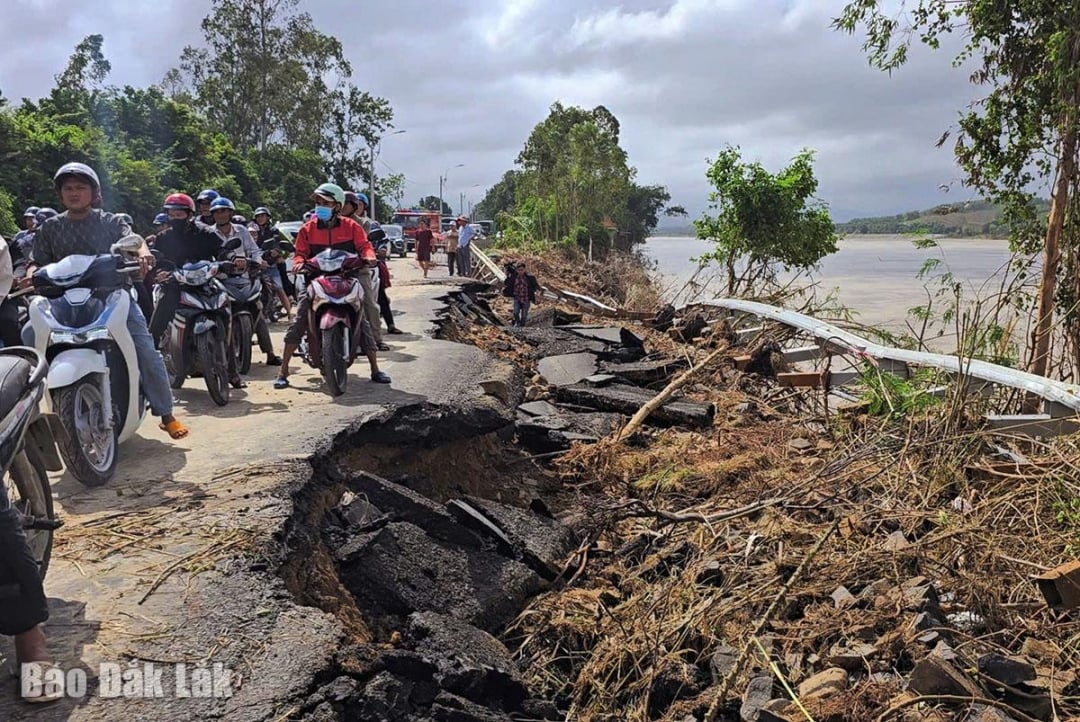 |
| Heavy rains and floods have caused landslides, affecting traffic on National Highway 25 in the section passing through Phu Hoa 1 commune. |
Placed within the overall national context, the damage caused by natural disasters is extremely serious. From the beginning of the year until now, natural disasters and floods nationwide have caused property damage of approximately 100,000 billion VND, equivalent to 0.7 - 0.8% of GDP in 2025. Furthermore, in the period 2006 - 2025, natural disasters have caused an average annual economic loss equivalent to 1 - 1.5% of GDP. This is an alarming figure, showing that natural disasters have become and continue to be one of the major challenges to the goal of rapid and sustainable growth.
Notably, the severity of current natural disasters is also a consequence of human activities. Uncontrolled development, overexploitation of resources, deforestation, water pollution, and the concretization of ecological spaces have gradually eroded the environment's inherent self-regulating mechanisms. When these "natural shields" are broken, natural disasters become more intense, and the consequences are more devastating.
From a management and development perspective, the losses caused by natural disasters are directly hindering the process of sustainable development. Resources that should have been allocated to development investment are being diverted to disaster relief, social welfare support, and infrastructure reconstruction. If this vicious cycle continues, it will weaken the competitiveness of the economy, while increasing inequality and social risks, especially for vulnerable groups.
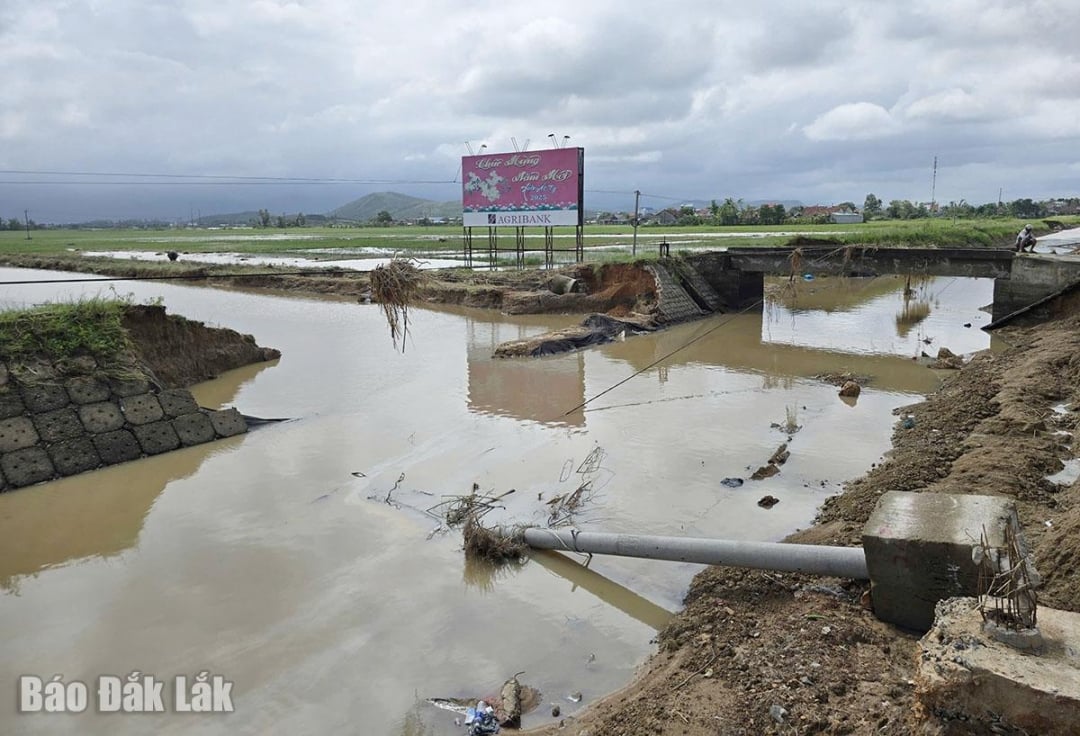 |
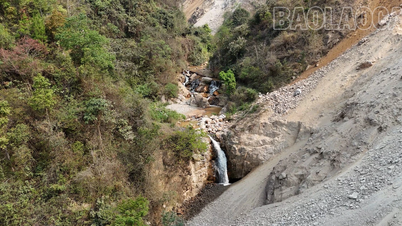
| Heavy rains and floods caused landslides, damaging a section of the main southern canal of the Dong Cam irrigation system that runs through Tay Hoa commune. |
In this context, environmental protection must be identified as one of the pillars of national security and sustainable development. This is not only the responsibility of the natural resources and environment sector but also a shared responsibility of the entire political system, all levels of government, the business community, and the entire population. Any development strategy, plan, and policy that separates itself from the environmental factor carries the risk of long-term negative consequences.
Correct awareness is a necessary condition, but decisive action is the sufficient condition. Protecting the environment requires a substantive shift in development thinking, from an exploitation-consumption-disposal model to a green economy, a circular economy, efficient resource use, and emission reduction. The development process cannot continue to sacrifice the environment for growth, because the cost will far outweigh the short-term benefits.
To protect the environment, alongside the leading role of the State, the active participation of the community and the people is crucial. A lifestyle in harmony with nature needs to be formed through specific, persistent, and responsible actions. When each individual understands that environmental protection is directly linked to their own safety and quality of life, the strength of society will be sustainably unleashed.
Environmental education should therefore be considered a long-term strategic task. Equipping the younger generation with the right environmental knowledge, skills, and attitudes will not only contribute to raising awareness but also lay the foundation for positive changes in the future.
Natural disasters leave behind not only tangible losses but also force us to re-examine our approach to nature. Protecting the environment, therefore, is not just a matter for today but a responsibility for tomorrow.
Source: https://baodaklak.vn/xa-hoi/202512/loi-canh-tinh-tu-thien-tai-f8408c5/
![[Image] The appearance of the Bien Hoa-Vung Tau expressway before its opening.](https://vphoto.vietnam.vn/thumb/1200x675/vietnam/resource/IMAGE/2026/03/25/1774430324663_ndo_br_2-resize-6064-jpg.webp)
















































































Comment (0)