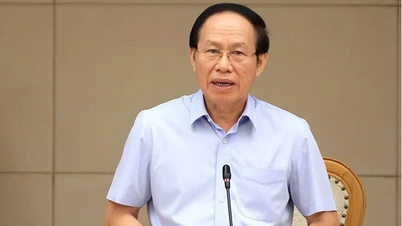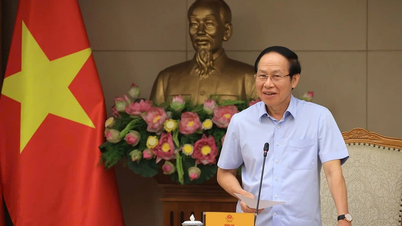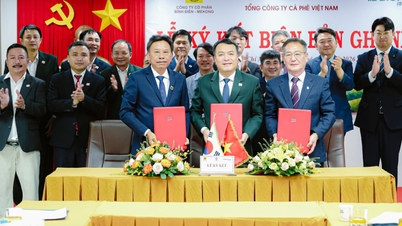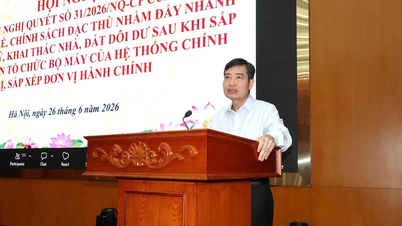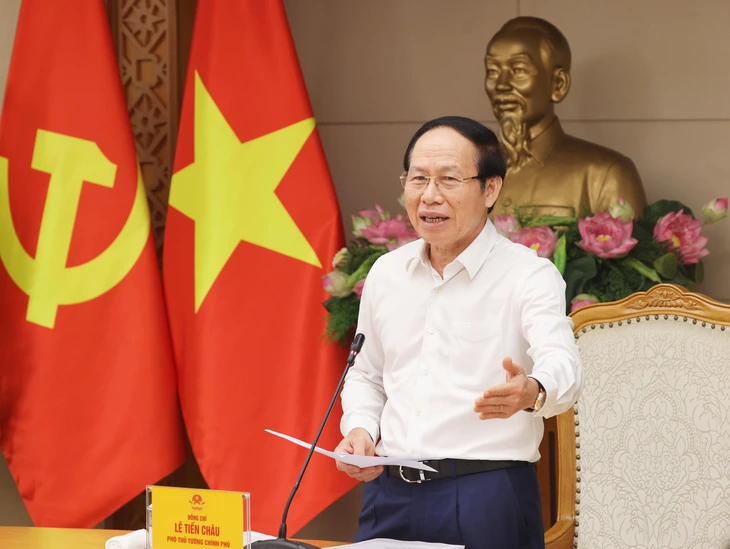
Deputy Prime Minister Le Tien Chau speaks at the working session - Photo: VGP/Thu Sa
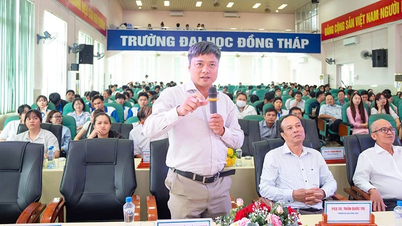
On the afternoon of June 25th, Deputy Prime Minister Le Tien Chau chaired a meeting on the Project for developing and improving the quality of higher education institutions in the capital city.
Identify 12 higher education institutions that play a leading role.
According to a report by the Ministry of Education and Training , the plan identifies 12 leading higher education institutions, including 4 institutions whose individual development plans have been approved by the Prime Minister and 8 key higher education institutions based on specific fields and training disciplines.
The selected higher education institutions all possess strengths and outstanding achievements in key training and research fields; have clear development strategies, and are committed to leading and supporting the development of the capital's higher education system, contributing to the goal of improving the position of Vietnamese higher education in international rankings.


The project's implementation roadmap spans from 2026 to 2035, with a vision extending to 2045, ensuring synchronization with the strategies and plans for the development of education, science, technology, and the capital city that have already been issued.
There must be specific outputs for each school.
At the meeting, Deputy Prime Minister Le Tien Chau stated that higher education in the capital city must play a leading role in training high-quality human resources, nurturing talent, and serving key sectors and fields of the capital and the country.
The Deputy Prime Minister requested that the project clarify current baseline data, redefine the gap with the target, and outline the annual roadmap to 2030. Based on this, specific targets, tasks, solutions, and outputs should be set for each school, and an implementation roadmap should be developed for each year.
Regarding the group of 12 leading higher education institutions, the Deputy Prime Minister requested a unified principle of focused and targeted investment, avoiding a scattered approach. The Ministry of Education and Training must ensure that the selection process is open, transparent, and well-founded.
However, it is also necessary to study and clearly classify: which institutions aim for overall university rankings, which aim for rankings by field, and which serve as centers for elite training, research, or innovation. Simultaneously, research should be conducted to establish mechanisms for periodic evaluation, supplementation, adjustment, or removal from the leading group if they do not meet the requirements.
Regarding elite training and strategic technology, according to the Deputy Prime Minister, the plan needs to shift strongly from an investment mindset focused on "schools" to one based on "problems": national problems, capital city problems, business problems, defense and security problems... Areas to focus on include semiconductors, artificial intelligence (AI), big data, quantum computing, new materials, biotechnology, modern railways, smart cities, and dual-use technologies.



At the same time, training programs must have selection standards, output standards, and mechanisms for co-training with businesses and research institutes. There should be scholarships, laboratories, research assignments, and commitments to receive and utilize the output products.
Notably, AI needs to be approached simultaneously as a strategic training field and as a tool for innovation in university governance, teaching, research, assessment, open educational resources, and personalized learning. Therefore, the Deputy Prime Minister suggested adding a provision that the 12 selected training institutions must be leading and pioneering in the application of AI in training and scientific research.
Source: https://tuoitre.vn/lua-chon-12-truong-dai-hoc-dan-dat-o-thu-do-ha-noi-100260625182353804.htm

![[Photo] "Hanoi Lotus Festival" honors the lotus flower that has been associated with Vietnam for thousands of years.](https://vphoto.vietnam.vn/thumb/1200x675/vietnam/resource/IMAGE/2026/06/27/1782516943048_sen-ha-noi-2026-minh-duy-1-jpg.webp)