Given this reality, how should schools change their teaching methods, and what competencies should they equip students with, starting from primary school?
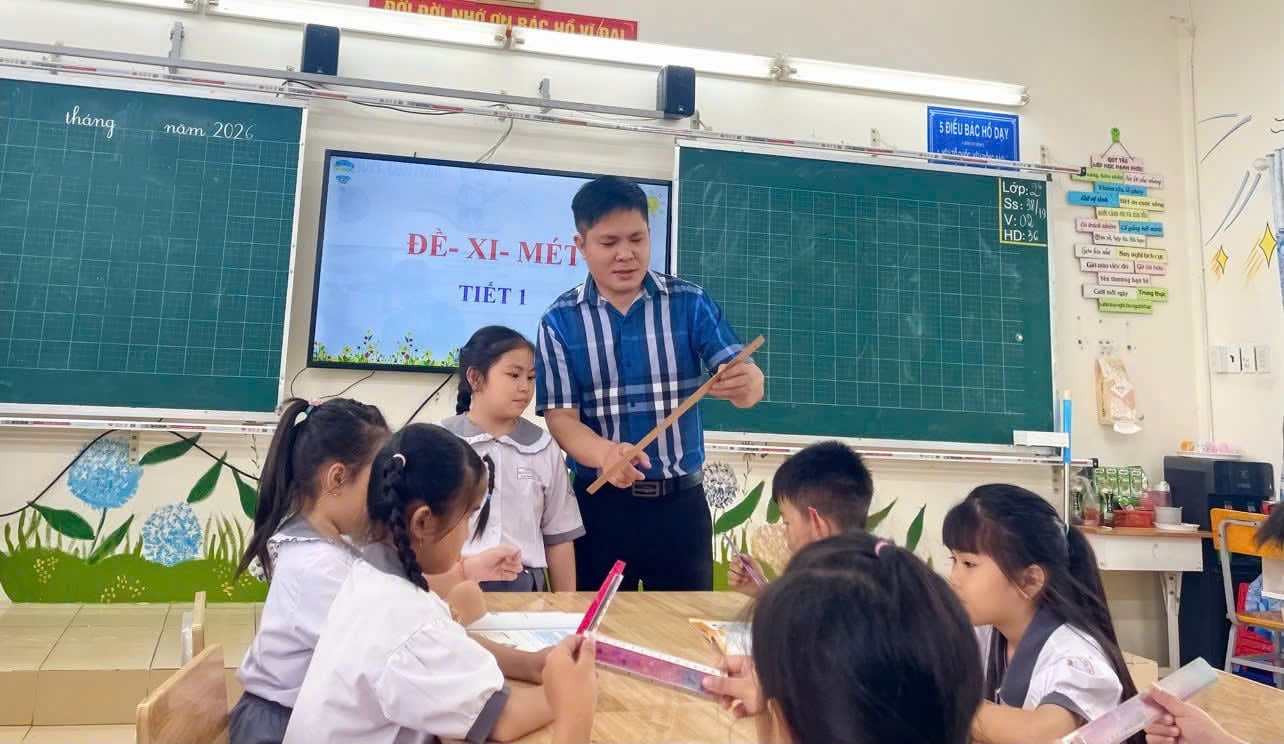
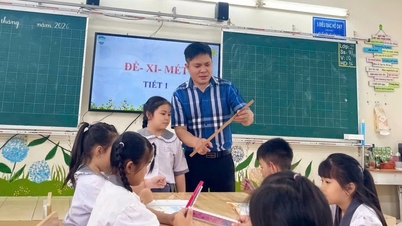
Teacher Nguyen Tan Sang during visual math lessons for second-grade students.
PHOTO: NVT
WHY DO CHILDREN NEED TO LEARN THE MULTIPLICATION TABLE?
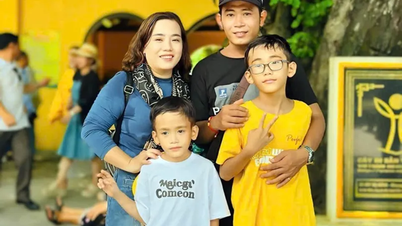
Ms. Phuong Anh, whose child attends primary school in An Phu Dong Ward, Ho Chi Minh City, is helping her child review for the end-of-year exam. Holding a stack of study guides for all subjects, she doesn't immediately tell her child to memorize them, but instead asks questions. "Why do you have to learn the multiplication table? For example, in the multiplication 3x9=27, can you explain it using addition?" she asks her third-grade child. When it comes to the creative writing review section, she tells her child to create a mind map to structure their essay so they can develop an essay for any topic. "The worst thing is when children memorize sample essay outlines repeatedly, but then get stuck when given a different topic," the mother says.
She further shared: "When students understand the concepts, they are able to explore and adapt to different situations. For example, when children understand addition and multiplication, and grasp the essence of area and perimeter, they will find learning math interesting, rather than just memorizing formulas without understanding the meaning of the problem they just solved."
TEACH STUDENTS TO UNDERSTAND THE ESSENCE RATHER THAN JUST MEMORIZING IT.
Mr. Nguyen Tan Sang, a teacher at Nguyen Van Tran Primary School in Hung Long Commune, Ho Chi Minh City, affirms that the important thing at the primary school level is not to cram knowledge for secondary and high school, but to equip students with tools for critical thinking, self-learning abilities, and problem-solving skills. Mr. Sang's approach is to help students understand the essence of the problem instead of rote memorization. This is done through lessons, experiential activities, group discussions, learning games, and open-ended questions to encourage students to think and find different solutions.
"For example, in second-grade math, instead of just requiring students to perform calculations, I present situations that are familiar problems in life for students to analyze and choose appropriate solutions. In Vietnamese language class, students are encouraged to express their personal thoughts, relate to real-life situations, and be creative in their expression. Other subjects also enhance observation, exploration , and experiential activities so that students can discover knowledge on their own under the guidance of the teacher," Mr. Sang said.
At Nguyen Truong To Primary School in Xom Chieu Ward, Ho Chi Minh City, students are encouraged to ask questions of their teachers. Mr. Phan Anh Tuan, the school principal, gave an example: in mathematics, instead of just teaching formulas, teachers create situations close to real life so that students can find solutions and explain why they chose that method. In Vietnamese language class, teachers not only help students read correctly and understand the content of texts but also focus on developing reading comprehension skills, expressing personal opinions, and relating the material to real-life situations.
"For example, when studying a reading passage about honesty, instead of just asking students what the characters in the passage did, we ask open-ended questions like, 'If you were in that situation, what would you choose?'; 'Do you agree with the character's actions? Why?'. Or after reading a story about environmental protection, students not only answer questions in the textbook but also relate it to reality at school and in their residential area, suggesting specific actions to reduce plastic waste and maintain public hygiene… Each student can offer a different perspective, and they are encouraged to explain and defend their opinions with appropriate arguments," Mr. Tuan said.
"Personally, I believe the most important thing in primary school is not to teach children a lot of knowledge, but to develop their ability to ask questions, to explore, to cooperate, and to think independently. With these foundational skills, students will adapt well to competency-based exams and to a constantly changing society," Mr. Tuan added.
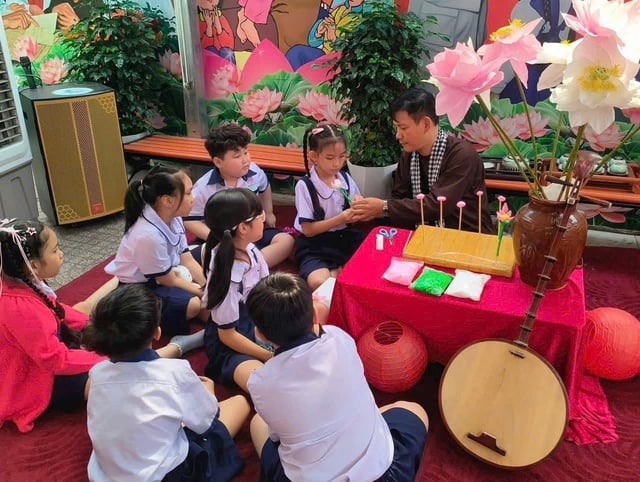
Principal Phan Anh Tuan is the teacher guiding the students in the Vietnamese lotus theme. He personally makes cakes and molds clay figurines, helping students understand more about Vietnamese culture.
PHOTO: NTT
Raising the level of teachers is a prerequisite for educational reform.
The 2018 General Education Program (referred to as the New Program) has been implemented for the past six academic years and has shown changes in the approach to equipping students with knowledge and developing their competencies and qualities, such as self-reliance and self-learning; communication and collaboration; and problem-solving and creativity. However, reality shows that innovation is not just about slogans; first and foremost, teachers must be those who do not follow safe, conventional paths.
Ms. Nguyen Yen Nhi, homeroom teacher of class 5 at Thuan Kieu Primary School, Dong Hung Thuan Ward, Ho Chi Minh City, compared the old curriculum – where the teacher read and the students copied – to the new curriculum, with its flipped classroom model. Students are assigned the task of reading and researching information independently beforehand, then the teacher and students discuss it together in class.
"Students can present various solutions to problems, as long as they arrive at the correct answer. We also teach many practical problems to students, such as speed and time problems, having them calculate the travel time to school. Or when learning about percentages, teachers give assignments about promotional programs, discounts of 10-20% on items in supermarkets. As for creative writing, students are free to construct sentences, develop their vocabulary, and express their opinions… as long as they adhere to the structure and stay on topic," Ms. Nhi said.
However, according to Ms. Nhi, students don't always dare to express opinions that differ from the majority. Many students still prefer to play it "safe," so they write formulaic essays that sound very similar to each other. Therefore, Ms. Nhi stated that to eliminate rote learning and encourage individuality, teachers themselves must innovate and encourage students to dare to think, dare to make mistakes, and dare to challenge the truth.
Mr. Tran Thai, Principal and Literature Teacher at Athena Primary and Secondary School in Xuan Huong Ward, Da Lat City, Lam Dong Province, said that in recent years, we have talked a lot about reforming the curriculum, textbooks, and assessment methods. Looking at the 2026 high school graduation literature exam, Mr. Thai is concerned about the quality of the teaching staff and how they have improved to help students not only adapt to competency-based exams but also to adapt to a life full of changes.
"If we want students to be able to think independently, teachers must be independent thinkers. If we want students to have a broad perspective, teachers must have a broad perspective. If we want students to learn throughout their lives, teachers must first be lifelong learners themselves. An exam can change how students are assessed. But only teachers who constantly learn and develop can change the quality of an entire education system," Mr. Thai said.
Assessment should focus on student progress, not on comparing one student to another.

The Ministry of Education and Training issued Circular No. 27/2020/TT-BGDĐT regulating the assessment of primary school students. Article 4 of the Circular clearly states the requirement: Student assessment should be conducted by evaluating the extent to which students meet the required learning objectives and the specific manifestations of the competency components of each subject, educational activity, and the qualities and abilities of students as required by the primary school general education program.
Regular assessments are conducted through comments, periodic assessments are based on scorecards combined with comments; assessments from teachers, students, and parents are combined, with teacher assessments being the most important.
And to evaluate and promote student progress; to value and encourage students' efforts in learning and training; to help students maximize their abilities and potential; to ensure timeliness, fairness, and objectivity; to avoid comparing one student to another, and to avoid creating pressure on students, teachers, and parents.
At the end of the 2025-2026 school year, the Ho Chi Minh City Department of Education and Training also issued a document guiding the organization of end-of-year periodic tests and assessments. The document emphasized that review sessions for primary school students should be conducted in the classroom; for classes with two sessions per day, no homework should be assigned; teaching should not be based on prescriptive syllabi or sample lessons; and students should not be required to memorize sample lessons.
Source: https://thanhnien.vn/xoa-hoc-vet-tu-tieu-hoc-185260626233807328.htm





![[Photo] "Hanoi Lotus Festival" honors the lotus flower that has been associated with Vietnam for thousands of years.](https://vphoto.vietnam.vn/thumb/1200x675/vietnam/resource/IMAGE/2026/06/27/1782516943048_sen-ha-noi-2026-minh-duy-1-jpg.webp)