

 |
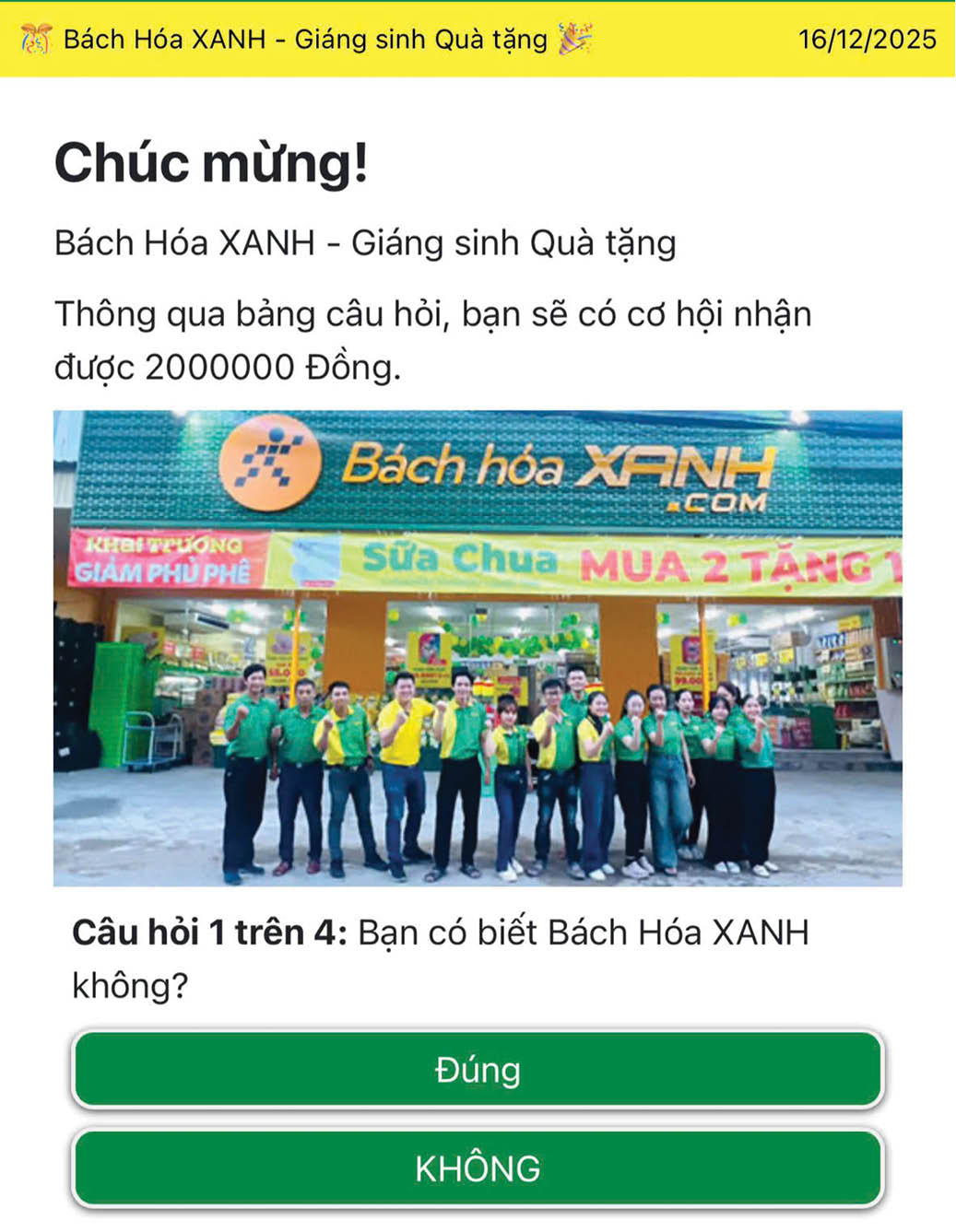
| Fraudulent promotions impersonating brands. |
A sophisticated trap stemming from a few simple questions.
Upon receiving a message from a friend, along with a link, Ms. Tran Thanh Thao (My Thuong Ward, Hue City) thought it was some kind of content being shared and clicked on it without suspicion. After accessing the link, a Bach Hoa Xanh - Christmas Gift program appeared. Along with it were questions requiring answers to receive a gift. Not long ago, there was a similar program from Jollibee..., so Ms. Thao became suspicious and called Bach Hoa Xanh's customer service hotline. And indeed, there was no such promotional program. "The hotline staff confirmed that there was no such program offering a 2 million VND reward and advised against clicking on strange links," Ms. Thao shared.
Thanks to her timely vigilance, Ms. Thao avoided the risk of losing her account and having her personal information leaked. However, before she could inform the friend who sent her the link, a relative informed her that her friend's Facebook account had been lost after clicking the link and answering the questions.
When these links are sent, users who click on them will see an interface that closely resembles the brand's official website, along with a few simple questions such as: "Do you know Bach Hoa Xanh?", "How would you rate the quality of service?"...
After responding, users are asked to continue entering personal information such as full name, phone number, Facebook account, and even a verification code sent to their phone to "complete the reward claim process." To receive the reward, participants must share the link with 20 other Facebook users.
Similarly to Ms. Thao, Ms. Nguyen Huyen Anh (Thuan Hoa Ward, Hue City) said that she also received a similar message from a friend via Facebook. “When I clicked on it, the interface looked real, and it only asked simple questions, so I followed the instructions. After entering all the information, my Facebook account was logged out, and I couldn't log back in,” Ms. Huyen Anh said worriedly. Later, she discovered that her account had been compromised by a scammer who was sending fraudulent messages to her friends.
Risk of data loss and unauthorized access.
When users click on fake links and provide information, scammers can gain control of their Facebook accounts, collect personal data, and even install malware to take control of their phones. From there, they continue to impersonate the victims to scam relatives and friends or commit other illegal acts.
Given the increasing sophistication of online scams, it's best for social media users to avoid clicking on suspicious links sent via messages, especially those announcing prize draws or valuable gifts. Do not provide personal information, verification codes, or login credentials to any websites or applications of unknown origin.
If in doubt, check the information on the brand's official website or fan page, or call the customer service hotline directly. Simultaneously, quickly change your password, enable two-factor authentication, and report any signs of account breach to the social media platform.
Holidays and festivals are times when scams increase, with increasingly sophisticated methods. Every social media user needs to be vigilant and alert to offers of "easy rewards" to protect themselves and the community.
Source: https://huengaynay.vn/chinh-polit-xa-hoi/phap-luat-cuoc-song/lua-dao-nhan-thuong-2-trieu-dong-dip-giang-sinh-tet-duong-lich-161182.html










































































![[Photo] Closing Ceremony of the 15th Conference of the Central Committee of the 13th Party Congress](https://vphoto.vietnam.vn/thumb/402x226/vietnam/resource/IMAGE/2025/12/23/1766462841764_a1-bnd-3731-1647-jpg.webp)























Comment (0)