

Living amidst rocks, preserving the soul of heritage.
According to scientists , the Dong Van Karst Plateau, dating back over 540 million years, possesses some of the most unique geological formations in Vietnam, with high scientific value unmatched anywhere else in the world. Covering an area of over 2,350 km2, with an average altitude of 1,400-1,600 m, and stretching across 23 communes, this limestone mountain region has 139 geological heritage sites, including 15 international heritage sites and 68 national heritage sites. The area is also blessed with majestic natural wonders such as the Quan Ba Twin Mountains, Ma Pi Leng Pass, and Tu San Gorge…
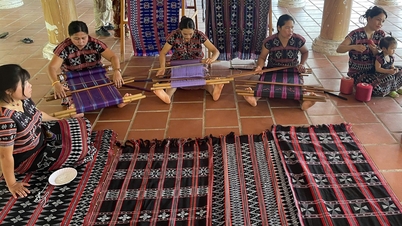
Hidden behind the majestic beauty of fossils, karst valleys, and jagged mountains lies the ancient culture of 17 ethnic minority groups, creating a unique cultural symphony. Sixteen festivals, social customs, beliefs, and folk knowledge of these ethnic groups have been recognized as National Intangible Cultural Heritage, such as: the Forest God worship ceremony (Pu Péo), Gầu Tào, the Khèn flute art, linen cultivation and weaving techniques (Mông); Bố Y folk songs; the Khâu Vai cultural market (Nùng, Giáy)…
 |
| Tourists explore the picturesque beauty of the Nho Que River. |
These heritage sites not only affirm unique cultural values but also serve as captivating destinations for tourists, offering authentic local experiences. Community-based tourism villages like Nam Dam (Quan Ba commune), Pa Vi (Meo Vac commune), and Lo Lo Chai (Lung Cu commune) are considered magnets attracting domestic and international visitors. They are also places where heritage lives on with the community, present in every house, every flute melody, every embroidered skirt, every ritual, every custom… creating a “heritage flame” that illuminates the rocky plateau.
Thanks to its outstanding geological, historical, and cultural value, in 2010, the Dong Van Karst Plateau was recognized by UNESCO as a Global Geopark, becoming the first geopark in Vietnam and the second in Southeast Asia. To date, the Dong Van Karst Plateau has successfully passed three reassessments of its membership in the Global Geopark Network (GGN) and maintained its Green Card status – the highest level of UNESCO recognition.
Transform heritage into assets.
Associate Professor Tran Tan Van, a consultant for the UNESCO Geopark Network, affirmed: “The greatest success of the Dong Van Karst Plateau UNESCO Geopark is transforming heritage into a resource for development, directly improving livelihoods for the community. To maintain its UNESCO status and enhance its global value, the province has placed the people at the center, because they are both the subjects of conservation and the beneficiaries of the heritage.”
The story of heritage intertwined with the community is a testament to the extraordinary resilience of the people in the rocky highlands. In an area where nearly three-quarters of the land is covered in jagged rocks, with steep terrain and a harsh climate, the people of the rocky plateau have persistently cultivated and created a unique method – “rock crevice farming.” This involves carrying soil from deep crevices into rock crevices, patiently tending to each small handful of soil to sow corn seeds. Each corn cob represents the sweat, intelligence, and resilience of the highlanders in nurturing life. It is this uniqueness that has made “rock crevice farming” a National Intangible Cultural Heritage.
 |
| The Hmong boys and girls of Meo Vac commune harmonize their flute music with the traditional dances. |
During the period 2021-2025, Tuyen Quang province implemented a comprehensive range of solutions to preserve and promote the value of the UNESCO Dong Van Karst Plateau Geopark, including: intensifying propaganda and education to raise community awareness about heritage values; preserving culture, geology, landscape, and biodiversity; carrying out 8 provincial-level scientific research projects; investing in infrastructure, standardizing 45 heritage sites on tourist routes 1, 2, and 3, and operating the information station on route 4; and building experiential route 5 connecting with the Non Nuoc Cao Bang Geopark.
To date, the 23 communes in the Rocky Plateau region have more than 5,000 commercial establishments, nearly 1,650 hotels, restaurants, and homestays; and 73 service, handicraft, and homestay establishments recognized as official partners of the UNESCO Global Geopark. Many distinctive OCOP products help increase value and income for the people.
Along with the above results, tourism in the Dong Van Karst Plateau region is becoming increasingly attractive with its unique adventure and experiences. From the Mong Flute Festival with its vibrant mountain and forest colors, the dazzling Buckwheat Flower Festival, the international Marathon on the legendary Happiness Road, to kayaking on the emerald green Nho Que River, exploring mysterious caves, or trekking through treacherous jagged mountains… all blend together to create an attractive destination that captivates domestic and international tourists. In 2024 alone, the Dong Van Karst Plateau welcomed over 2 million visitors, generating tourism revenue of over 4,000 billion VND and creating jobs for approximately 8,000 direct employees.
Affirming the status of heritage
Currently, the UNESCO Dong Van Karst Plateau Geopark is entering a crucial preparation phase for its fourth reassessment in 2026, aiming to maintain its status from 2026 to 2030 and beyond. Vice Chairman of the Provincial People's Committee, Vuong Ngoc Ha, affirmed: “The Provincial People's Committee has issued a comprehensive action plan, closely adhering to the recommendations of UNESCO and GGN from the third assessment (2022). The overarching goal is to harmoniously integrate conservation with development, using heritage as the foundation, the community as the main actors, and international integration as the driving force.”
According to Plan No. 22 KH-UBND dated July 31, 2025, of the Provincial People's Committee on the Implementation of Tasks for the Re-evaluation of the UNESCO Dong Van Karst Plateau Geopark for the Fourth Time in 2026: Relevant agencies and units are urged to promptly consolidate their organizations, upgrade infrastructure, beautify heritage sites, build community education models, conduct communication and promotion activities, and complete the dossier... All tasks must be completed before April 30, 2026. This is a crucial deadline for the province to be ready to welcome the UNESCO and GGN expert delegation expected to visit and work in the field from May to August 2026.
With a sense of urgency, preparations were carried out synchronously by all levels, sectors, and localities according to the "5 clear" principle: Clear responsibilities, clear tasks, clear progress, clear results, and clear accountability. The Dong Van Karst Plateau Geopark Management Board served as the coordinating body; the 23 communes in the karst plateau region played a direct role in improving the destination and leveraging community resources; and domestic and international experts provided technical support.
To enhance the visitor experience, four new heritage sites will be surveyed and content developed: the Northernmost Point (Lung Cu commune), Thach Ke Thach Khuyen (Quan Ba commune), Nho Que Lake - Tu San Gorge (Meo Vac commune), and Mau Due Antimony Mine (Mau Due commune). The system of signs, information boards with integrated QR codes, promotional signs, and directional signs will also be redesigned, promising a more friendly, modern, and comprehensive experience for visitors. The "community-centric" approach is clearly demonstrated through the mobilization of social resources for the beautification and preservation of ecological landscapes along key tourist routes.
With thorough preparation, responsibility, and strategic vision, the UNESCO Dong Van Karst Plateau Geopark is ready to enter the 2026 reassessment period with confidence, autonomy, and pride. This is also an important foundation for Tuyen Quang province to realize the goals of the Master Plan for the Development of the Dong Van Karst Plateau National Tourist Area to 2025, with a vision to 2030, which has been approved by the Prime Minister.
The province aims to transform the Dong Van Karst Plateau UNESCO World Heritage Site into a national tourist area by 2030; achieving a total tourism revenue of 5,000 billion VND and creating jobs for over 13,000 direct employees. Notably, Tuyen Quang province is currently campaigning for the Dong Van Karst Plateau UNESCO World Heritage Site to be selected as a "Leading Cultural Destination in Asia." This will further promote the heritage site to the world and affirm its position on the regional tourism map.
From its harsh rocky terrain, the Dong Van Karst Plateau has risen to become a global brand. Maintaining its UNESCO status is not only a duty but also an affirmation of the community's enduring vitality, the millennia-old value of its heritage, and the aspiration for international recognition from this northernmost point of the country.
Thu Phuong
Source: https://baotuyenquang.com.vn/van-hoa/202508/lua-di-san-tren-mien-da-xam-4907a4b/




![[Image] Nearly 125,000 Hanoi students completed the Literature exam for the 10th grade entrance exam.](https://vphoto.vietnam.vn/thumb/1200x675/vietnam/resource/IMAGE/2026/05/30/1780117233041_ndo_br_thiet-ke-chua-co-ten-2-png.webp)













![[Video] Sunset at Lap An Lagoon – Where the sun sets over the fishing nets](https://vphoto.vietnam.vn/thumb/800x450/vietnam/resource/IMAGE/2026/05/31/1780187239592_2222.jpeg)































![[Video] Sunset at Lap An Lagoon – Where the sun sets over the fishing nets](https://vphoto.vietnam.vn/thumb/402x226/vietnam/resource/IMAGE/2026/05/31/1780187239592_2222.jpeg)




































Comment (0)