

A century-long flow
Stepping through the solemn wooden doors of the Ho Chi Minh City Museum of Fine Arts, visitors feel as if they are traveling back in time, touching upon layers of artistic memories that have traveled halfway around the world to return to where they belong. Paintings "repatriated" from Europe are quietly reconnecting. The origins of the Southern Vietnamese art movement began with the Gia Dinh School of Fine Arts – established in 1913. Professor Nguyen Xuan Tien, Chairman of the Ho Chi Minh City Fine Arts Association and former Vice Rector of the Ho Chi Minh City University of Fine Arts (the predecessor of the Gia Dinh School of Fine Arts), explains: Initially named the Gia Dinh School of Applied Arts (École des Arts Appliqués de Gia Dinh), the Gia Dinh School of Fine Arts was established as a training institution for applied arts and crafts, emphasizing skill, technique, and practical use of materials.
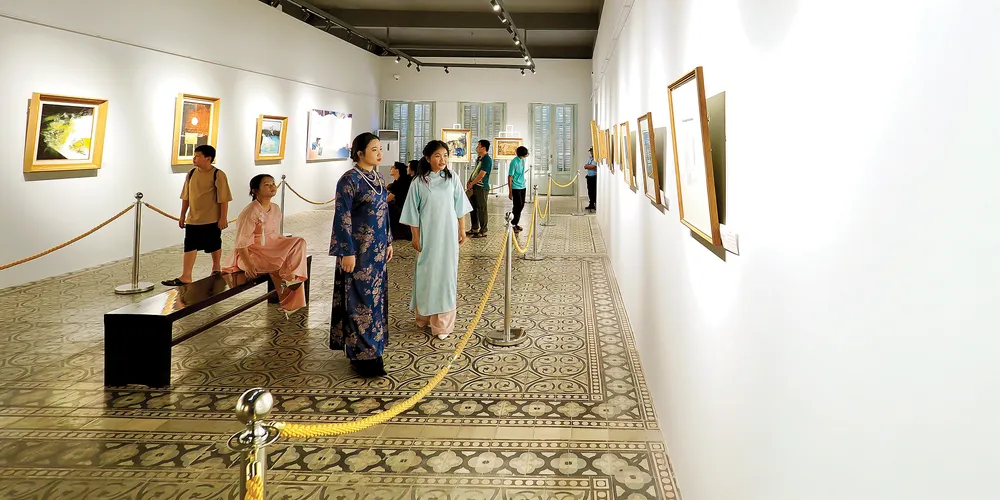
From 1913 to 1945, the Gia Dinh School of Fine Arts flourished as a center for training in high-level crafts such as lacquerware, mother-of-pearl inlay, wood carving, bronze casting, stone carving, jewelry making, and interior decoration. The curriculum emphasized practical skills, demanding a high level of craftsmanship, while harmoniously blending traditional Vietnamese art with the influences of Art Nouveau and Art Deco from Europe.
Throughout the years of resistance, revolutionary art flourished and developed strongly to serve the cause of fighting for independence and national reunification. The Gia Dinh School of Decorative Arts and the Saigon National College of Fine Arts became the cradle for training a generation of vibrant revolutionary artists such as Co Tan Long Chau, Ha Van Duc, Mai Thanh Huong, and others.
In the field of fine arts, many artists from Gia Dinh opened workshops, built brands, and achieved great commercial success as well as design awards both domestically and internationally. A prime example is Thanh Le lacquerware, which created a "craze" in the 1960s and 70s, bringing Vietnamese fine arts to the international market.
The vitality of the "Southern spirit"
In recent years, through donations from Vietnamese expatriates in France, Indochinese and Gia Dinh art works have truly returned to Vietnam. The collection is currently stored and displayed at the Ho Chi Minh City Museum of Fine Arts, including many works by artists who grew up in the Gia Dinh School of Fine Arts, becoming a witness connecting the vitality of Southern Vietnamese art.
Over the centuries, this flow of painting has intertwined and shaped the artistic style of an entire region: steadfast in identity, yet courageous in innovation. Indochinese paintings have already developed enough liquidity to become a "blue chip" investment channel, raising the next question for the Vietnamese market: "What will be the next wave of transactions?"
“Gia Dinh paintings possess many elements that make them a strong contender, alongside segments such as paintings by artists who traveled to France, resistance art, or postmodern art. These groups all have sufficient time lag for curators to establish their academic and market value,” Curator Ace Le commented.
The "awakening" of Gia Dinh paintings today is not only a sign of market movement, but also the return to its rightful place as an artistic heritage. As its value is gradually established, Gia Dinh paintings have every opportunity to emerge as an independent segment with cultural depth and sustainable investment appeal. And who knows, from this very flow, the Vietnamese art market may welcome a new wave, strong enough to reshape the value map of national painting in the coming years. Gia Dinh art is not only returning to the market, but is also returning to its rightful place as a heritage that nurtures the identity of Southern Vietnamese painting.
* Professor Nguyen Xuan Tien - Chairman of the Ho Chi Minh City Fine Arts Association:
A particular, unconventional clause.
The unique characteristic of Gia Dinh - Saigon art lies in its creative inspiration stemming from dynamic urban life and strong cultural exchange. Gia Dinh art is not bound by rigid forms but aims for freedom of expression, an element that contributes to the enduring vitality of Southern painting.
* Curated by ACE LE - Senior Advisor at Sotheby's Auction House:
A pillar of Southern scholarship and arts
Despite undergoing numerous structural and curriculum changes, the legacy of the Gia Dinh School of Painting continues to shape its academic identity: a blend of exquisite craftsmanship, Southern decorative spirit, modern application, and design thinking that serves everyday life. This legacy remains not only in historical memory but also permeates the style of many generations of Vietnamese artists and designers.
Source: https://www.sggp.org.vn/di-san-thuc-giac-post838701.html
![[Photo] The General Secretary, President and his wife begin their state visit to the Philippines.](https://vphoto.vietnam.vn/thumb/1200x675/vietnam/resource/IMAGE/2026/05/31/1780230559452_anh-man-hinh-2026-05-31-luc-19-28-11.png)

![[Photo] Solemn bathing ceremony and Buddha procession in Hue](https://vphoto.vietnam.vn/thumb/1200x675/vietnam/resource/IMAGE/2026/05/31/1780228263543_1-jpg.webp)
![[Photo] Admire the coral "masterpiece" amidst the million-year-old heritage of Dak Lak province.](https://vphoto.vietnam.vn/thumb/1200x675/vietnam/resource/IMAGE/2026/05/31/1780221235105_anh-man-hinh-2026-05-31-luc-16-53-27.png)









![[Video] Weather forecast for tonight and tomorrow, June 1st, 2026: Northern Vietnam experiences rising temperatures, Southern Vietnam continues to have thunderstorms.](https://vphoto.vietnam.vn/thumb/402x226/vietnam/resource/IMAGE/2026/05/31/1780232471628_thumb-toi-3105-png.webp)






![[Video] Sunset at Lap An Lagoon – Where the sun sets over the fishing nets](https://vphoto.vietnam.vn/thumb/340x192/vietnam/resource/IMAGE/2026/05/31/1780192137701_beach-landscape-sea-water-nature-grass-745871-pxhere-com.jpeg)
































![[Photo] Admire the coral "masterpiece" amidst the million-year-old heritage of Dak Lak province.](https://vphoto.vietnam.vn/thumb/402x226/vietnam/resource/IMAGE/2026/05/31/1780221235105_anh-man-hinh-2026-05-31-luc-16-53-27.png)

































Comment (0)