

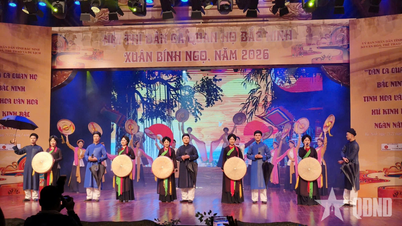
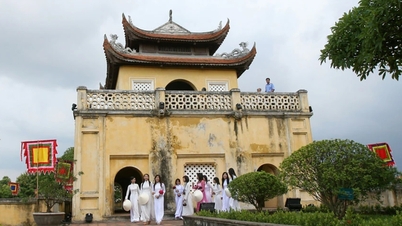
Each region has its own memorable sound. If Phu Tho has Xoan singing, Hue has court music, the Central Highlands has gongs and drums... then Bac Ninh has Quan Ho folk songs. Visiting Kinh Bac during the first two months of the year, you'll easily see the flowing traditional four-panel dresses fluttering in the spring breeze throughout the villages. Young men in silk robes and turbans, and young women in pink bodices and conical hats, leisurely make their way to festivals. The village atmosphere seems more charming and vibrant with the sparkling eyes and shy smiles of the Quan Ho singers.
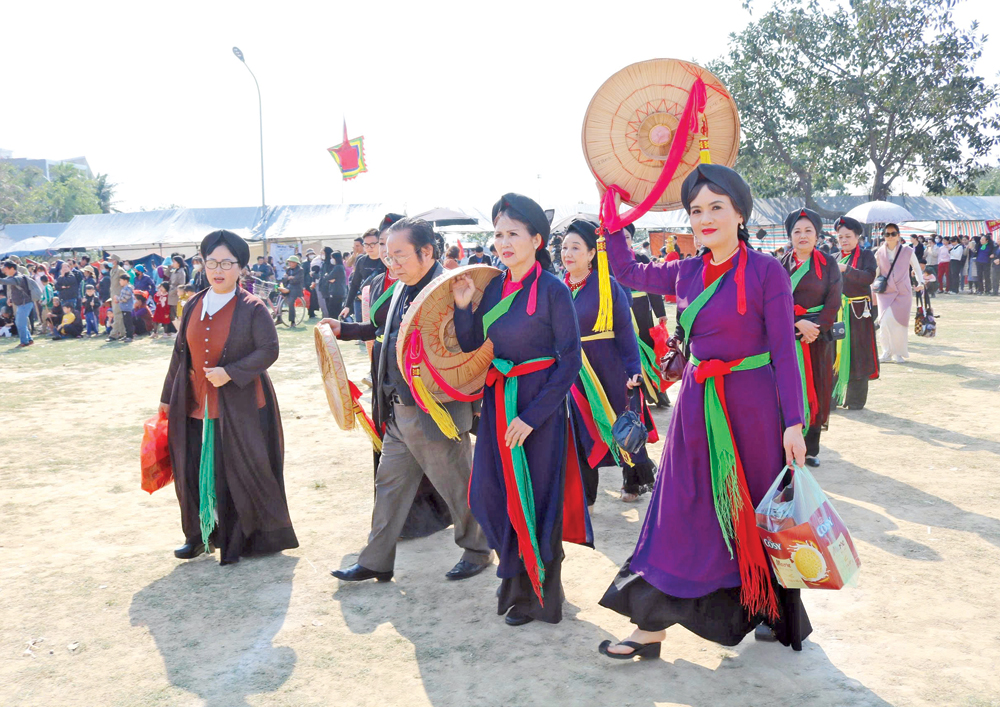 |
The two older sisters of the Quan Ho folk singing group, dressed in their finest clothes and headscarves, went to the festival. |
Performing and enjoying Quan Ho folk singing is an inherent need in the spiritual life of the people of Bac Ninh. In today's contemporary life, the space for practicing the Quan Ho heritage is expanding, and the forms of performance are more diverse and rich, but enjoying Quan Ho in the spring in the Kinh Bac region remains an irresistible cultural "specialty" every time Tet (Lunar New Year) arrives. Because, in its very cradle, the pure essence of Quan Ho truly blossoms and spreads its fragrance...
Ms. Huynh Thi Thu Ha, from the Muoi Nho Quan Ho Club ( Ho Chi Minh City), expressed: "Every spring, we prepare our bags and fly to the North to meet our Quan Ho friends and immerse ourselves in the vibrant atmosphere of the singing festival. Each time we go, we spend about 10-15 days attending festivals and interacting with Quan Ho villages throughout the Kinh Bac region... For many young people in the South, Quan Ho folk songs are still new, so we bring our young members back to the birthplace of Quan Ho to experience the spring festivities, learn the songs and melodies, learn the singing style, and learn the culture, customs, and the heartfelt way of interacting with others that are characteristic of the Quan Ho people."
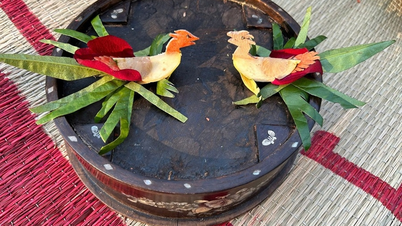
Spring is an occasion for each community to showcase its cultural beauty, for kindred spirits to meet in the subtlety of rituals and songs. Traditional Quan Ho folk singing performances are still meticulously preserved by artisans and singers in many Quan Ho villages. Under the ancient communal house, bearing the faint traces of time's dust, on a floor covered with floral mats, the male singers sit on one side and the female singers on the other, facing each other, with cups of tea and betel leaves arranged in phoenix wing shapes in between. Without musical accompaniment or loudspeakers, the performance begins with the female singer's line, "I long for you like a fish longs for rain," and the male singer's response, "I should have stayed home too." Then the male singer returns with "Friend's Path," and the female singer responds with "Kim Lan." The female singer then says, "The best is Lam Dien sugarcane," and the male singer responds, "Her wrists are already white and round"... These simple, heartfelt Quan Ho melodies resonate in the pure, tranquil space, captivating the hearts of listeners.
The artisans who have performed Quan Ho folk songs, living with them from their youth until their old age, say that the pure essence of Quan Ho lies in its resonant, rich, and expressive voice. To participate in a traditional Quan Ho performance properly, singers must not only memorize the songs and possess a substantial repertoire, but also undergo a long training process, from breath control and vocal practice to polite and courteous manners and speech. Quan Ho does not tolerate carelessness. It is a meticulous and refined art, requiring skill and expertise to truly master.
With unwavering dedication to their craft and initial success in the spring Quan Ho folk singing competition, the singing duo Nguyen Quang Tam and Nguyen Duc Sang (from Van Mon commune) shared: "We perform Quan Ho all year round, but just staying home and diligently practicing our voices and breath control is never enough. We have to be adventurous, listen a lot, and 'experience' live performances with live, unadorned songs to truly understand them... Spring is the time when we go out, listen, and socialize the most because most Quan Ho villages in the area hold festivals. During these exchanges, if we encounter a line we can't respond to or haven't heard before, we absolutely must learn it."
And so, season after season, Quan Ho folk songs are passed down, preserved, and spread like a persistent, endless stream of spring flowing through the cultural landscape of Kinh Bac - Bac Ninh. January and February in the Quan Ho region thus seem longer, wider, and more deeply imbued with the heartfelt, lingering, and affectionate melodies of these songs...
Source: https://baobacninhtv.vn/gieng-hai-mua-hat-hoi-postid439759.bbg



























![[Image] Nearly 125,000 Hanoi students completed the Literature exam for the 10th grade entrance exam.](https://vphoto.vietnam.vn/thumb/1200x675/vietnam/resource/IMAGE/2026/05/30/1780117233041_ndo_br_thiet-ke-chua-co-ten-2-png.webp)






























































Comment (0)