

But will the curve of those eyes fade as the city creeps into every alleyway? How much of the village memory—passed down through labor, customs, and breath—will remain in the face of a world changing in every instant? Stretching along the banks of the Cau, Duong, and Thuong rivers; from the foot of Nham Bien to the slopes of Thien Thai mountain and reaching to the lush green Lim hill, Bac Ninh emerges as "one of the richest cultural and geographical fields of the Vietnamese people"—as Professor Tran Quoc Vuong remarked. Not only rich in heritage, this land is also a "cultural source," the origin of many layers of sediment shaping national identity.
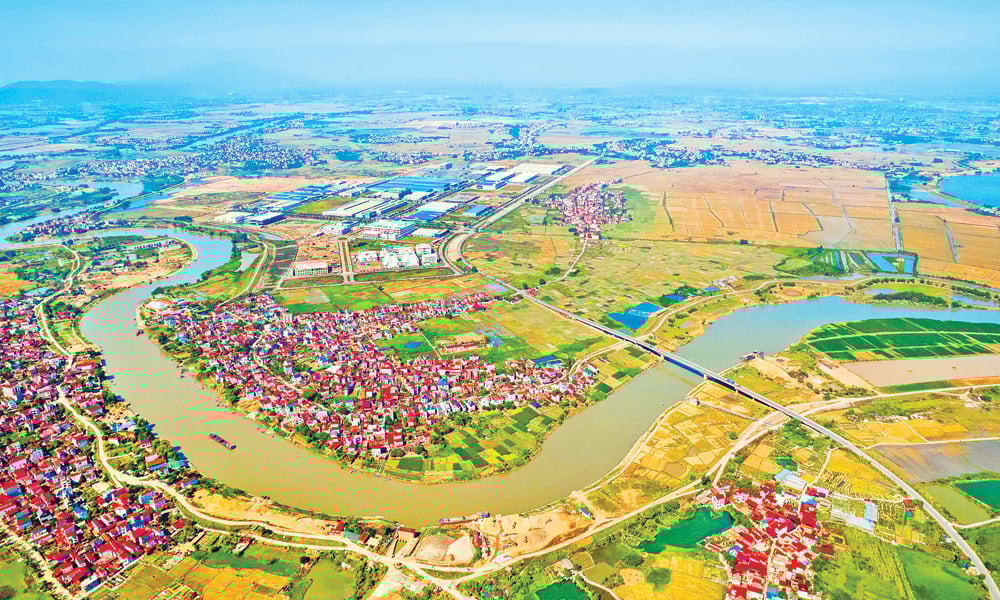 |
The banks of the Nhu Nguyet River. Photo: Truong Xuan Thang. |
The system of historical relics in Bac Ninh is a unique whole: Lo Hanh Temple and Diem Temple – distinctive in architecture and rituals; Do Temple, a sacred temple of the Ly Dynasty; Dau Pagoda – the earliest Buddhist center of the Vietnamese people; Bo Da Pagoda with its vast collection of woodblock prints; Vinh Nghiem Pagoda, inscribed by UNESCO; and the Amitabha Buddha statue at Phat Tich Pagoda – "the pinnacle of Dai Viet sculpture," according to scholar Nguyen Ba Lang. All of these combine to form an "architecture of memory," where every brick and stone is steeped in the breath of time.
If tangible heritage is the physical form of Kinh Bac, then intangible heritage is the lifeblood of this land. Quan Ho – an Intangible Cultural Heritage of Humanity – is not just call-and-response singing, but a system of standardized culture: it has rituals, alliances, norms, and a philosophy of life. In the communal house of Vien Xa, by the Tieu Mai riverbank, on Lim hill, the melodies of courtship songs still resonate, a lasting affirmation that culture is not preserved through ostentation, but through subtlety deeply ingrained in life.
The festival space of Kinh Bac also possesses a distinctive depth: the Lim Festival maintains the standard Quan Ho folk singing style; the Dong Ky Festival is vibrant with martial arts traditions; the festivals of Tho Ha, Tieu Mai, Phu Luu… recreate ancient performances; and the rituals of carrying gods, carrying water, and praying for national peace and prosperity retain their original spirit. Researcher Ngo Duc Thinh once remarked: "Nowhere in Vietnam has such a high density of festivals and such a deep level of authenticity as Kinh Bac."

The culture of Kinh Bac is further enriched by a system of craft villages – "living museums of knowledge" passed down through hands and ways of thinking. Phu Lang pottery, with its deep reddish-brown hue; Dong Ho paintings, simple yet rich in symbolism; Xuan Lai smoked bamboo, black and lustrous like precious wood; Dai Bai and Da Hoi bronzes, exquisite; Phu Khe and Dong Ky wood carvings, elaborate; Ke rice crackers, crispy and fragrant with the scent of the countryside… These craft villages create not only products, but also culture – a form of "tangible memory."
Many scholars believe that Bac Ninh possesses a "strong intrinsic vitality," a unique ability to regenerate its traditions. Professor Nguyen Dang Thuc once wrote: "Kinh Bac is a treasure trove where each generation finds a source of origin, a spiritual support." It is this "support" that prevents the culture here from freezing or dissolving – instead, it quietly adapts and persistently develops.
But entering the age of market forces and rapid digital technology , values that have endured for millennia are facing new challenges: Festivals are commercialized, rituals are simplified; traditional crafts are industrialized; many traditional villages are disappearing; and the space of Quan Ho folk singing is sometimes theatricalized. These changes raise the poignant question: What keeps the soul of the village from fading? What preserves the profound depth in the eyes of Quan Ho singers? What provides the younger generation with a foundation to understand, love, and continue to pass on this essence? Amidst the flow of globalization, villages are forced to choose their own path – and there is no neutral choice left. Maintain traditions or adapt to survive? Preserve or recreate? Return to purity or integrate into the contemporary? Each choice carries a price and touches upon the identity of the community.
And then, as that question resonates, we hear the melody of composer An Thuyên's "I Choose This Path": "My feet have walked many paths through the forest... but I choose this path... I choose only this path..." In that moment, we see the figure of a girl from Kinh Bắc standing at the crossroads of time: Before her are the inviting paths of modernity, behind her lies the alluvial soil of culture built up over a thousand years. And amidst countless crossroads, the enduring strength of culture perhaps does not come from coercion, but from a simple yet steadfast choice of the heart. Choosing the path of return. Choosing the path of preservation. Choosing the path of stepping towards the future without losing one's identity.
The land of the Luc River and Huyen Mountain; the silken ribbon of the Cau River flowing across the alluvial plains; the long-haired Thuong River reflecting its image; the Duong River sparkling with silt – all seem to whisper a message. As long as there are people who cherish the old ways, preserving the songs, crafts, and the image of the village as a peaceful haven, the memories of Kinh Bac will remain – gentle yet enduring. Moreover, the essence of the village soul – kindness, righteousness, refinement, and loyalty – will be passed on to future generations, to be preserved, nurtured, and renewed in rhythm with the times. So that these memories will continue to flourish and shine… and the national spirit will forever radiate brightly on the gilded paper…
Strangely, in a new space, a new era, with countless highways crossing rivers and mountains, and even express flights along with information technology drawing us closer together, we find ourselves on a journey back to the past… and yearn for an old-fashioned sash bridge, to reminisce about the dream of "If only the river were only a handspan wide / I could build a sash bridge to welcome my beloved across."

Source: https://baobacninhtv.vn/giu-hon-lang-kinh-bac-postid439750.bbg










































![[Video] Sunset at Lap An Lagoon – Where the sun sets over the fishing nets](https://vphoto.vietnam.vn/thumb/1200x675/vietnam/resource/IMAGE/2026/05/31/1780192137701_beach-landscape-sea-water-nature-grass-745871-pxhere-com.jpeg)






























Comment (0)