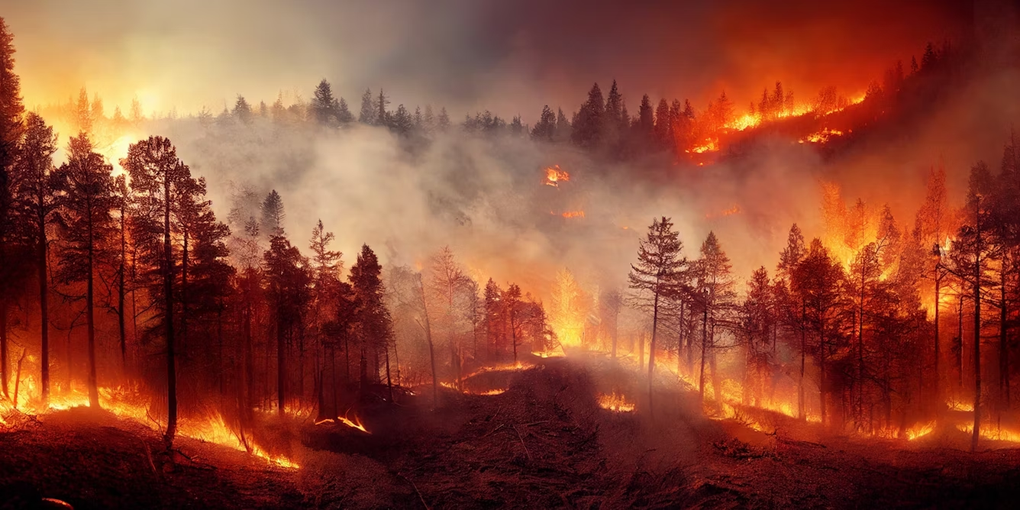
Fire and humans are so closely intertwined that few people consider what happened to fire before humans learned to use it (Photo: Getty).
Even today, after decades of research, our understanding of ancient fire remains quite limited. There are few books and documents directly documenting this period, making the reconstruction of fire largely dependent on geological evidence.
With the Earth warming rapidly and deadly wildfires becoming increasingly frequent globally, understanding the origins and history of fire is more urgent than ever.
Humans may have used fire from very early times, but never truly mastered it. One of the major challenges facing scientists today is distinguishing between man-made fires and natural fires. To do that, it is first necessary to understand the nature and role of fire in the distant past.
Much of our current knowledge comes from studies of fossilized charcoal found in rocks dating back over 350 million years, to the Carboniferous period.
In his book "The Burning Planet: The Story of Fire Through Time," British geologist Andrew Scott states that charcoal can retain many plant structures after burning. If charcoal is examined under a magnifying glass, even from a recently extinguished fire, it is still possible to discern the intricate anatomical details of plants.
For many years, Professor Scott and his students at Royal Holloway University in London have collected and analyzed samples of ancient charcoal to reconstruct the history of past fires.
The key to understanding when fire first appeared on Earth lies in the "triangle of fire".
First, there's the fuel. Fire needs plants to burn, so it couldn't have existed before plants appeared. Marine plants began spreading onto land around 420 million years ago, so fire is unlikely to have formed before that time.
Secondly, there is the heat source. In ancient nature, lightning was the primary trigger for fires. Evidence of lightning has been found in the clumped sand particles in some ancient sediments.
Thirdly, there's oxygen. Combustion requires oxygen, just like human respiration. Today, the atmosphere contains about 21% oxygen. Experiments show that if the oxygen concentration drops below 17%, fires are difficult to spread. Conversely, when it exceeds 30%, fires are very difficult to control, and even damp vegetation can catch fire. This is also why medical facilities strictly prohibit lighting fires or smoking in environments with supplemental oxygen.
Oxygen concentrations in the Earth's atmosphere have fluctuated dramatically over time. From approximately 350 to 250 million years ago, oxygen levels were high, ranging from 23% to 30%, creating conditions conducive to widespread wildfires.
The earliest evidence of forest fires dates back approximately 420 million years, manifested in charcoal deposits in sedimentary rocks. However, at that time, vegetation was sparse and small-scale, limiting the extent of the fires. It wasn't until around 350 million years ago, when primeval forests flourished, that fires spread and destroyed the first forests on the planet.
Another period of intense wildfires occurred between 140 and 65 million years ago, coinciding with the time when dinosaurs like Triceratops and Tyrannosaurus lived, and also when flowering plants appeared. Around 40 million years ago, oxygen levels gradually stabilized at near-modern levels. Tropical rainforests expanded, and the humid environment made wildfires less common.
However, around 7 million years ago, the expansion of grasslands altered the ecological balance. Grasslands became more flammable than rainforests, creating a cycle of recurring fires. These frequent fires burned down young trees, preventing grasslands from transforming into forests.
It was in that turbulent and fiery world that humankind began to evolve, approximately 1.5 million years ago.
Source: https://dantri.com.vn/khoa-hoc/lua-xuat-appear-on-earth-since-when-20260221031421306.htm



![[Image] Shipbuilders exposed to steel and record-breaking heat.](https://vphoto.vietnam.vn/thumb/1200x675/vietnam/resource/IMAGE/2026/06/04/1780545781745_ndo_br_img-5402-4683-jpg.webp)
























































![[Video] Sunset at Lap An Lagoon – Where the sun sets over the fishing nets](https://vphoto.vietnam.vn/thumb/1200x675/vietnam/resource/IMAGE/2026/05/31/1780192137701_beach-landscape-sea-water-nature-grass-745871-pxhere-com.jpeg)






































Comment (0)