

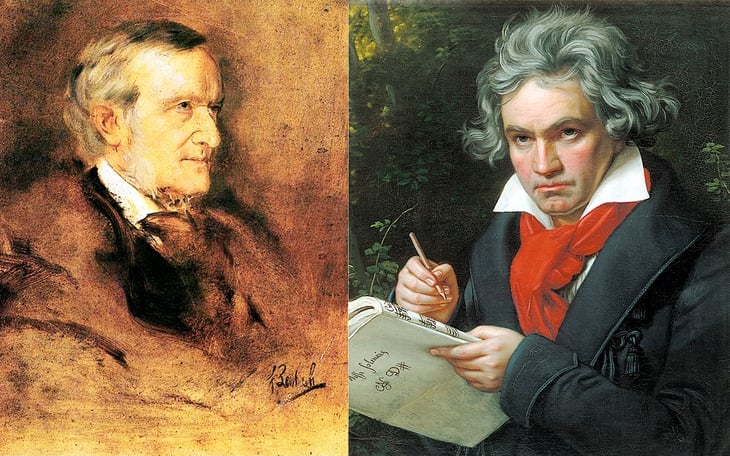
Wagner and Beethoven possess two of the world's top classical music recordings.
Recently, BBC Music magazine invited critics to select the 50 best classical music recordings of all time. While called "all time," that's actually only about 140 years.
Although classical music has existed for hundreds of years, it wasn't until 1888 that the first recording of classical music was made—a song by Handel entitled *Israel in Egypt *.
Therefore, classical music, although called classical, is in fact a very modern form of performance for audiences today – after all, none of us know exactly how Chopin performed his music; we can only hear it through Maurizio Pollini or Claudio Arrau.
For those who always wonder where to begin when learning about classical literature?
The BBC chart is a concise musical map, with incredibly rich "terrains": mountains of symphonies, forests of operas, oceans of concertos, streams of nocturnes, sonatas, etudes...; with "chiefs" of classical music: Yehudi Mehunin, Martha Argerich, Yevgeny Maravinsky, Glenn Gould, Maria Callas...
And unlike mainstream genres where politics, race, and gender are frequently brought in to question critics' musical tastes, the conservatism of classical music—a genre that is inherently white and masculine—can sometimes be a good thing when it comes to ranking: the only real ranking criterion is the music itself, unaffected by "woke" sentiment, and no one gets extra points for representing a marginalized group.
The choices all seemed obvious. The top two spots were occupied by recordings from the Vienna Symphony Orchestra, featuring Wagner's opera *The Ring of the Nibelung* and Beethoven's Symphony No. 5 and No. 7.
With Wagner's opera, the head of the Decca recording company at the time was determined to record the performance as a sound drama, creating an invisible stage in the minds of the listeners, and through the music alone, they could imagine the sublime scenes, each frame of the epic story about a ring that corrupted both humans and gods, leading to the downfall of the divine.
As for Beethoven's two classical symphonies—two works that also have so many great recordings: the emotionally charged version by conductor Leonard Bernstein, the elegant version by conductor Claudio Abbado, the breathtaking version by conductor Herbert von Karajan—critics have chosen the version under the direction of Austrian conductor Carlos Kleiber.
During his lifetime, Kleiber rarely recorded. Despite being one of the greatest conductors of the 20th century, he always avoided the public eye, frequently canceling events before performances and unable to "bear the thought of audiences sitting at home with sheet music in hand... noticing every mistake."
The recording of Beethoven's symphony is among the few things Kleiber left for those born later or those in the afterlife; who knows if anyone can find any fault with it, but certainly, listening to it is like witnessing a genius from a bygone era.
And perhaps no one would argue that the charts highly rank recordings of Glenn Gould playing Bach's Golden Variations in 1955, or Puccini's opera Tosca with Maria Callas at its peak in the leading role, the passionate, courageous, yet conflicted and tragic Tosca.
These are all recordings that have reshaped the original works themselves, even though they have existed for centuries.
For example, Glenn Gould's piano playing created a fast, crisp, sharp version of Golden Variations, eliminating all the lingering effects of the pedal to create a modern, precise, mathematical sound that shocked the entire piano world.
Gould, then only 22 years old, transformed Bach's music, which was often considered too academic and usually only performed on a hapischord, into something vibrant and energetic.
Of course, besides those obvious choices, perhaps people will also ask: why choose Nocturne and Arrau instead of Rubinstein, or even, why are there no albums by Rubinstein...?
It's okay, there are no final rankings, art isn't a wrestling match to see who wins and who loses. Ultimately, it's just a blueprint, helping us step into it and then draw our own map.
Source: https://tuoitre.vn/luoc-do-nhac-co-dien-140-nam-2025042009221865.htm


![[Photo] Chief Justice of the Supreme People's Court commemorates Vietnamese Heroic Mothers and Martyrs.](/_next/image?url=https%3A%2F%2Fvphoto.vietnam.vn%2Fthumb%2F1200x675%2Fvietnam%2Fresource%2FIMAGE%2F2026%2F02%2F06%2F1770349590651_ndo_br_aq-28-jpg.webp&w=3840&q=75)





Comment (0)