

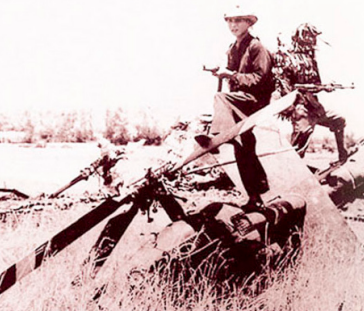
 |
| Our troops shot down an enemy helicopter during the Binh Gia campaign. |
From political struggle to a combination of political and armed struggle.
Exactly 60 years ago, from December 2, 1964, to January 3, 1965, the army and people of the Southeastern region, under the leadership of the Central Party Committee, the Central Military Commission, and directly the Central Bureau of the Southern Region and the Southern Command, successfully carried out the Binh Gia campaign. This victory was of great significance, opening a new era of the revolutionary war in the South. This victory was the convergence and culmination of many factors, first and foremost the wise and correct leadership and guidance of the Party, headed by President Ho Chi Minh ; it demonstrated the tradition of indomitable struggle, the will to fight and win for the independence and unification of the Fatherland of the entire Party, army, and people.
In early 1964, on the battlefields of South Vietnam, the political and military struggle of local armed forces thwarted a crucial step in the US and Saigon government's "Strategic Hamlet" policy; internal contradictions within the Saigon government deepened; and the Staley-Taylor plan completely failed. With its belligerent and stubborn nature, from March 1964, the US imperialists implemented a new plan – the Johnson-McNamara Plan – aimed at pacifying South Vietnam within 18 months, hoping to avert the complete collapse of the "Special War" strategy.
Faced with the schemes of the US and the Saigon government, and in accordance with the spirit of the 9th Conference of the Central Committee of the Party (3rd Term), the Central Bureau of the Southern Region, the Military Committee and the Regional Command decided to launch the 1964-1965 Winter-Spring Campaign in the Eastern South Vietnam battlefield, with Binh Gia as the decisive battle point of the campaign. This was a shift in strategy from political struggle to a combination of political and armed struggle, with increasing emphasis on armed struggle.
| Binh Gia is a commune in Chau Duc district, located about 18km north of Ba Ria. The commune comprises three hamlets: Vinh Chau, Vinh Ha, and Vinh Trung, with a population of approximately 6,000 people. The enemy built a fortified strategic hamlet system here, a strong military base in Ba Ria with complete military equipment, considered an "impregnable fortress". |
To achieve the objective of a decisive victory in the Binh Gia campaign, in October 1964, the Eastern Military Command assigned Comrade Nguyen Viet Hoa, Commander of the Ba Ria Provincial Military Command, to directly command the local armed forces, including Company 440, Company 445, along with district troops and Ngai Giao commune guerrillas, to launch an attack on the Binh Gia strategic hamlet to gauge the enemy's reaction. Each time the enemy was attacked by our forces, they immediately used helicopters to drop troops from the 38th Special Forces Battalion to Binh Gia for reinforcement. After three attacks, we had grasped the enemy's operational patterns, as well as their strengths and weaknesses, and the Campaign Command finalized the operational plan down to the smallest detail.
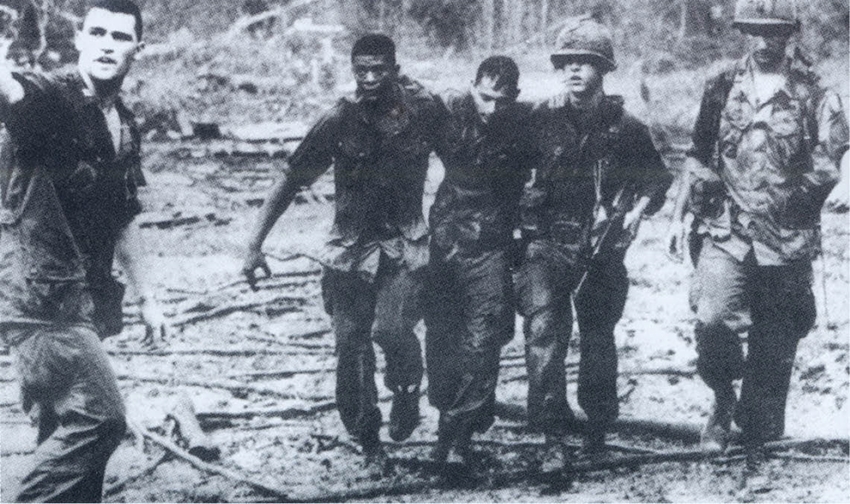 |
| Wounded American soldiers flee the battlefield at Binh Gia. |
This marks the failure of the "Special War" strategy.
During the campaign, which consisted of two phases (Phase 1: from December 2 to 17, 1964; and Phase 2: from December 27, 1964 to January 3, 1965), under the close and skillful direction of the Regional Command, and with the support of the military and people of the Southeast region, our fighting forces fought 5 regimental-level battles and 2 battalion-level battles. After one month of fighting, we annihilated 2 main battalions of the Saigon army (with over 2,000 soldiers, including 28 American soldiers), captured 293, destroyed 1 M113 armored vehicle detachment and 2 motorized vehicle convoys, 45 military vehicles of various types, shot down 24 aircraft, and seized 1,000 weapons of various types. The victory at Binh Gia marked the failure of the "Special War" strategy, breaking the balance of power and strategic position between us and the enemy. Following this defeat, the US Department of Defense had to admit: "Washington's frustration with the military situation increased when the Saigon army suffered a visible defeat in the fierce battle at Binh Gia..."
The Associated Press (December 28, 1964) also commented: "The Viet Cong could do whatever they wanted in the Binh Gia area throughout December 1964; there was no safe base left for the United States and the Republic of Vietnam in South Vietnam." For the United States and the Saigon government, the Binh Gia campaign marked the end of the "Special War," forcing the US to shift its military involvement to the increasingly bogged-down "Local War" strategy in Vietnam.
The victory in the Binh Gia campaign marked a significant leap forward in tactics, particularly in the art of "creating a strategic position and igniting the enemy's reinforcements." Choosing the strategic hamlet of Binh Gia as the "igniting point" was a wise decision by the Party Committee and the Campaign Command, as the Binh Gia strategic hamlet held both military and political significance; it was a crucial link in the eastern Saigon defense system...
Major General Nguyen Hoang Nhien, Director of the Vietnam Military History Institute, assessed: “The victory at Binh Gia will forever be a milestone in the process of the resistance war against the US, saving the nation. In this victory, the people and military of the provinces and cities of the Southeast region made enormous contributions in terms of personnel and resources, contributing to the success of the campaign on the key battlefield of the Southeast region, fundamentally contributing to the defeat of the US imperialist “Special War” strategy in South Vietnam, forcing them to switch to a new military strategy: “Local War” from mid-1965.”
Source: https://baothuathienhue.vn/chinh-polit-xa-hoi/theo-dong-thoi-su/mai-mai-la-moc-son-148609.html


![OCOP during Tet season: [Article 4] Elevating local products](/_next/image?url=https%3A%2F%2Fvphoto.vietnam.vn%2Fthumb%2F402x226%2Fvietnam%2Fresource%2FIMAGE%2F2026%2F01%2F29%2F1769652810578_2935-z6982071462129_649e82db06fb2f2ea701388b1f5f5b0b-173322_176-185229-202804_457.jpeg&w=3840&q=75)


![OCOP during Tet season: [Part 3] Ultra-thin rice paper takes off.](/_next/image?url=https%3A%2F%2Fvphoto.vietnam.vn%2Fthumb%2F402x226%2Fvietnam%2Fresource%2FIMAGE%2F2026%2F01%2F28%2F1769562783429_004-194121_651-081010.jpeg&w=3840&q=75)

![OCOP during Tet season: [Part 2] Hoa Thanh incense village glows red.](/_next/image?url=https%3A%2F%2Fvphoto.vietnam.vn%2Fthumb%2F402x226%2Fvietnam%2Fresource%2FIMAGE%2F2026%2F01%2F27%2F1769480573807_505139049_683408031333867_2820052735775418136_n-180643_808-092229.jpeg&w=3840&q=75)


Comment (0)