'4G networks will remain dominant for the next 5 years'
VnExpress•16/04/2024
According to Minister of Information and Communications Nguyen Manh Hung, in addition to 5G, network operators need to invest in 4G because this will continue to be the infrastructure widely used in the future.
At the first quarter 2024 conference of the Ministry of Information and Communications , Minister Nguyen Manh Hung said that improving the quality of mobile networks is always a hot topic. As users use the network more, its quality may decline, so it needs to be optimized daily and invested in regularly.
He affirmed that 2024 would be the year of nationwide 5G commercialization, but also urged network operators to invest in 4G – a crucial infrastructure for at least the next five years.
Minister Nguyen Manh Hung speaks at the conference on the afternoon of April 15. Photo: Thao Anh
You may also like
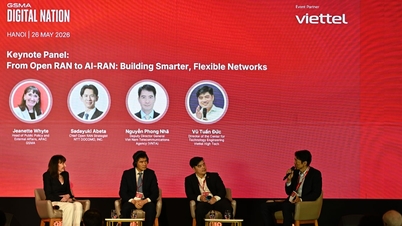
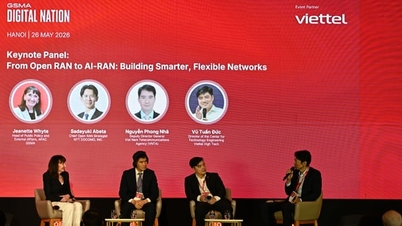
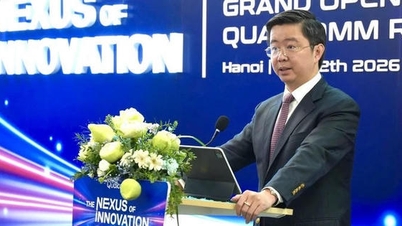
Viettel and the Mobile World Association discuss how digital technology can drive economic growth.At the Digital Summit Hanoi 2026, co-organized by Viettel and the Global Mobile Association (GSMA), leaders from the science and technology sector and representatives from domestic and international technology companies participated in discussions on digital infrastructure, 5G, AI, cybersecurity, and new growth models for Vietnam's digital economy.
"We talk a lot about 5G, but in Vietnam, from now until 2030, the majority of capacity will still be 4G. At the earliest, 5G may not surpass 4G in terms of traffic and subscribers until 2029," the Minister said.
He also acknowledged the reality that Vietnam's 4G infrastructure lacks low frequencies. Low frequencies have the characteristic of lower speeds but greater coverage compared to high frequencies. Utilizing low frequencies allows the network to reach every home.
"We may have to consider bidding on low frequencies like 700 MHz for the three major carriers to deploy in order to ensure quality," he said.
According to the Minister, mobile is currently the main digital infrastructure, closely and directly affecting user behavior. He instructed the Telecommunications Department to measure network quality and publish the results monthly.
At the conference, the Ministry of Information and Communications also granted licenses to Viettel and VNPT to establish networks and provide terrestrial mobile communication services using 5G technology. In March, these two entities successfully bid for the right to use the B1 frequency band (2500-2600 MHz) for VND 7.533 billion and the C2 frequency band (3700-3800 MHz) for VND 2.581 billion, respectively.
You may also like
Viettel shares insights on how digital technology drives economic growth.At the Digital Summit Hanoi 2026, organized today, May 26th, by Viettel Group in collaboration with the Global Mobile Association (GSMA), Viettel's units shared insights on digital infrastructure, 5G, artificial intelligence (AI), cybersecurity, and new growth models for Vietnam's digital economy.
Priced almost three times higher, the advantage of B1 is its wider coverage, allowing carriers to reduce investment in base stations. Additionally, another major advantage is that B1 supports both 5G and 4G networks, enabling carriers to improve 4G network quality during the transition to 5G.
At the end of last year, the Ministry of Information and Communications reported that Vietnam's 4G coverage reached 99.8% of the population, significantly higher than many developed countries. According to the Information and Communications Infrastructure Development Plan 2021-2030, Vietnam aims to achieve 5G coverage for 99% of the population by 2030, with a minimum speed of 100 Mbps.



























































![[Video] Sunset at Lap An Lagoon – Where the sun sets over the fishing nets](https://vphoto.vietnam.vn/thumb/1200x675/vietnam/resource/IMAGE/2026/05/31/1780192137701_beach-landscape-sea-water-nature-grass-745871-pxhere-com.jpeg)





































Comment (0)