

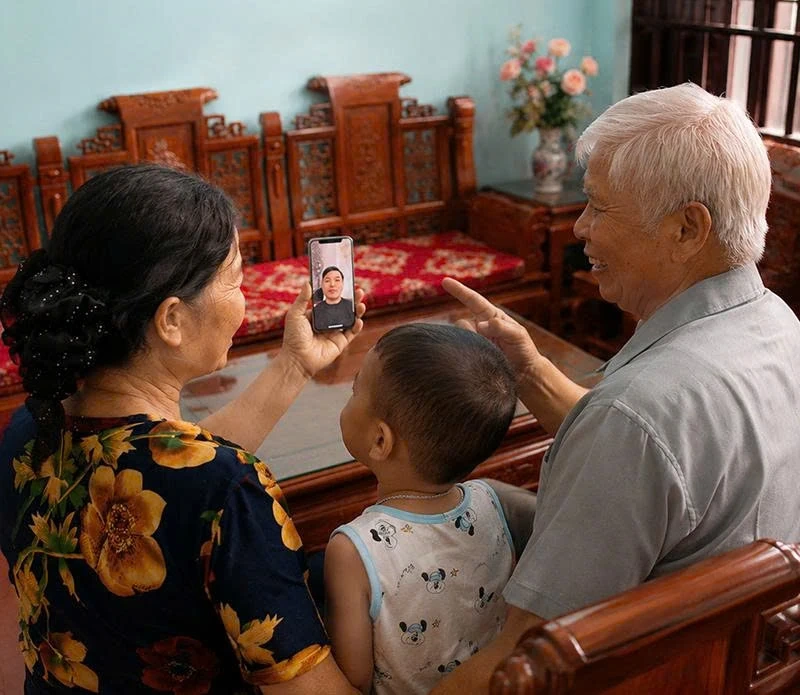
The joy in the 8 PM phone calls every day for Mr. Le Van Phieu's family (Quang Trung ward).
It was around 10 PM in Japan at that time – the same time his children had just finished their shifts. The older brother worked in Tokyo, while the younger brother lived and worked in Chiba. Therefore, since his eldest son went to Japan as a migrant worker in 2018, for almost eight years now, nightly video calls have become an indispensable part of the family's life.
Before, Mr. Phieu could only hear his son's voice over the phone, but now he can see his son's face every day, see where he lives, what he does for a living, and even his late meals after work. Thanks to this, the feeling of distance has lessened considerably. Mrs. Lien, Mr. Phieu's wife, added that in 2023, their eldest son, Le Xuan Phan, returned to Vietnam to get married. After a while, he went back to Japan to work. Thanks to video calls, he was still able to talk to his wife and watch his children grow up day by day. Because of this, when Mr. Phan returned to Vietnam in 2025, his son recognized him and quickly became close to his father. "That was a pleasant surprise for the whole family, because everyone thought it would take a long time for the two of them to get used to each other," Mrs. Lien happily recounted.
Amidst countless stories of children addicted to screens, silent family meals filled with each person engrossed in their device, or the growing distance between family members living under the same roof, Mr. Phieu's family story offers a different perspective on smartphones. Clearly, the "downside" of smartphones is easily visible, but the "right side" seems to be largely overlooked. Meanwhile, technology itself isn't at fault; the problem lies in how we choose to use it.
Nowadays, smartphones not only help families with distant relatives connect with each other, but they are also quietly changing the lives of many older adults. According to a 2022 study published in the journal Social Sciences (MDPI), approximately 72.03% of older adults in Vietnam use the internet daily. This figure shows that digital technology is gradually becoming a familiar part of the lives of older adults, rather than being reserved only for young people.
Nowadays, it's not uncommon to find people over 60 who are proficient in messaging via Zalo, making video calls, ordering ride-hailing services, shopping online, or transferring money via bank. Thanks to these features, they are more proactive in their daily lives and less dependent on their children and grandchildren. Ms. Nguyen Thi Nga from Dong Tien ward said that since learning to use a smartphone, her life has become much more convenient. "I feel much more comfortable. Whatever I want, I just pick up my phone and get it right away, without having to bother my children and grandchildren," Ms. Nga said.
However, along with the convenience come numerous risks in cyberspace. Therefore, her daughter frequently spends time talking to and guiding her mother on how to use social media safely, and to be wary of fake news and scams. Besides that, Ms. Nga still maintains real-life activities such as exercising and participating in neighborhood clubs... to avoid negatively impacting her health from excessive use of electronic devices.
Instead of outright bans, many parents now choose to support their children's use of phones and social media. They proactively discuss with their children the time, purpose of use, and necessary limits. "I think children should understand both the benefits and limitations of electronic devices. Young people today access technology early and also know how to apply it flexibly to their lives," shared Mr. Nguyen Ha, from Dong Quang ward.
Clearly, phone use has never been the sole cause of any problem. A smartphone is just an inanimate object; it doesn't create distance or connection on its own. Therefore, the deciding factor in whether something is "beneficial" or "harmful" doesn't lie in the technology itself. Screens can distance people if each person is engrossed in their own world . But that same screen, from afar, can help a father see his son after a late shift, a child recognize their father's face through video calls, a patient find renewed strength from seeing the smiles and encouragement of loved ones, or help the elderly be more proactive in their daily lives...
Ultimately, the "pros" or "controversies" of smartphones don't lie in the device itself, but in how people choose and use them.
Text and photos: Tran Linh
Source: https://baothanhhoa.vn/mat-phai-cua-nhung-chiec-man-hinh-288223.htm




![[Photo] National Assembly Chairman Tran Thanh Man working with the Standing Committee of the Law and Justice Committee](https://vphoto.vietnam.vn/thumb/1200x675/vietnam/resource/IMAGE/2026/05/21/1779378929214_ndo_br_1-4610-jpg.webp)
![[Photo] General Secretary and President To Lam presides over a working session with the Central Policy and Strategy Committee on the development of the materials industry.](https://vphoto.vietnam.vn/thumb/1200x675/vietnam/resource/IMAGE/2026/05/21/1779359935432_a3-bnd-3129-1412-jpg.webp)




















































































Comment (0)