The aircraft, registration number N61101, was received by United Airlines at the end of February and officially entered commercial service on March 29th. This is the first of five Boeing 787-9 aircraft delivered with the new generation Elevated passenger cabin design, including Polaris Business Class Suites and Polaris Studio premium seats.
However, just a few months after being put into operation, N61101 has been experiencing continuous technical problems.
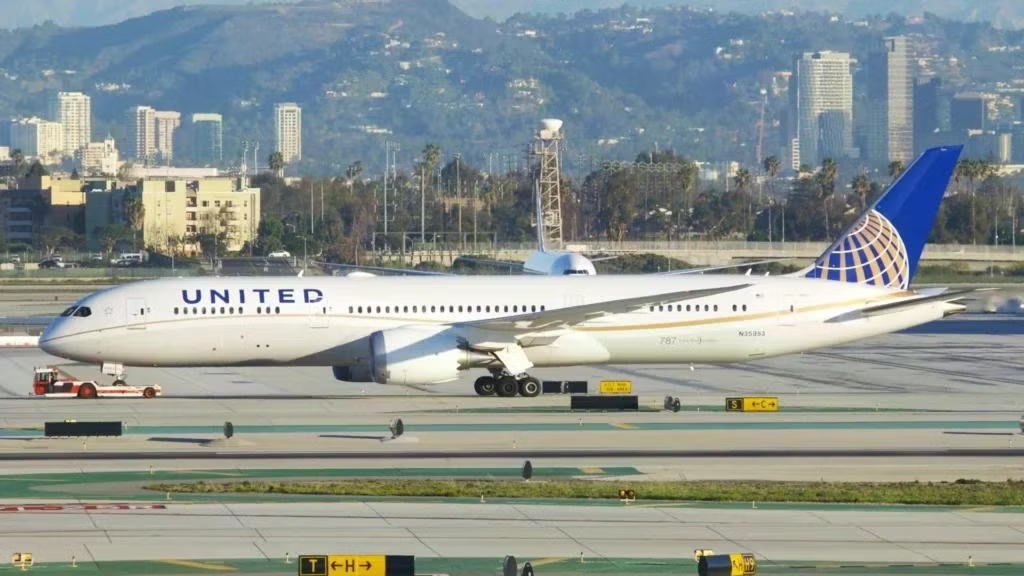
The first serious incident occurred on April 24th on a flight from Singapore to San Francisco. Shortly after takeoff, the crew detected a burning smell, similar to that of electricity, spreading throughout the passenger cabin and were forced to declare an emergency and divert the flight for a safe landing.
Following the incident, engineers grounded the aircraft for further ground testing to determine the cause. Initial suspicions focused on the two GEnx engines fitted to the Boeing 787-9.
After completing inspections, United returned N61101 to service on domestic routes before resuming use on the San Francisco-Singapore route in early May. However, the aircraft experienced another malfunction and had to be taken out of service in Singapore, before flying empty back to the US for further repairs.



United Airlines subsequently repurposed this Dreamliner for the San Francisco-London Heathrow route. Initially, the flights were stable, leading the airline to decide to return the aircraft to the Singapore route starting June 4th. However, the same scenario repeated itself when N61101 was grounded shortly after landing in Singapore and was rerouted to fly empty back to California without passengers.
By mid-June, following a flight to London on June 13th, the Boeing 787-9 experienced further technical problems, forcing United to return the aircraft to San Francisco for the fourth time since it began commercial operations.
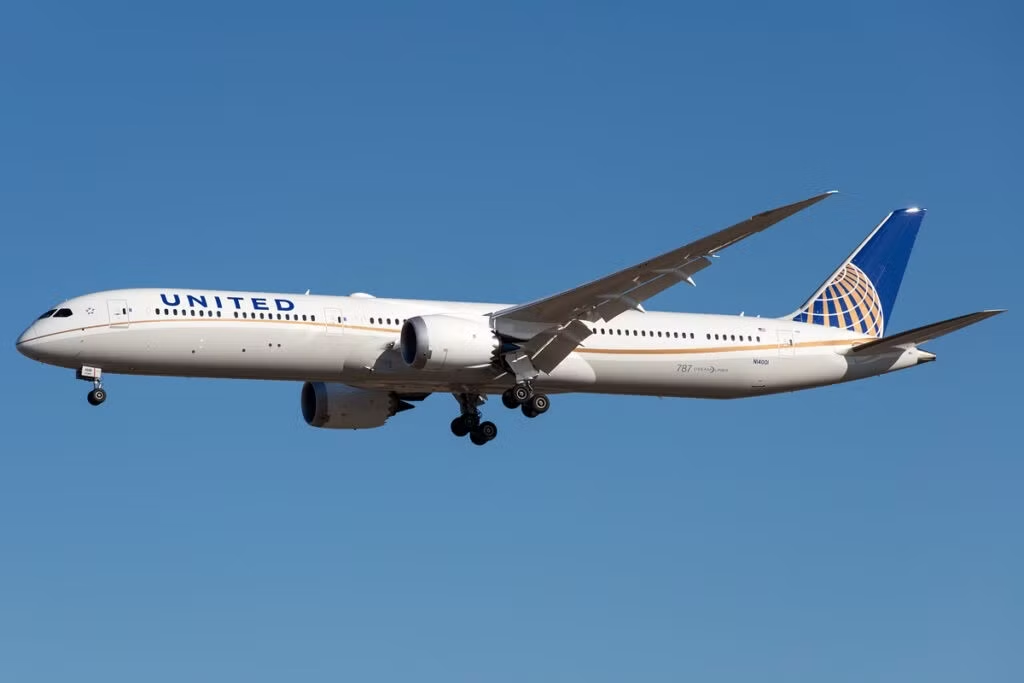
According to experts, it is not uncommon for new aircraft to experience some malfunctions in the initial stages of operation. However, the frequency of incidents involving the N61101 is considered to be far beyond the normal level for a newly delivered aircraft.
According to aviation expert JonNYC, United Airlines has now moved N61101 to Boeing's repair facility in Moses Lake, Washington. This location was once known in the aviation industry as the "Shadow Factory," where Boeing stored many undelivered aircraft during a period when the company was experiencing production difficulties.
This time, the aircraft was taken to Moses Lake not for storage but for extensive repairs. According to JonNYC, the problems on N61101 "are not minor issues," exceeding the capabilities of United's technical team and requiring direct involvement from Boeing engineers.
United has not announced when the aircraft will return to service.

N61101 is part of United Airlines' strategy to modernize its wide-body fleet. The new Elevated cabin is expected to become the standard for long-haul flights in the future, featuring 56 Polaris business class suites with private sliding doors, 8 Polaris Studio premium seats, 35 Premium Plus seats, and 123 economy class seats, including 39 Economy Plus seats with extra legroom.
Additionally, another Boeing 787-9 belonging to the airline, registration number N61104 and also equipped with an Elevated interior, is believed to have experienced numerous maintenance issues. American Airlines has also previously reported reliability issues on newly delivered Boeing 787 Dreamliner aircraft, highlighting the challenges many airlines face during the initial phase of introducing new aircraft into service.
Source: https://tienphong.vn/may-bay-boeing-lien-tuc-gap-su-co-post1853766.tpo
![[Image] Schools organize meetings and introduce teaching models to students admitted to grade 10.](https://vphoto.vietnam.vn/thumb/1200x675/vietnam/resource/IMAGE/2026/06/25/1782368077271_ndo_br_z7970052192242-1ec8daeb77a6eed1a4e9f58c564ddd3e-jpg.webp)

![[Photo] General Secretary and President To Lam receives Palestinian Ambassador Saadi Salama](https://vphoto.vietnam.vn/thumb/1200x675/vietnam/resource/IMAGE/2026/06/25/1782365384740_a1-bnd-9423-8322-jpg.webp)


![[Image] Ho Chi Minh City: Ma Lang area, Chicken-Rice Market about to change its appearance](https://vphoto.vietnam.vn/thumb/1200x675/vietnam/resource/IMAGE/2026/06/25/1782377698627_ndo_br_m1-jpg.webp)