


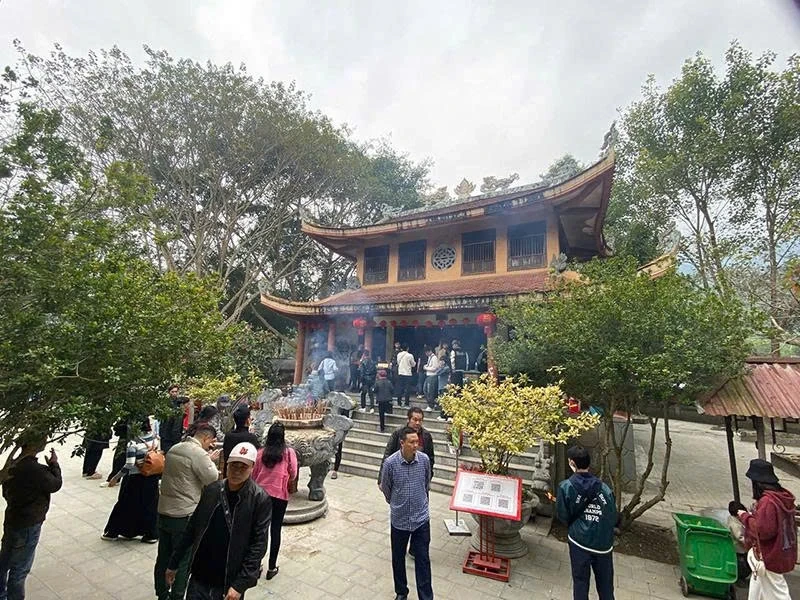
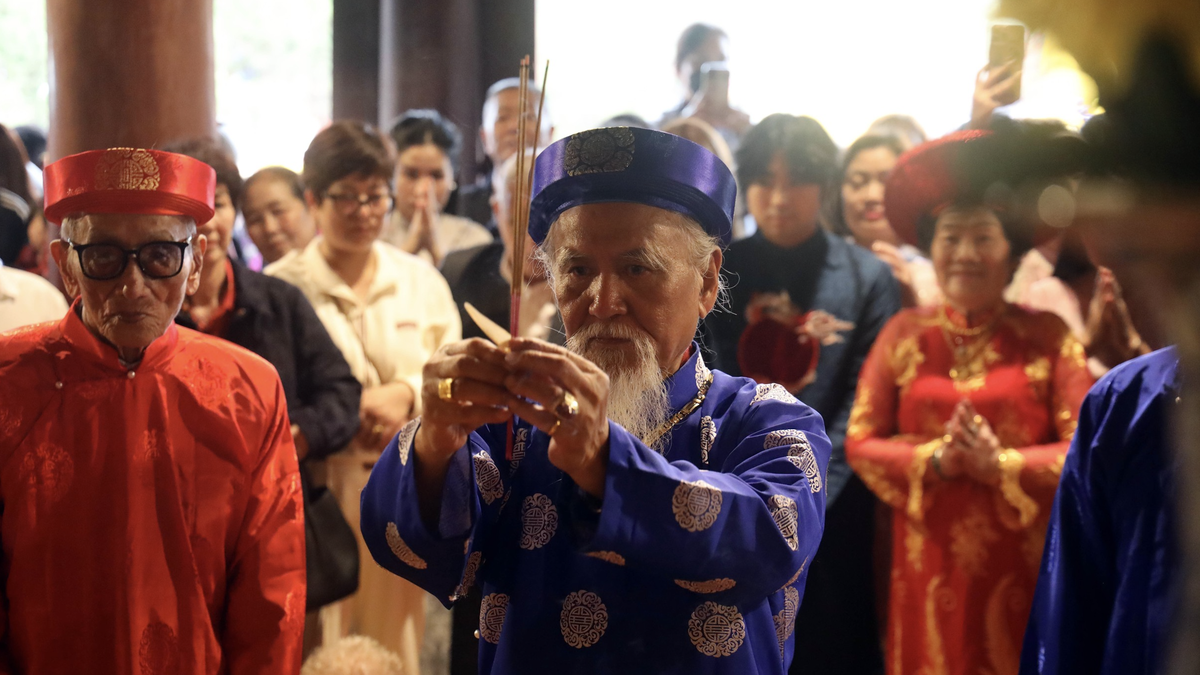
Visitors light incense at the Cam Ba Thuoc temple, a place that preserves the historical memories and beliefs of the mountainous region of Thanh Hoa province.
Every spring, from January to the end of March in the lunar calendar, pilgrims flock to Cua Dat. Traversing the winding slopes and crossing the bridge over the Chu River, groups of people, dressed in formal attire, offer incense to commemorate the renowned figure Cam Ba Thuoc, leader of the Can Vuong movement in the upper reaches of Thanh Hoa province, and to pay homage to the Goddess of the Mountains in the Vietnamese Mother Goddess worship tradition. The festive atmosphere is both solemn and warm, like a meeting between the present and memory.
The temple complex is situated on a hillside nestled against the mountains, with its back against Mount Roc and its front facing the confluence of the Dat and Chu rivers. Previously, the site consisted only of small shrines with tiled roofs and moss-covered walls. In 2006, the site was restored and relocated to higher ground to ensure safety from changing river flows, while still retaining its traditional architecture with curved roofs and ornate eaves, creating a solemn yet approachable atmosphere. The lingering incense smoke amidst the mountains and the ringing of bells in the evening breeze allow visitors to pause in contemplation of the sacred spirit of the land.
Cầm Bá Thước (1858 - 1895), whose Thai name was Lò Cắm Pán, was born in the mountains of Thanh Hóa province. Amidst the widespread Cần Vương movement of the late 19th century, he recruited patriots, established a base from Bái Thượng to Cửa Đạt and Bát Mọt, and organized numerous battles against the French colonialists. The Battle of Thổ Sơn on February 6, 1894, is considered a tragic milestone of the uprising. In 1895, he was captured and died at the young age of 37, leaving behind the image of a steadfast and loyal leader of the mountainous region. His temple still preserves the couplet: “His immortal name will live on with the universe / His righteous spirit is etched into the mountains and rivers.” More than a century later, these words still resonate in the vast forests, reminding us of a heroic period in the history of the Thanh Hóa highlands.
According to local folklore, the upper reaches of the Chu River still bear traces of legends associated with the Lam Son Uprising. Hon Mai Muc and Hon Ngoi are mentioned as places where King Le Loi and his generals once stopped to forge weapons and discuss military matters. While the physical traces are no longer clear, these place names remain in the spiritual life of the people as a layer of historical memory passed down from generation to generation.
Entering the 21st century, Cua Dat witnessed a major transformation. The Cua Dat irrigation and hydroelectric project commenced construction in 2004, began impounding water in 2010, and commenced power generation with its first turbine in 2011. The reservoir, with a capacity of approximately 1.45 billion cubic meters, plays a crucial role in flood control for the downstream Chu and Ma rivers, providing irrigation water, generating electricity, and supplementing water resources during the dry season. The formation of the reservoir has significantly altered the landscape of the area. Many households in Xuan Lien, Xuan Khao, and Xuan My communes (formerly part of Thuong Xuan district) were relocated, giving up their land for this key national project. This was a considerable sacrifice, but it also opened a new phase of development for the upstream Chu River. After nearly two decades of operation, the Cua Dat irrigation and hydroelectric project has not only demonstrated economic and irrigation benefits but has also contributed to shaping a unique and distinctive landscape. The lake's surface, calm as a mirror, embraces the undulating mountain slopes, while the Chu River downstream flows silently, carrying with it silt and layers of memories of a land that was once a resistance base and a timber trading hub in the early 20th century.
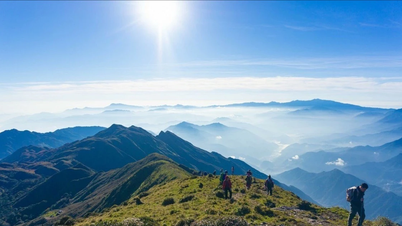
From that vast expanse of water, a development direction linked to ecology and tourism is gradually taking shape. Visitors can access Xuan Lien National Park, covering 25,601 hectares, one of Vietnam's important biodiversity centers. The peaks of Pu Gio and Pu Xeo, shrouded in clouds, along with the rich primary forest and many rare species, create a spectacular natural landscape. Yen Waterfall cascades down from a height of over 1,600m, while Thien Thuy Waterfall, also known as Mu Waterfall, resembles a silver silk ribbon amidst the vast forest. The streams, valleys, and forests offer potential for experiential tourism linked to conservation.
Alongside its natural beauty lies the rich cultural life of the Thai and Muong ethnic groups, from the Nang Han festival to stilt house architecture, traditional clothing, and cuisine. Many resettled households are now involved in community-based tourism and service activities, gradually transforming their livelihoods towards sustainability. The interplay between nature, history, and community identity has created a new face for Cua Dat, a place where economic development is linked to forest conservation, cultural preservation, and the stability of people's lives.
As evening falls over Cửa Đặt, sunlight shimmers on the water's surface, and incense smoke swirls around the temple at the foot of Róc Mountain. Pilgrims continue to flock there, offering incense in remembrance of the Thai national hero and entrusting their hopes for peace. Today, Cửa Đặt is a harmonious blend of past and present, where the spirit of the Cần Vương movement, the legend of Lam Sơn, modern constructions, and local life coexist in a unified space. Amidst the vast Chu River, the sacred spirit of the mountains and rivers still resonates in the consciousness of preserving and promoting the historical and cultural values of this upstream region.
Text and photos: Tang Thuy
Source: https://baothanhhoa.vn/mien-dat-vong-hon-thieng-song-chu-279328.htm


![[Photo] Prime Minister Pham Minh Chinh receives the Director General of TASS News Agency (Russian Federation)](https://vphoto.vietnam.vn/thumb/1200x675/vietnam/resource/IMAGE/2026/02/25/1772024599891_dsc-8041-jpg.webp)















![[Photo] Prime Minister Pham Minh Chinh presides over the meeting of the Steering Committee for the Development of Science, Technology, Innovation, Digital Transformation and Project 06.](https://vphoto.vietnam.vn/thumb/1200x675/vietnam/resource/IMAGE/2026/02/25/1772024613089_1772024091685-jpg.webp)




































![[Infographic] Eight task groups in the Action Program to implement Resolution 80-NQ/TW on the development of Vietnamese culture](https://vphoto.vietnam.vn/thumb/402x226/vietnam/resource/IMAGE/2026/02/26/1772064804794_chuong-trinh-17720096665761428525089-0-105-1400-2345-crop-17720097331061282725800.jpeg)















Comment (0)