The journey across the mountains
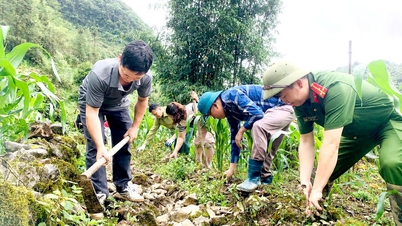
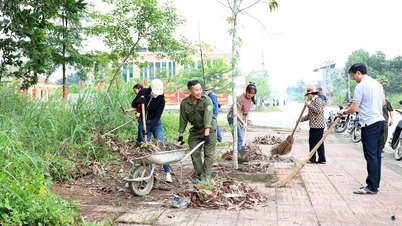
One morning in late June, while the mist still covered the mountain slopes of Tung Vai commune, the sounds of hoes and crowbars echoed through the vast forest. On the steep slopes of Chin Sang village, hundreds of armed forces officers and soldiers, commune officials, and local people diligently cleared vegetation, leveled the ground, and carried stones to open up every meter of road towards border markers 306, 307, and 308. There were no roaring excavators or modern equipment to assist them because the terrain was too treacherous. Without being told, everyone worked with urgency and determination, as if each swing of the hoe today would make tomorrow's patrol less difficult.
 |
| Officers, soldiers of the armed forces and people of Tung Vai commune participated in opening a border patrol road. |
Tuyen Quang province has 17 border communes with a total border length of over 277.5 km. Tung Vai commune alone has over 33 km of border with China , bordered by 56 border markers managed and protected by the Tung Vai Border Guard Post. This is a mountainous area, heavily fragmented, with many border markers located deep within dense forests or precariously perched on rocky mountain slopes.
In the past, each patrol was a grueling journey. To reach many of the border markers, officers and soldiers had to follow narrow trails barely wide enough for one person, crossing sharp, jagged cliffs and dense primeval forests. Some markers took three to four hours to reach.
I still remember the trip I took with the officers from the Tung Vai Border Guard Post to border markers 275, 276, 277, and 289. From early morning, each person carried rice, drinking water, raincoats, and medical kits, then silently entered the forest. The narrow, winding path hugged the mountainside, with a sheer cliff on one side and a deep abyss on the other. A single unsteady step could have disastrous consequences.
Lieutenant Vi Trung Kien, Team Leader of the Armed Team at Tung Vai Border Guard Post, shared: "There are days when patrols last from early morning until late afternoon. Sometimes the fog is so thick that you can't see clearly even a few meters ahead. The jagged rocks are as sharp as knives, tearing shoes and cutting hands and feet. But the officers and soldiers always stand firm, because ahead lies a sacred border marker that needs to be regularly inspected and protected."
From those hardships, opening border patrol routes has become a fervent desire of both the Border Guard force and the local people.
Comrade Nguyen Huu Nghiep, Vice Chairman of the People's Committee of Tung Vai commune, said: "Before implementation, the commune government and the Border Guard Post conducted numerous field surveys to select the safest and most suitable route; at the same time, they organized meetings with the people, mobilized households to donate land, and gathered manpower to participate in the construction. This consensus created the strength for the project to be implemented smoothly."
The path of the Party's will and the people's aspirations.
Immediately after deployment, the forces promptly began clearing the land for the road leading to milestones 306, 307, and 308. The road, over 2.6 km long and 1 meter wide, will be paved with concrete upon completion, at a total cost of approximately 450 million VND. Of this amount, the Mobile Police Command contributed 350 million VND, and charitable organizations contributed over 100 million VND; all labor was contributed by officers, soldiers, commune officials, and local people.
 |
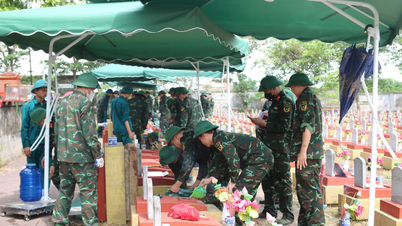
| Officers and soldiers carried water cans up mountain passes, contributing to the road construction effort. |
What is most valuable is the solidarity of the people. Fifteen households voluntarily donated over 2,600 square meters of land to build the road. Every Saturday, nearly 100 officials, civil servants, armed forces personnel, and local people gather together. Each person contributes their strength with the shared desire for the road to be completed soon. Due to the rugged terrain, machinery cannot access the area, so almost all the work relies on human labor. Steep slopes require the use of crowbars to pry up rocks, and in some places, trees must be cleared to make way, leveling the ground right at the edge of the cliff. The road, gradually taking shape amidst the mountains and forests, not only shortens patrol routes but also instills greater confidence in those on the front lines of the Fatherland.
Lieutenant Colonel Hoang Van Kham, Commander of Tung Vai Border Guard Station, said: "When the road is completed, it will create favorable conditions for the Border Guard force to move around and perform their duties, improve the effectiveness of patrols and controls, and promptly detect and handle incidents arising on the border; at the same time, it will serve well in rescue and relief work and disaster prevention and control. Not only does it have national defense significance, the road also opens up opportunities for development for people in the border region. Travel and transportation of agricultural products will be more convenient, contributing to promoting trade and improving the lives of the people. This is also a prerequisite for developing the potential of the economy and tourism, gradually narrowing the gap between the border region and central areas."



Soon, when the concrete road connecting border markers 306, 307, and 308 is completed, the patrols will face less hardship. But along that road, the footprints of those who contributed their efforts to opening this path through the vast forest will remain deeply imprinted. This is not just a border patrol road, but also a road of willpower, responsibility, and love for the Fatherland. Every meter of road opened is another solid link between the Party, the State, and the people in the border region, another bulwark protecting the sacred sovereignty of the Fatherland's frontier.
Text and photos: Nguyen Yem
Source: https://baotuyenquang.com.vn/an-ninh-quoc-phong/202607/mo-duong-tuan-tra-bien-gioi-5631d75/